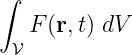
Let F(r,t) represent the amount of some physical property of a continuous material medium per
unit volume. The total amount of this property present in a finite region 𝒱 of the material is
obtained through the volume integral.
If this property is being transported by the action of the flow of the material with a velocity
u(r,t), then Reynolds’ transport theorem states that the rate of change of the total amount of F
within the material volume is equal to the volume integral of the instantaneous changes
of F occuring within the volume, plus the surface integral of the rate at which F is
being transported through the surface 𝒮 (bounding 𝒱) to and from the surrounding
region.
Here, n is a unit vector indicating the normal direction of the surface (oriented to point out of the
volume).