The Rayleigh-Ritz method is an algorithm for obtaining approximate solutions to eigenvalue
ODEs. It can be neatly summarized as follows:
- Choose an approximate form for the eigenfunction with the lowest eigenvalue (the
ground state wavefunction, in the language of quantum mechanics). Include one or
more free parameters.
- Find the expectation value of the eigenvalue with respect to the trial eigenfunction.
- Minimize the resulting equation with respect to the free parameter(s), hence finding a
value for the free parameter.
- Substitute this new eigenfunction back into the expectation value.
- The expectation value obtained is an upper bound for the actual eigenvalue of the true
eigenfunction.
1 Example
Consider the time independent Schrödinger equation for a one-dimensional harmonic oscillator
potential:
where m is the mass of the particle in the well, and ω is the angular velocity a classical particle
would move with in the well. This equation can be solved exactly using Frobenius’ method, and
leads to eigenfunctions of the form of Hermite polynomials multiplied by Gaussians, and
half-integer eigenvalues of the form En = (n + 1∕2)ℏω. Since the solutions are known, it is a good
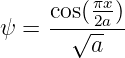
test case. We choose the ground state wavefunction of the infinite potential well as our trial
eigenfunction:
with a as our free parameter. We now find the expectation value:
Evaluating the integral, we find
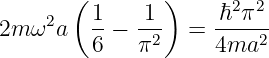
We now minimise this with respect to a to obtain:
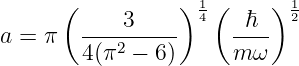
Hence:
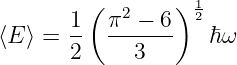
Substituting this into the expecation value ⟨E⟩ we obtain
The analytical value is of course 0.5ℏω. Considering the crudeness of the approximation used, the
result is impressive.