This is a topic on quantum super-operators (or superoperators).
0.1 Time and Microentropy: Irreversibility in Open Systems
A significant part of the scientific and philosophical work of Ilya Prigogine has been devoted to the
dynamical meaning of phenomenal/physical irreversibility expressed in terms of the second law of
Thermodynamics and quantum statistical mechanics. For systems with strong enough instability of
motion the concept of phase space trajectories is no longer meaningful and the dynamical
description has to be replaced by the motion of distribution functions on the phase space. The
viewpoint is that quantum theory produces a more coherent type of motion than in the classical
setting and the quantum effects induce correlations between neighbouring classical trajectories in
phase space.
0.2 Quantum Super-Operators
Prigogine’s idea (1980) is to associate a macroscopic entropy (or Lyapounov function) with a
microscopic entropy (quantum) super–operator M. Here the time–parametrized distribution
functions ρt are regarded as densities in phase space such that the inner product ⟨ρt,Mρt⟩ varies
monotonously with t as the functions ρt evolve in accordance with Liouville’s equation (Prigogine,
1980; Misra et al, 1979). For well defined systems for which the super-operators M exist, a time
super-operator T (‘age’ or ‘internal time’) can also be introduced. (For the precise details,
the reader is referred to Misra et al. 1979). Furthermore, the equations of motion with
randomness at the microscopic level then emerge as irreversibility on the macroscopic
level. However, unlike the usual quantum operators representing observables, the M
super-operators are non-Hermitian operators, (i.e., they are not self-adjoint, M ≠M*
).
However, there are certain provisions that have to be made in terms of the spectrum of the
hamiltonian H for M to be properly defined: if H has a pure point spectrum, then M does not
exist, and likewise, if H has a continuous but bounded spectrum then M cannot exist. Thus, the
super-operator M cannot exist in the case of only finitely extended systems containing only a finite
number of particles. Furthermore, the super-operator M cannot preserve the class of ‘pure states’
since it is non-factorizable. The distinction between pure states (represented by vectors in a Hilbert
space) and mixed states (represented by density operators) is thus lost in the process of
measurement. In other words, the distinction between pure and mixed states is lost in a quantum
system for which the algebra of observables can be extended to include a new dynamical
variable representing the non-equilibrium entropy. In this way, one may formulate the
second law of thermodynamics in terms of M for quantum mechanical systems. Let us
mention that the time operator T represents ‘internal time’ and the usual, ‘secondary’
time in quantum dynamics is regarded as an average over T. When T reduces to a
trivial operator the usual concept of time is recovered Tρ(x,v,t) = tρ(x,v,t), and thus
time in the usual sense is conceived as an average of the individual times as registered
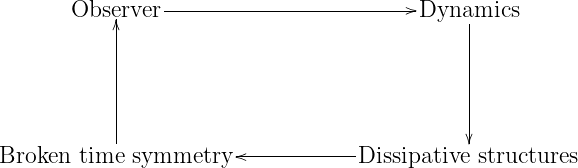
by the observer. Given the latter’s ability to distinguish between between future and
past, a self-consistent scheme may be summarized in the following diagram (Prigogine,
1980):
for which ‘irreversibility’ occurs as the intermediary in the following sequence:
(Note however that certain quantum theorists, as well as Einstein, regarded the irreversibility of
time as an ‘illusion’ caused by statistical averaging. Others– operating with minimal
representations in quantum logic for finite quantum systems– go further still by denying that there
is any need for real time to appear in the formulation of quantum theory.)
The importance of the above diagram will become fully apparent in the context of section 4 ,
where we discuss living organisms in terms of open systems that by definition are irreversible, and
also have highly complex (generic) dynamics supported by dissipative structures which may have
come into existence through ‘symmetry breaking’ , as explained in further detail by Baianu
and Poli, 2008, in this volume, and also briefly in the next subsection. This diagram
sketches four major pieces from the puzzle of the emergence/origin of life on earth, without
however coming very close to completing this puzzle; thus, Prigogine’s subtle concepts of
microscopic time and micro–entropy super–operators may allow us to understand how life
originated on earth several billion years ago, and also how organisms function and survive
today. They also provide a partial answer to subtle quantum genetics and fundamental
evolutionary dynamics questions asked by Schrödinger– one of the great founders of
quantum ‘wave mechanics’ in his widely read book “What is Life?” Other key answers to
the latter’s question were recently provided by Robert Rosen (2000) in his popular
book “Essays on Life Itself.”, unfortunately without any possibility of continuation or of
reaching soon the ‘ultimate’ or complete answer. Schrödinger’s suggestion that living
organisms “feed on ’negative entropy’...,” was at least in part formalized by Prigogine’s
super-operators, such as M. This theory is in great need of further developments that he
could not complete during his lifespan; such developments may also include several
of Rosen ’s (2000) suggestions and will apparently require a categorical and Higher
Dimensional algebraic, non–Abelian theory of irreversible thermodynamics, as well as a
quantum–mechanical statistics of open systems that are capable of autopoiesis,that is, living
organisms.
One notes that Albert Einstein would have discarded such notions along with the standard
quantum mechanics formulation it is interesting that no imaginary experiments have been designed
so far to test the reality of quantum super-operators.
References
[1] Prigogine, I.: 1980, From Being to Becoming– Time and Complexity in the Physical
Sciences, W. H. Freeman and Co.: San Francisco.