In Classical Mechanics, momentum is the product of mass and velocity of a moving object. More
precisely, the momentum of a particle or rigid body with mass m and velocity v is defined
as
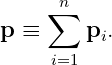
For a collection of n particles (or rigid bodies) moving with different velocities, the total
momentum p is defined as the vector sum of the momenta of the particles, p1,p2,…,pn:
The SI unit of momentum is kilogram metre per second (kg m/s).
Momentum plays an important role in Newton’s second law, which in its most concise formulation
reads
expressing that the total force exerted on an object equals the time derivative of its momentum. In
the special case that there are no forces acting on the object, we get back Newton’s first law: p
(and therefore v) is constant. More generally, if in a system consisting of a number of objects there
are no external forces (i.e., the only forces present are those between the objects themselves), then
Newton’s third law implies that all the forces cancel each other, so that the total momentum is still
constant.
This last observation leads to the idea of a conserved quantity. It turns out that the law of
conservation of momentum is equivalent to the invariance of the physical laws under
translations. This idea can be extended: Noether’s theorem shows that every continuous
symmetry of a physical law that can be formulated as an action principle leads to a
conserved quantity. In this setting, momentum can be viewed as the conserved quantity
corresponding to spatial translations. This notion of momentum can be generalised in such a
way that it is also possible to speak of the momentum of, for example, electromagnetic
waves.
Momentum plays an important role in the Hamiltonian formalism of classical mechanics, where
mechanical systems are described in terms of generalised coordinates and generalised momenta.
This, in turn, explains the appearance of the momentum operator in the Schrödinger equation in
quantum mechanics.
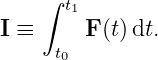
A quantity related to momentum is impulse, which is defined as the force exerted on a moving
object integrated over a time interval [t0,t1]:
By integrating the two sides of Newton’s second law over time, we obtain the equation
In words: the impulse is equal to the change in momentum.