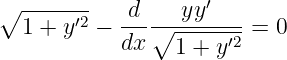
The Calculus of Variations owed its origin to the attempt to solve a very interesting and rather
narrow class of problems in Maxima and Minima, in which it is required to find the form of a
function such that the definite integral of an expression involving that function and its derivative
shall be a maximum or a minimum.
Let us consider three simple examples: The Shortest Line, The Curve of Quickest Descent, and The
Minimum Surface of Revolution.
(a) The Shortest Line. Let it be required to find the equation of the shortest plane curve joining
two given points.
We shall use rectangular coordinates in the plane in question taking one of the points as the origin.
Call the coordinates of the second point x1, y1.
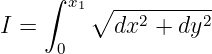
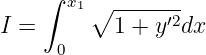
If y = f(x) is a curve through (0, 0) and (x1, y1) and I is the length of the arc between the points,
obviously
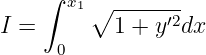
or
and we wish to determine the form of the function f so that this integral shall be a
minimum.
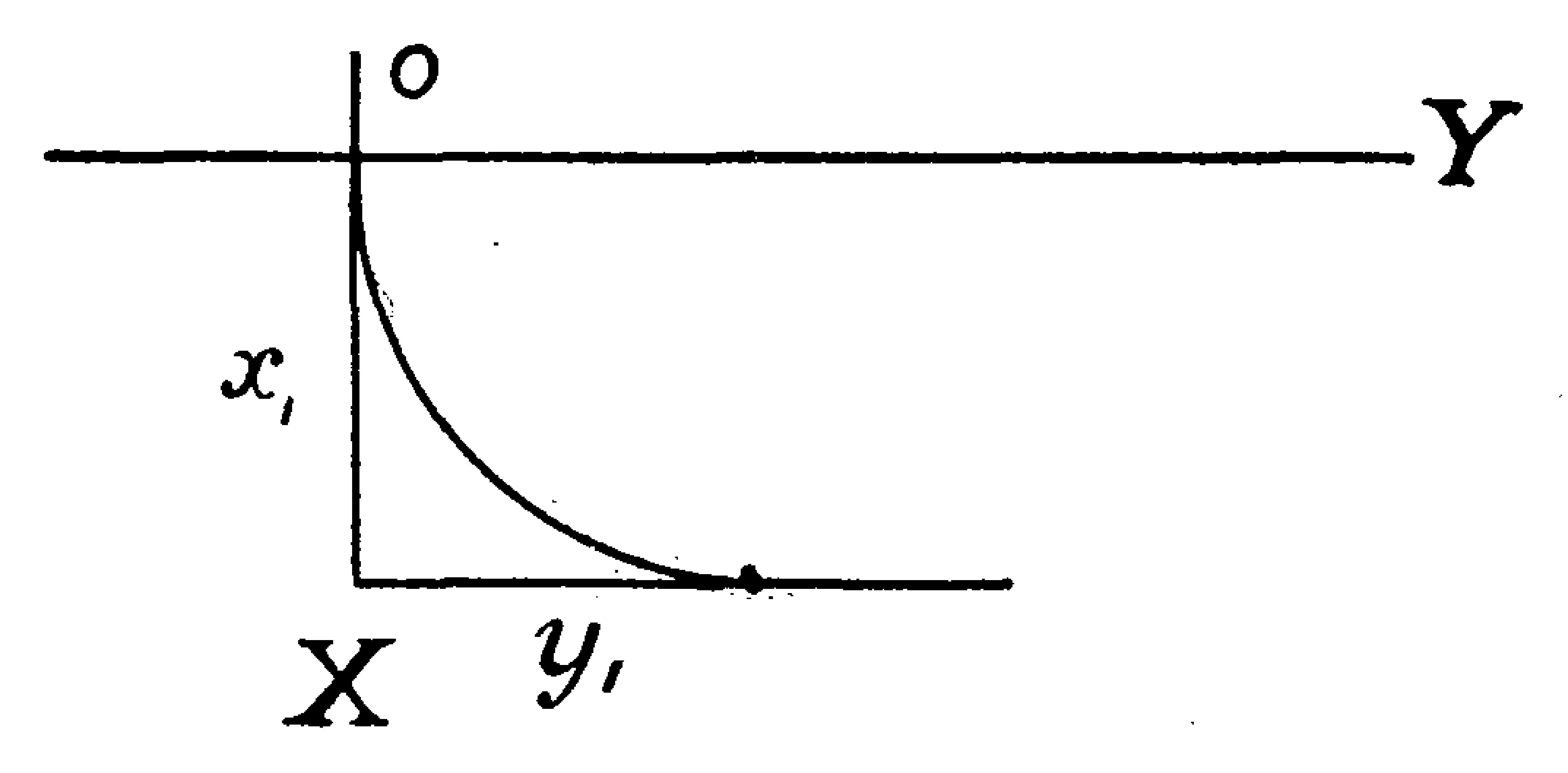
(b) The Curve of Quickest Descent. Let it be required to find the form of a smooth curve
lying in a vertical plane and joining two given points, down which a particle starting
from rest will slide under gravity from the first point to the second in the least possible
time.
We shall use rectangular axes in the vertical plane taking the higher point as the origin
and taking the axis of X downward. Call the coordinates of the second point x1, y1.
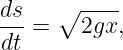
Let y = f(x) be a curve through (0, 0) and (x1, y1) and use the well-known fact that  , the
velocity of the moving particle at any time, is
, the
velocity of the moving particle at any time, is  .
.
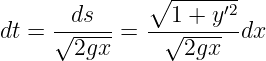
We have
whence
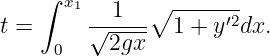
and
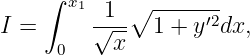
Let
and the form of the function f is to be determined so that this integral shall be a minimum.
(c) The Minimum Surface of Revolution. Given two points and aline which are co-planar, let it be
required to find the form of a curve terminated by the two points and lying in the plane
which, by its revolution about the given line, shall generate a surface of the least possible
area.
Take the line as the axis of X and use an axis of Y through one of the points. Call the
coordinates of the points 0, y0, and x1, y1. Let y = f(x) be a curve through (0, y0) and
(x1, y1).
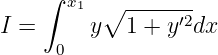
If S is the area of the surface of revolution generated by the curve,
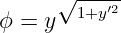
Let
and we wish to determine the form of the function f so that I shall be a minimum.
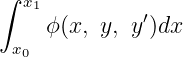
The three problems just considered are special cases of what we shall call our fundamental problem
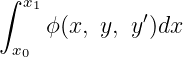
which is, to determine the form of the function f so that if y = f(x),
shall be a maximum or a minimum; ϕ being a given function and x0 and x1 being given constants,
as are y0 and y1, the corresponding values of y.
In ordinary problems in maxima and minima y = f(x) is a given function and we wish to find a
value, x0, of x for which y is greater, if we seek a maximum, less, if we seek a minimum, than for
neighboring values of x; that is, for values of x differing from x0 by a sufficiently small amount
whether that amount is positive or negative.
In our new problems, to speak in geometrical language, we have to find the form of a curve for
which our integral, I, is greater or less than for any neighboring curve having the same
end-points.
Let us now attack our first problem, that of the shortest line. We have to find the form of the
function f so that if
I shall be a minimum when y = f(x).
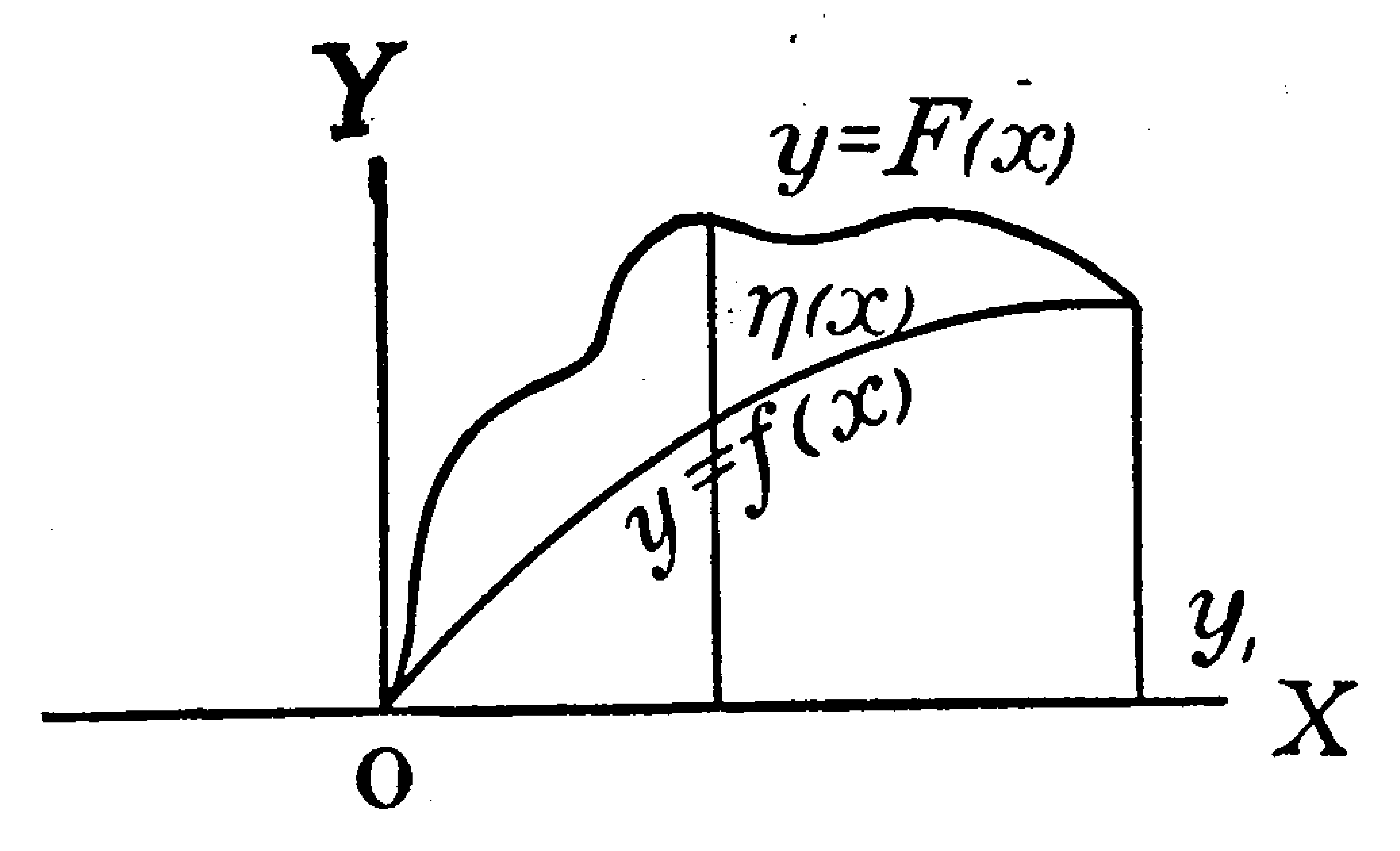
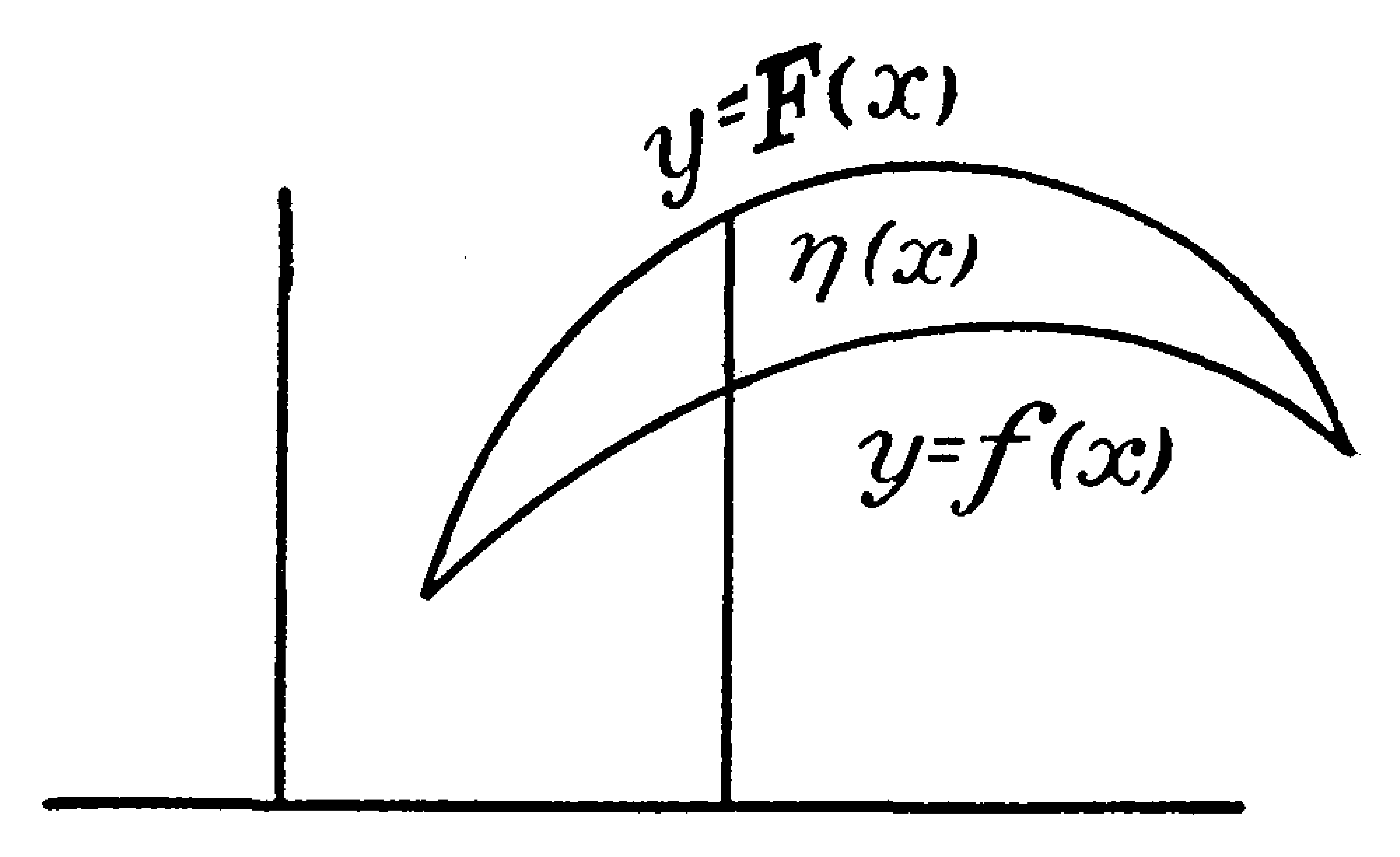
Let y = F(x) be any other continuous curve joining the given points, and let η(x) = F(x) − f(x).
Then y = f(x) + η(x) is our curve y = F(x). Consider the curve y = f(x) + αη(x) where α is a
parameter independent of x.
For any particular value of α the curve y = f(x) + αη(x) is one of a family of curves including
y = f(x) for α = 0 and y = F(x) for α = 1.
By taking a sufficiently small value for α we can make αη(x) less in absolute value for that and all
less values of α, and for all values of x between 0 and x1, than any previously chosen quantity ξ;
and for such values of α the curve y = f(x) + αη(x) is said to be a curve in the neighborhood of
y = f(x).
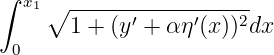
If y = f(x) and y = F(x) are given, I(α), the I for any one of our curves y = f(x) + αη(x),is
and I(α) is a function of α only.
A necessary condition that I(α) should be a minimum when α = 0 is well known to be that  I(α)
should be zero when α = 0. This condition we shall express as I′(0) = 0.
I(α)
should be zero when α = 0. This condition we shall express as I′(0) = 0.
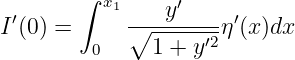
Since the limits 0 and x1 are constants
and
Integrating by parts
since η(x) vanishes when x = 0 and when x = x1.
A necessary condition that I(0) shall be less than I(α) for some value of α and for all less values
of α no matter what F(x) may be, in which case the length of the curve y = f(x) is
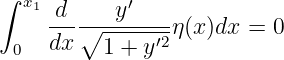
less than that of any neighboring curve, is that I′(0) = 0 independently of η(x, i.e.
that
no matter what the form of the arbitrary function η(x).
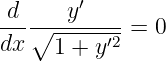
This condition will be satisfied if and only if
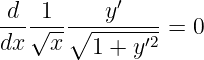
and we thus are led to a differential equation of the second order between y and x.
Its solution will express y as a function of x involving two arbitrary constants.
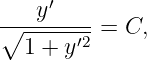
whence
a constant;
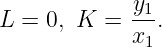
The required curve is to pass through (0, 0) and (x1, y1) and thus we are able to determine K
and L.
Hence y =  x; and our curve is a straight line through the given points.
If certain other conditions, depending on the fact that when I(α) is a minimum I′′(α) must be
positive, are satisfied, y =  x must be the required shortest line.
As our necessary conditions gave us but a single solution it is clear that if there is any shortest line
it must be our line y =  x.
x.
We may note in passing that in simplifying I′(0) by integration by parts we tacitly assumed that
f(x) and F(x) were continuous and had continuous first derivatives over the range of
integration.
We can deal with the general problem formulated previously precisely as we have dealt with the
shortest line problem.
Let it be required to determine the form of the function f so that y = f(x) shall make
a maximum or a minimum; given that y = y0 when x = x0 and y = y1 when x = x1.
As in the last section let η(x) = F(x) − f(x), and consider the family of curves
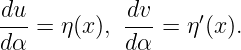
Let
Let
and I′(0) must be made equal to zero.
Integrating by parts,
since η(x) vanishes when x = x0 and when x = x1. I′(0) must be zero independently of the form of
η(x) therefore
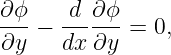
and as before we are led to a differential equation of the second order which if solved gives y as a
function of x involving two arbitrary constants which must be determined from the facts that
y = y0 when x = x0 and y = y1 when x = x1. This differential equation is known as
Lagrange’s equation and it is a necessary condition that I should be a maximum or a
minimum.
Any particular solution of Lagrange’s Equation is called an extremal, and if the given problem has
a solution it is that extremal which passes through the given end-points.
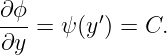
If ϕ is a function of y′ only Lagrange’s Equation becomes
Whence
a constant, and the extremals are straight lines; and therefore the required solution is the straight
line through the given end-points as before.
The problems of (b) and (c) can be solved by substituting in Lagrange’s Equation the appropriate
value of ϕ and then solving the resulting equation.
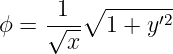
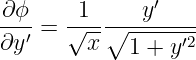
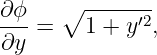
For the curve of quickest descent
Lagrange’s Equation becomes
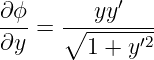
For the minimum surface
Lagrange’s Equation becomes
We shall reserve the solving of (4) and (5) for a later article.
References
[1] Byerly, Willian E., Introduction to the Calculus of Variations. Harvard University
Press, Cambridge, 1917.
This entry is a derivative of the Public domain work [1]


![∫ x1 d ∘ -----------------
I′(α) = --- 1 + [y ′ + αη ′(x)]2dx
0 dα](https://images.physicslibrary.org/cache/objects/512/make4ht/IntroductionToCalculusOfVariations14x.png)
![y ′ + αη′(x)
I′(α) = ∘------------------η ′(x)dx,
1 + [y′ + α η′(x )]2](https://images.physicslibrary.org/cache/objects/512/make4ht/IntroductionToCalculusOfVariations15x.png)
![[ ′ ]x1 ∫ x1 ′
I′(0) = ∘---y----η(x) − d--∘--y-----η(x)dx
1 + y′2 0 dx 1 + y′2
0](https://images.physicslibrary.org/cache/objects/512/make4ht/IntroductionToCalculusOfVariations17x.png)









![∫ x1[∂ ϕ ∂ ϕ ]
I′(α ) = ---η(x ) +---η′(x) dx.
x0 ∂u ∂v](https://images.physicslibrary.org/cache/objects/512/make4ht/IntroductionToCalculusOfVariations36x.png)
![∫ x [ ]
′ 1 ∂-ϕ -∂ϕ- ′
I (0 ) = x ∂y η(x ) + ∂y ′η(x) dx
0](https://images.physicslibrary.org/cache/objects/512/make4ht/IntroductionToCalculusOfVariations37x.png)
![∫ x1∂ ϕ [∂ϕ ]x1 ∫ x1 d ∂ϕ
I′(0) = ---η(x )dx + ---η(x) − -----′η(x)dx,
x0 ∂y ∂y x0 x0 dx ∂y](https://images.physicslibrary.org/cache/objects/512/make4ht/IntroductionToCalculusOfVariations38x.png)
![∫ x1[ ]
I′(0) = ∂-ϕ − -d-∂ϕ-- η(x)dx
x0 ∂y dx ∂y′](https://images.physicslibrary.org/cache/objects/512/make4ht/IntroductionToCalculusOfVariations39x.png)