GRE Physics Companion: Weight and Normal Force
This companion is designed for rapid review after M02-04. The main strategy is to stop treating
N = mg as a memorized rule. Instead, choose the direction Normal to the contact or inward along
a curved path and write Newton’s second law in that direction.
1 Fast triage
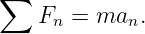
For a vertical support or elevator, choose a vertical sign convention and write
For an incline, choose a normal axis and write
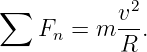
For a curved path, inward acceleration has magnitude
so use
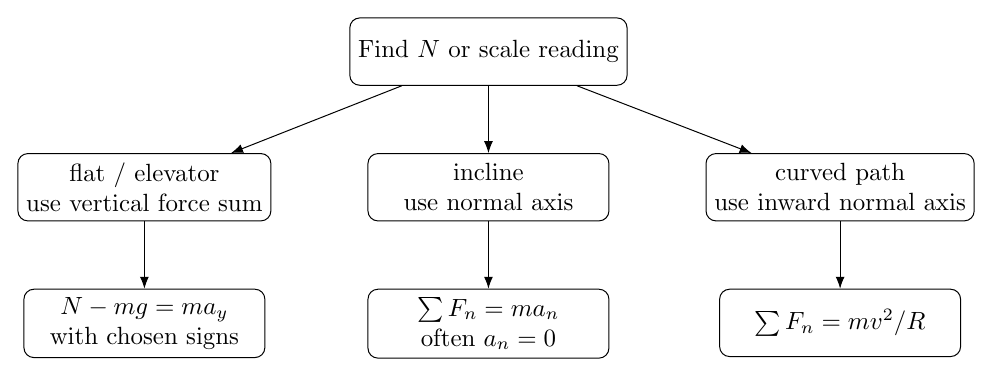
Figure 1. GRE triage for normal force problems. Choose the normal or inward direction first, then
write Newton’s second law along that axis.
2 High value traps
A scale measures the support force, not mg directly.
Free fall can give
even while gravity remains strong.
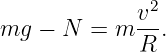
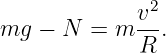
On a hill crest, inward is downward, so
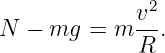
At the bottom of a valley, inward is upward, so
If a maintained contact calculation gives N < 0, the body has already lost contact. Use N = 0 at
the threshold.
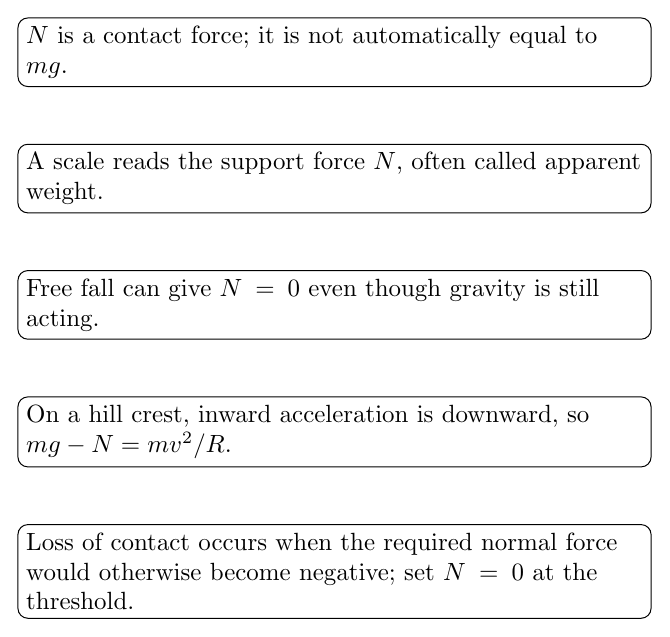
Figure 2. Common GRE traps involving apparent weight, free fall, curved paths, and loss of
contact.
3 Worked GRE example 1: moving upward but slowing down
An elevator passenger is moving upward but slowing down with acceleration magnitude a. Is the
scale reading greater than, equal to, or less than mg?
Moving upward while slowing means the acceleration points downward. Taking upward as
positive,
Thus
so
Velocity direction is irrelevant to this instantaneous force balance.
4 Worked GRE example 2: hill contact threshold
A vehicle moves over the crest of a hill of radius R. At what speed does it just lose
contact?
At the crest,
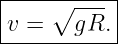
At the threshold of contact loss,
Therefore
and
The mass cancels.
5 GRE speed questions
- A person stands on a scale in an elevator accelerating upward. The scale reading is (A)
less than mg (B) equal to mg (C) greater than mg (D) zero.
- An elevator moves downward at constant velocity. The scale reading is (A) zero (B)
less than mg (C) equal to mg (D) greater than mg.
- A block rests on a frictionless incline of angle 𝜃 with no acceleration normal to the
plane. The normal force is (A) mg (B) mg sin 𝜃 (C) mg cos 𝜃 (D) mg tan 𝜃.
- A CAR passes over the crest of a circular hill at nonzero speed. Compared with mg,
the normal force is generally (A) smaller (B) equal (C) larger (D) unrelated to the
motion.
- A rider passes through the bottom of a circular dip. Compared with mg, the support
force is generally (A) smaller (B) equal (C) larger (D) zero.
- A person and scale are both in ideal free fall. Which statement is correct? (A) N = 0
and gravity is zero (B) N = 0 but gravity is not zero (C) N = mg (D) N > mg.
6 Answers and rationales
- C. Upward acceleration requires N − mg = ma > 0.
- C. Constant velocity means zero acceleration, so N = mg.
- C. The normal component of Weight is mg cos 𝜃.
- A. At the crest, mg − N = mv2∕R, so N < mg.
- C. At the bottom, N − mg = mv2∕R, so N > mg.
- B. Free fall removes the support force, not the gravitational force.
References
[1] PhysicsLibrary, M02-04, Weight and Normal Force.
[2] J. Moore et al., Mechanics Map, CC BY-SA 4.0.

![[parent]](https://images.physicslibrary.org/images/uparrow.png)