Physics Library
 An open source physics library
Encyclopedia | Forums | Docs | Random  

[parent] GRE Physics Companion: Conservative Forces and Potential Energy

(Example)

GRE Physics Companion: Conservative Forces and Potential Energy

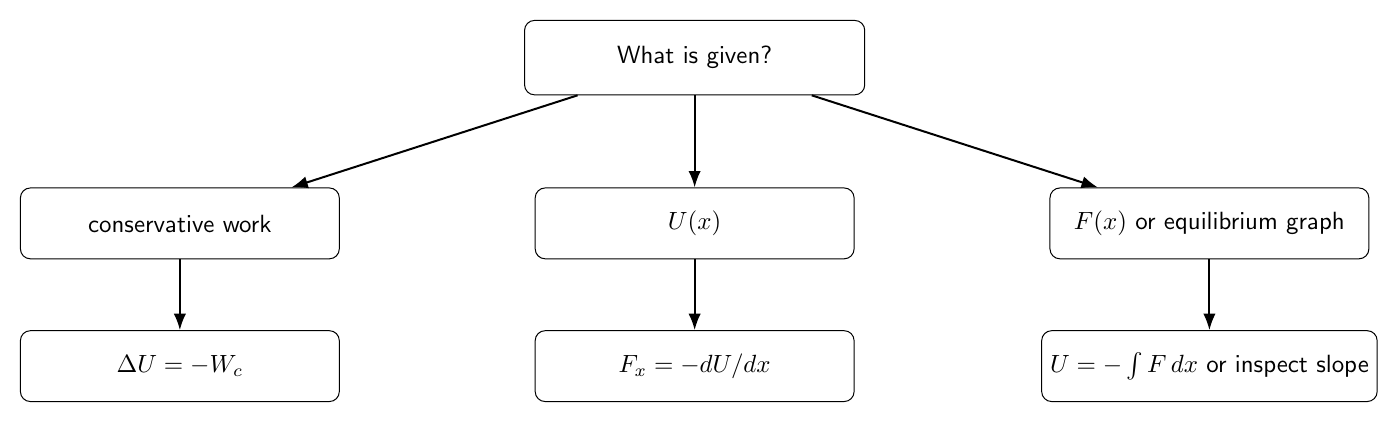
The fastest way to approach conservative-force questions is to recognize which relation is being tested.

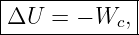
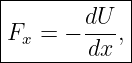
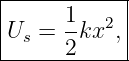
The four central relations are

|------------|
-ΔU--=-−-Wc,--
(1)

|------------|
|       dU-  |
|Fx = −  dx ,|
-------------
(2)

|------------|
|      1     |
|Us =  -kx2, |
-------2-----
(3)

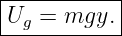
and, near Earth’s surface,

|----------|
Ug--=-mgy.--
(4)

PIC

Figure 1. A compact strategy for conservative-force problems. Identify whether the problem gives work, force, potential energy, or an equilibrium curve, then use the corresponding relation.

1 High-value GRE facts

  1. Positive conservative work means potential energy decreases.
  2. Negative conservative work means potential energy increases.
  3. A conservative force does zero net work around a closed path.
  4. Potential energy is defined only up to an additive constant.
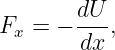
  5. In one dimension,
    F  = − dU ∕dx.
 x
    (5)

  6. Force points toward decreasing potential energy.
  7. A local minimum of U is stable equilibrium.
  8. A local maximum of U is unstable equilibrium.
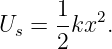
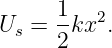
  9. For an ideal spring,
    U  =  1kx2.
  s   2
    (6)

  10. Near Earth’s surface,
    ΔUg  = mg Δy.
    (7)

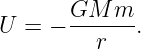
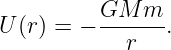
  11. With U(∞) = 0, Newtonian gravitational potential energy is
           GM  m
U =  − --r---.
    (8)

Part I: Original GRE-style problems

Problem 1: sign of potential-energy change

A conservative force does +40 J of work on a particle. The particle’s potential energy changes by

  1. −40 J
  2. −20 J
  3. 0
  4. +20 J
  5. +40 J

Problem 2: closed path

A particle moves around a closed loop under a conservative force. The net work done by that force is

  1. always negative
  2. zero
  3. equal to the maximum potential energy
  4. equal to the path length times the average force
  5. impossible to determine

Problem 3: force from potential

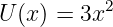
The potential energy of a particle is

U (x) = 3x2
(9)

in SI units. The force is

  1. +6x
  2. +3x
  3. 0
  4. −3x
  5. −6x

Problem 4: gravitational potential-energy change

A 2.0 kg mass rises by 5.0 m near Earth’s surface. Taking g = 9.8 m∕s2, the change in gravitational potential energy is

  1. −98 J
  2. −49 J
  3. 0
  4. +49 J
  5. +98 J

Problem 5: spring energy

An ideal spring has spring constant k = 200 N∕m and is compressed by 0.10 m. Its elastic potential energy relative to equilibrium is

  1. 0.5 J
  2. 1.0 J
  3. 2.0 J
  4. 10 J
  5. 20 J

Problem 6: stable equilibrium

A one-dimensional potential-energy curve has an equilibrium at x = x0. Which condition identifies stable equilibrium?

  1. U′(x0) > 0
  2. U′(x0) < 0
  3. U′(x0) = 0 and U′′(x0) > 0
  4. U′(x0) = 0 and U′′(x0) < 0
  5. U(x0) = 0

Problem 7: path independence

A mass moves from height h1 to lower height h2 under uniform gravity. Path A is vertical and Path B is a long curved track. Neglecting all forces except gravity, which statement is correct?

  1. Gravity does more work along Path A.
  2. Gravity does more work along Path B.
  3. Gravity does the same work along both paths.
  4. Gravity does zero work along both paths.
  5. The result depends on the travel time.

Problem 8: additive constant

If

 ′
U (x) = U (x) + C,
(10)

where C is constant, the force obtained from U′ is

  1. larger than the original force by C
  2. smaller than the original force by C
  3. identical to the original force
  4. zero
  5. undefined

Problem 9: gravitational potential

With the convention U(∞) = 0, the Newtonian gravitational potential energy of masses M and m separated by r is

  1. +GMm∕r
  2. −GMm∕r
  3. +GMm∕r2
  4. −GMm∕r2
  5. 0

Problem 10: slope of a potential curve

At some point on a one-dimensional potential-energy graph,

dU- < 0.
dx
(11)

The force at that point points

  1. in the positive x direction
  2. in the negative x direction
  3. perpendicular to the x axis
  4. nowhere because the force is zero
  5. in a direction that cannot be inferred

Problem 11: work from spring potential

A spring with k = 100 N∕m moves from extension xi = 0.30 m to xf = 0.10 m. The work done by the spring is

  1. −4.0 J
  2. −2.0 J
  3. 0
  4. +2.0 J
  5. +4.0 J

Problem 12: double-well equilibrium

For

          4     2
U (x) = ax  − bx ,     a > 0,  b > 0,
(12)

which statement is correct?

  1. x = 0 is the only equilibrium and it is stable.
  2. x = 0 is the only equilibrium and it is unstable.
  3. x = 0 is stable and two additional equilibria are unstable.
  4. x = 0 is unstable and two additional equilibria are stable.
  5. There are no equilibrium points.

Part II: Complete worked solutions

Solution 1

For a conservative force,

ΔU  = − Wc.
(13)

Thus

ΔU  =  − 40J.
(14)

Answer: (A).

Solution 2

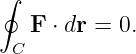
A conservative force satisfies

∮

   F ⋅ dr = 0.
 C
(15)

Therefore the net work around any closed path is zero.

Answer: (B).

Solution 3

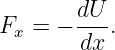
Use

F  = − dU- .
 x      dx
(16)

Since

U  = 3x2,
(17)

we have

dU- = 6x.
dx
(18)

Thus

Fx  = − 6x.
(19)

Answer: (E).

Solution 4

Near Earth’s surface,

ΔUg  = mg Δy.
(20)

Therefore

ΔUg = (2.0)(9.8)(5.0) (21)
= 98 J. (22)

Answer: (E).

Solution 5

The elastic potential energy is

      1-  2
Us =  2kx .
(23)

Thus

Us = 1-
2(200)(0.10)2 (24)
= 1.0 J. (25)

Answer: (B).

Solution 6

Stable equilibrium occurs at a local minimum of potential energy:

  ′               ′′
U (x0) = 0,     U  (x0 ) > 0.
(26)

Answer: (C).

Solution 7

Uniform gravity is conservative. Its work depends only on the initial and final heights:

Wg  = mg (h1 − h2).
(27)

Therefore both paths give the same gravitational work.

Answer: (C).

Solution 8

The force from U′ is

Fx′ = −   ′
dU--
dx (28)
= − d
---
dx(U + C) (29)
= −dU-
dx. (30)

The constant disappears upon differentiation.

Answer: (C).

Solution 9

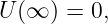
With

U (∞ ) = 0,
(31)

Newtonian gravity has

U (r) = − GM--m-.
            r
(32)

Answer: (B).

Solution 10

Since

       dU
Fx = − --- ,
        dx
(33)

a negative slope means

Fx > 0.
(34)

The force points in the positive x direction.

Answer: (A).

Solution 11

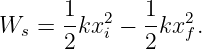
The spring work is

W  =  1kx2 −  1kx2 .
  s   2   i   2   f
(35)

Therefore

Ws = 1-
2(100)(0.30)2 −1-
2(100)(0.10)2 (36)
= 4.5 − 0.5 (37)
= 4.0 J. (38)

Answer: (E).

Solution 12

Differentiate:

U ′(x) = 4ax3 − 2bx.
(39)

Factor:

U ′(x) = 2x (2ax2 − b).
(40)

The equilibrium points are

x = 0
(41)

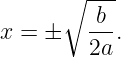
and

      ∘ ---
         b
x = ±   2a-.
(42)

The second derivative is

U′′(x ) = 12ax2 − 2b.
(43)

At the origin,

U ′′(0) = − 2b < 0,
(44)

so x = 0 is unstable.

At the other two equilibria,

U ′′ = 4b > 0,
(45)

so they are stable.

Answer: (D).

2 GRE checklist

Before calculating, identify which representation is shortest.

  1. If conservative work is given, use ΔU = −Wc.
  2. If U(x) is given, use Fx = −dU∕dx.
  3. If the force is given, integrate −Fx dx to obtain U.
  4. If gravity near Earth’s surface appears, use ΔUg = mgΔy.
  5. If a spring appears, use Us = 1
2kx2.
  6. If an equilibrium curve is shown, use the slope and curvature of U(x).
  7. If two different paths connect the same endpoints under a conservative force, the work is the same.
  8. Do not assign physical meaning to the absolute zero of potential energy unless a reference convention has been stated.

References

References

[1]   J. R. Taylor, Classical Mechanics, University Science Books, 2005.

[2]   D. Kleppner and R. Kolenkow, An Introduction to Mechanics, 2nd ed., Cambridge University Press, 2014.

[3]   OpenStax, University Physics, Volume 1, Rice University, 2016.


"GRE Physics Companion: Conservative Forces and Potential Energy" is owned by bloftin.
(view preamble)
View style:
Other names:  M03-05G
Keywords:  GRE physics, conservative force, potential energy, gravitational potential energy, elastic potential energy, spring, force from potential, equilibrium, path independence, mechanics problems

This object's parent.

Cross-references: representation, graph, mass, units, particle, dimension, net work, conservative force, equilibrium, potential energy, force, work, relation

This is version 1 of GRE Physics Companion: Conservative Forces and Potential Energy, born on 2026-10-03.
Object id is 1380, canonical name is GREPhysicsCompanionConservativeForcesAndPotentialEnergy.
Accessed 2 times total.

Classification:
Physics Classification: 45.20.Dd (Newtonian mechanics)
 45.50.-j (Dynamics and kinematics of a particle and a system of particles)
Pending Errata and Addenda
None.
Discussion
Style: Expand: Order:

No messages.

Interact
rate | post | correct | update request | add example | add (any)