|
|
|
|||||||
and
This companion concentrates on the two pieces introduced most directly in FS05: the sine coefficients bn and the constant projection a0∕2. The goal is to make the coefficient formulas behave like projection tools rather than formulas to memorize. The interval remains [−π,π] throughout. Rescaling to [−L,L] belongs to FS06.
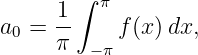
Figure 1. The exercise sequence moves from direct sine-harmonic isolation and the constant projection to parity shortcuts, integration by parts, odd piecewise functions, residual checks, and complete coefficient bookkeeping.
1 Three reusable checks
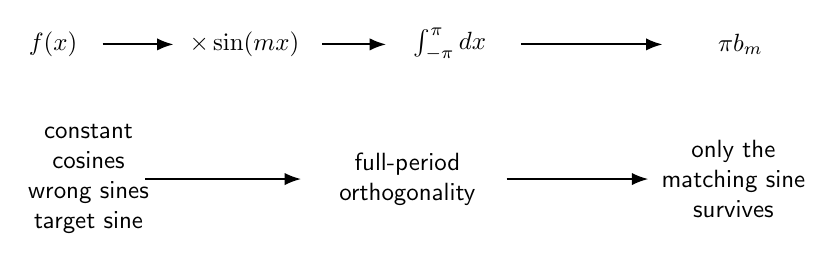
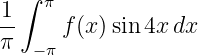
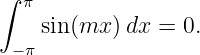
Sine-coefficient extraction checkA sine-coefficient extraction check verifies that multiplication by sin(mx) followed by integration over a complete period removes the constant term, all cosine terms, and all sine harmonics except the mth one. For a finite trigonometric polynomial,
the check should end with
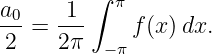
Constant-projection mean checkA constant-projection mean check verifies both
and
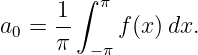
The second expression is the mean value of f over one complete period.
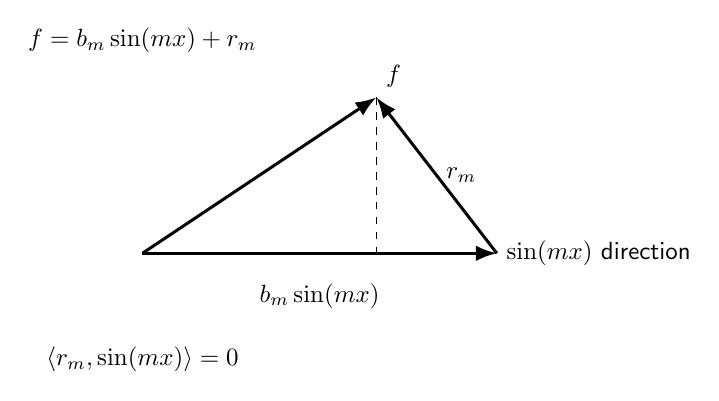
Sine-projection residual checkAfter projecting f onto sin(mx),
define
A correct projection satisfies
Figure 2. Sine-harmonic isolation acts as an orthogonality filter. Multiplication by the target sine harmonic and integration over a full period removes every component except the matching sine term.
2 ProblemsAll problems are stated before the hints and complete worked solutions.
Problem 1: isolate one sine coefficient from a known finite sumLet
Evaluate
by expanding every contribution. Do not simply read the answer from the given function.
Problem 2: rebuild the general sine-coefficient formulaAssume
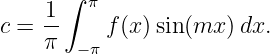
Multiply by sin(mx), integrate over [−π,π], and derive Equation (3) for 1 ≤ m ≤ N.
Problem 3: recover the constant coefficient and the meanFor
compute a0 by integration. Then identify the actual constant term a0∕2 and the mean value of f over one period.
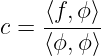
Problem 4: sine projection from the general projection formulaUse
with
on [−π,π] to derive Equation (3) directly.
Problem 5: residual orthogonality for the rampFor
the first sine coefficient is
Define
Verify directly that
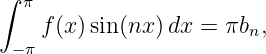
Problem 6: odd-function shortcut for bnSuppose f is odd. Starting from Equation (3), prove
Problem 7: even functions have no sine coefficientsSuppose f is even. Prove that
for every positive integer n.
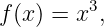
Problem 8: the odd ramp f(x) = xFor
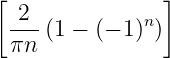
find a0, all an, and all bn. Carry out the integration by parts explicitly and show that
Write the resulting real Fourier series.
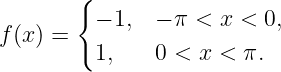
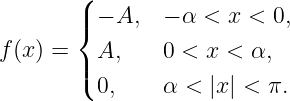
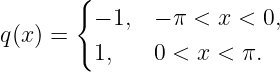
Problem 9: odd square waveDefine
Find a0, all an, and all bn. Show explicitly why only odd sine harmonics survive.
Problem 10: a DC offset plus an odd rampLet
Determine a0, an, and bn. Explain why adding the constant 2 changes only the constant projection and leaves all nonzero harmonic coefficients unchanged from the ramp example.
Problem 11: finite-width odd pulseFor 0 < α < π, define
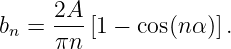
Find all Fourier coefficients. Show that
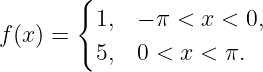
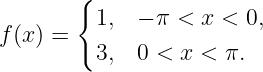
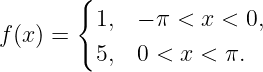
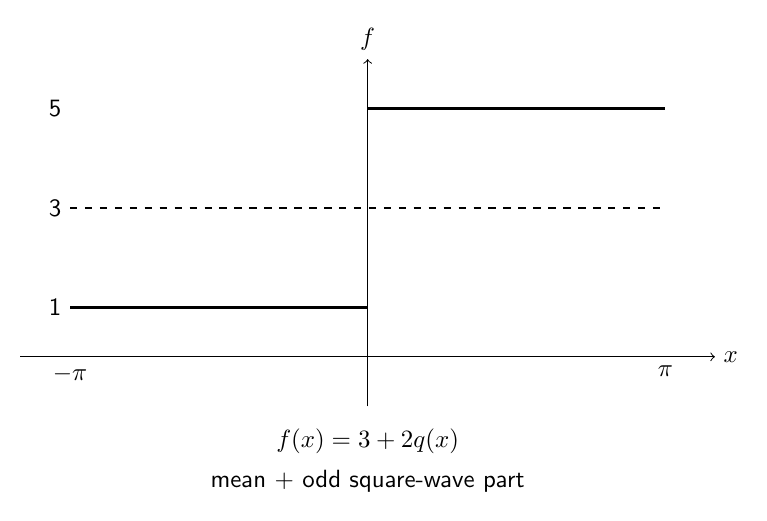
Problem 12: a two-level waveform with nonzero meanDefine
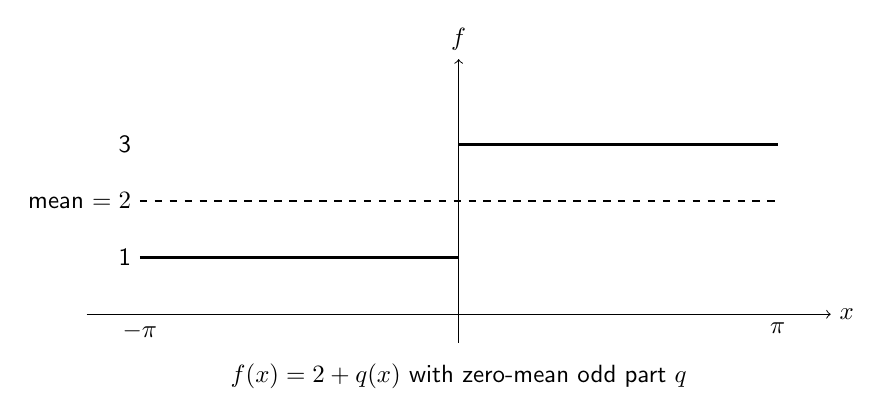
Find the constant projection and all sine coefficients. Interpret the result by writing f as a constant plus an odd square wave.
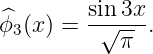
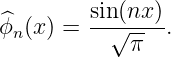
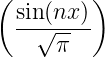
Problem 13: normalized sine basisDefine
Show that ∥ϕn∥ = 1. If
show that
Then verify that
Problem 14: energy bookkeeping for a finite orthogonal sumLet
Compute
using orthogonality rather than expanding the entire square. Then verify the result by identifying the squared norms of the constant and sine components.
Problem 15: direct coefficient check for a mixed finite sumFor
compute a0, b3, and b5 using their integral formulas. Explain why the cosine term does not contaminate either sine coefficient.
Problem 16: derive the complete coefficient bookkeeping for a shifted square waveLet
Find a0, all an, and all bn. Then rewrite the function as
where q(x) is the odd square wave from Problem 9, and show that this decomposition predicts the same coefficients immediately.
Figure 3. The constant projection is the mean level. A waveform can often be understood as a horizontal mean level plus an oscillatory part whose average over one period is zero.
3 Hints
4 Complete worked solutions
Solution 1: isolate one sine coefficient from a known finite sumWe must evaluate
Distribute the integral:
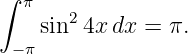
The first integral vanishes because a sine harmonic has zero full-period average. The second and fourth vanish by sine-cosine orthogonality. The third vanishes because the two sine harmonics have different indices. The last integral is
Therefore
The extraction procedure recovers the coefficient multiplying sin 4x.
Solution 2: rebuild the general sine-coefficient formulaStart with
Multiply by sin(mx):
Integrate from −π to π:
Now apply orthogonality. The constant-sine integral is zero:
Every cosine-sine inner product is zero:
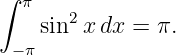
For the sine-sine terms,
Therefore every sine term disappears except n = m:
Divide by π:
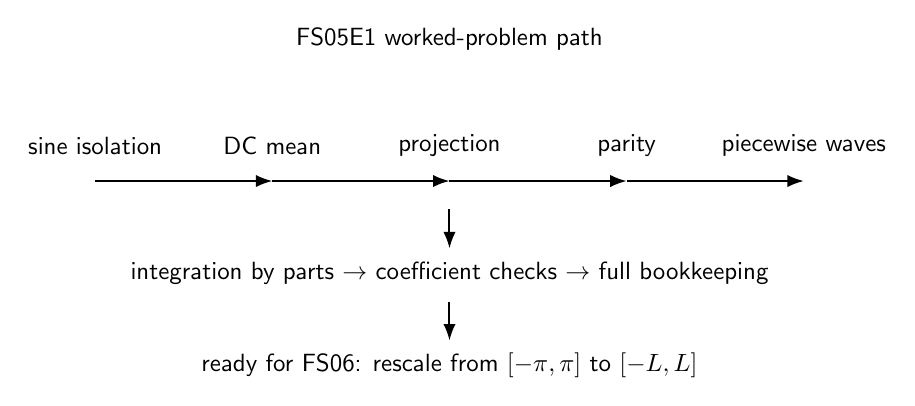
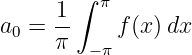
Solution 3: recover the constant coefficient and the meanUse
Thus
The Fourier series contains the constant term
The mean is
So the constant term and the mean agree, as they must.
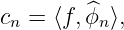
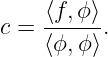
Solution 4: sine projection from the general projection formulaThe projection coefficient of f onto ϕ is
Set
The numerator is
The denominator is
Therefore
This is exactly bm.
Figure 4. After the mth sine projection is removed, the residual has zero inner product with that same sine basis function. This is the function-space analogue of a perpendicular vector residual.
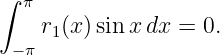
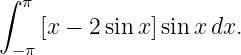
Solution 5: residual orthogonality for the rampWe need
Separate the terms:
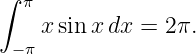
For the first integral, x sin x is even, so
Integrate by parts with
so
Then
Thus
Also,
Therefore
The residual is orthogonal to the basis function used in the projection.
Solution 6: odd-function shortcut for bnIf f is odd, then sin(nx) is also odd. The product of two odd functions is even:
Therefore
This is the odd-function shortcut.
Solution 7: even functions have no sine coefficientsIf f is even and sin(nx) is odd, their product is odd:
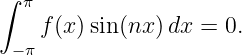
An odd integrand has zero integral over a symmetric interval:
Hence
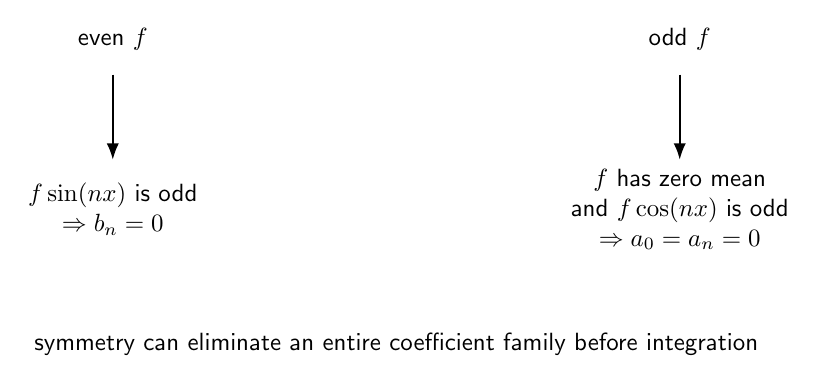
Figure 5. Parity predicts whole families of Fourier coefficients before any detailed integration: even functions have no sine coefficients, while odd functions have no constant or cosine coefficients.
Solution 8: the odd ramp f(x) = xBecause x is odd,
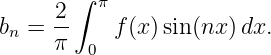
For the sine coefficient,
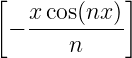
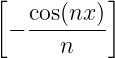
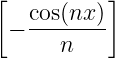
Use integration by parts:
so
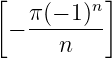
Then
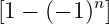
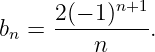
Therefore
Thus
The convergence symbol reminds us that pointwise convergence details are treated later in the series.
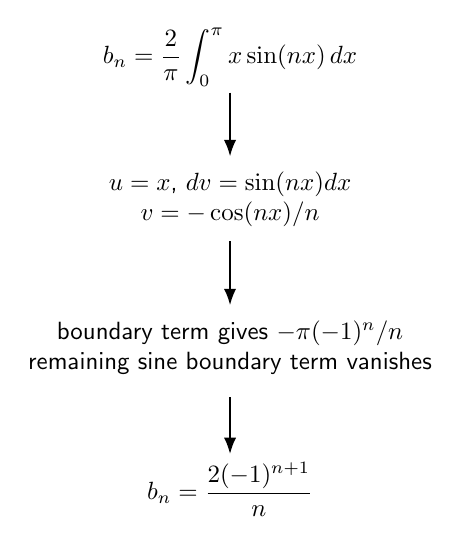
Figure 6. The ramp coefficient requires one integration by parts. The boundary term supplies the alternating factor (−1)n, while the remaining sine boundary term vanishes.
Solution 9: odd square waveThe square wave is odd, so
Use the odd-function shortcut:
If n is even,
so
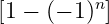
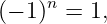
If n is odd,
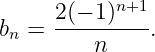
so
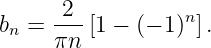
Hence
Solution 10: a DC offset plus an odd rampWrite
The constant part contributes only to a0. First,
Thus
For n ≥ 1,
The constant-cosine integral is zero, and x cos(nx) is odd. Therefore
For the sine coefficient,
The constant-sine integral is zero. The remaining integral is exactly the ramp coefficient from Problem 8:
Thus
Adding a constant shifts the mean but does not change the nonzero harmonic content.
Solution 11: finite-width odd pulseThe pulse is odd, so
Use the odd-function shortcut. On the positive half interval the function equals A only from 0 to α:
This formula contains the square wave as the special case α = π.
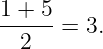
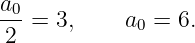
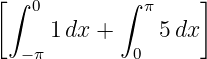
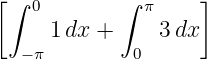
Solution 12: a two-level waveform with nonzero meanThe waveform has level 1 for half the period and level 3 for the other half. Compute the constant coefficient:
Therefore
Now write
where
The constant 2 has no sine coefficients, so f has the same sine coefficients as q:
Thus
for even n, and
for odd n.
Figure 7. A two-level waveform with unequal positive levels is naturally decomposed into its mean level plus an odd square wave. The mean contributes only the constant projection; the odd part contributes only sine harmonics.
Solution 13: normalized sine basisCompute the norm:
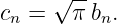
Thus ∥ϕn∥ = 1. The coefficient in the normalized basis is
Since
we obtain
Then
The coordinate changes when the basis is normalized, but the projected function does not.
Solution 14: energy bookkeeping for a finite orthogonal sumWrite
The three components
are mutually orthogonal on [−π,π]. Therefore the squared norm is the sum of the squared component norms:
This is a finite-dimensional version of the energy bookkeeping that later develops into Parseval’s theorem.
Solution 15: direct coefficient check for a mixed finite sumThe function is
For the constant coefficient,
Thus the actual constant term is
For b3,
The constant-sine term vanishes. The cosine-sine term vanishes. The sin 5x sin 3x term vanishes because the harmonic indices differ. Only
survives, so
Similarly,
The cosine term does not contaminate either sine coefficient because cosine and sine harmonics are orthogonal over the full interval.
Solution 16: complete coefficient bookkeeping for a shifted square waveThe waveform is
The mean of the two half-period levels is
Therefore we expect
Verify directly:
Now write
where q(x) is the odd square wave from Problem 9. The constant 3 contributes no nonzero harmonic coefficients. Because q is odd, it contributes no cosine coefficients. Hence
The sine coefficients are twice those of the unit-amplitude odd square wave:
Thus for even n,
and for odd n,
So the waveform has the Fourier representation
This final problem illustrates the clean separation
5 Further practice
6 What these exercises establishThe problems above reinforce four structural ideas.
The coefficient set on [−π,π] is now complete. The next article changes the interval itself and asks how the basis frequencies and normalization constants must change.
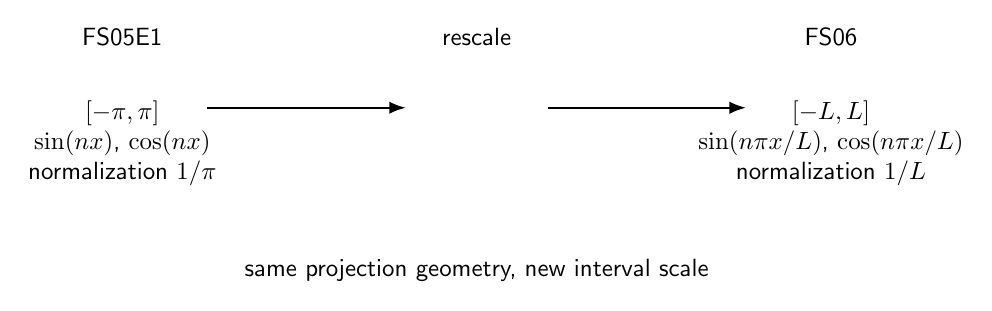
Figure 8. FS05E1 completes practice with the standard interval [−π,π]. FS06 rescales the same projection geometry to a general interval [−L,L], where the harmonics become cos(nπx∕L) and sin(nπx∕L).
References
"Fourier Sine and Constant Coefficient Derivation Exercises" is owned by bloftin.
This object's parent. Cross-references: frequencies, periodic function, representation, theorem, energy, boundary, vector, projection coefficient, inner products, amplitude, FS03, relations, norms, square, Fourier series, harmonics, period, functions, parity, formulas, Fourier coefficient, FS05 There is 1 reference to this object. This is version 1 of Fourier Sine and Constant Coefficient Derivation Exercises, born on 2026-10-27. Object id is 1540, canonical name is FourierSineAndConstantCoefficientDerivationExercises. Accessed 10 times total. Classification:
|
|
|
|
Pending Errata and AddendaNone.
|
DiscussionNo messages.
|
Interact |
























 sin 4




 sin(











 (12

















 +































 (







 (