Wave Mechanics Examples: Why Amplitude Is Not Energy
This companion article provides exercises for WM23, Why Amplitude Is Not energy. All exercises
appear first; complete worked solutions follow in Part II.
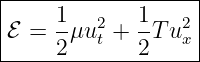
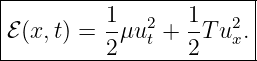
The central mechanical energy-density relation for an ideal stretched string is
For a right-moving sinusoidal wave
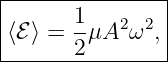
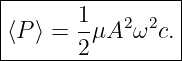
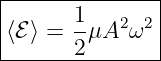
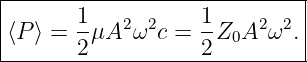
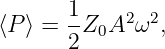
the average energy density and average power are
and
Thus energy and power scale as A2 only when the other relevant parameters are fixed. Amplitude
itself is a displacement scale, not an energy variable [1, 2, 4, 6].
How to use this problem set
Attempt all exercises in Part I before consulting Part II. In each problem, identify which quantities
are being held fixed before using a proportionality such as
The phrase “proportional to amplitude squared” is meaningful only after those hidden conditions
have been specified.
Part I: Exercises
Exercise 1: Amplitude, energy density, and power are different quantities
For a transverse string wave, classify each quantity below by its physical meaning and SI
units:
- displacement amplitude A,
- local energy density ℰ,
- total wave energy E,
- average power ⟨P⟩.
Then explain why the statement “A2 is the energy” cannot be literally correct on dimensional
grounds.
Exercise 2: The conditional square law
Two sinusoidal traveling waves propagate on the same string at the same frequency. Their
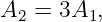
amplitudes satisfy
Find
and
State explicitly which quantities had to remain fixed for the A2 scaling to apply.
Exercise 3: Equal amplitude, unequal frequency
Two waves on the same ideal string have the same amplitude A but frequencies
The figure emphasizes that identical displacement amplitude does not imply identical energy
transport.
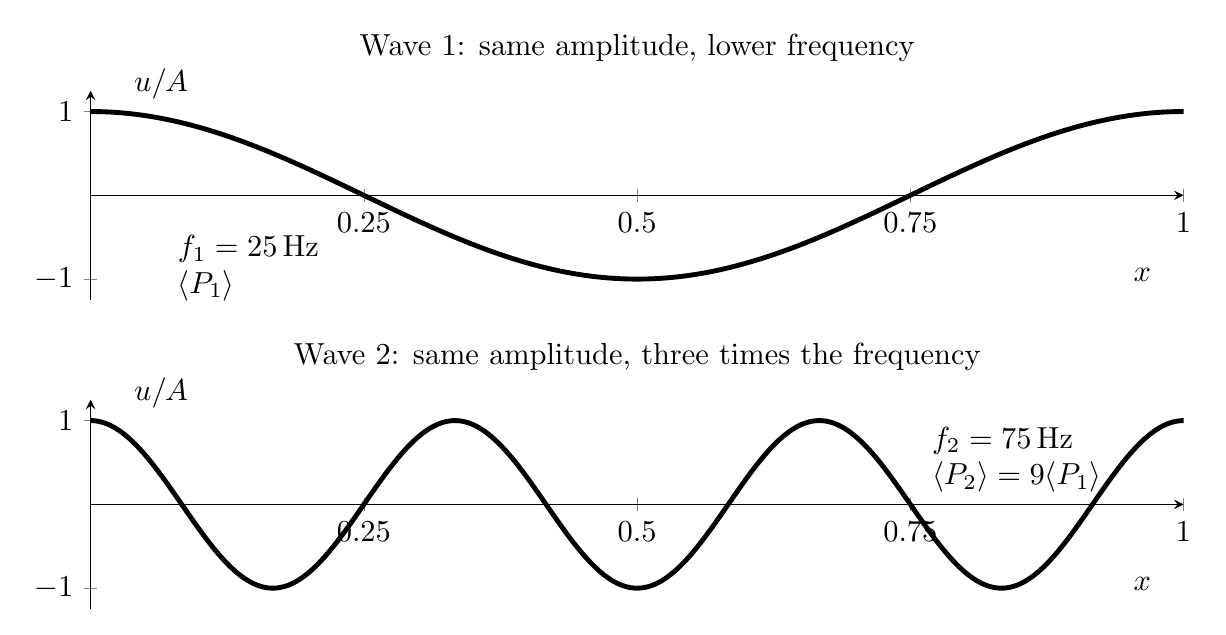
Figure. Two waves have the same amplitude but different frequency. On the same string,
average power scales as f2 when amplitude is fixed.
Find
Would the two waves also have equal average energy density? Explain.
Exercise 4: Equal amplitude and frequency, unequal medium
Two right-moving sinusoidal waves have identical amplitude and frequency. Their characteristic
impedances are
Using
find
Why does this problem provide another counterexample to the idea that amplitude alone
determines power?
Exercise 5: Displacement phase versus energy phase
For a right-moving sinusoidal wave, define
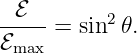
Then
and
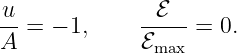
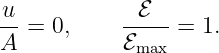
Use the figure below to answer the questions.
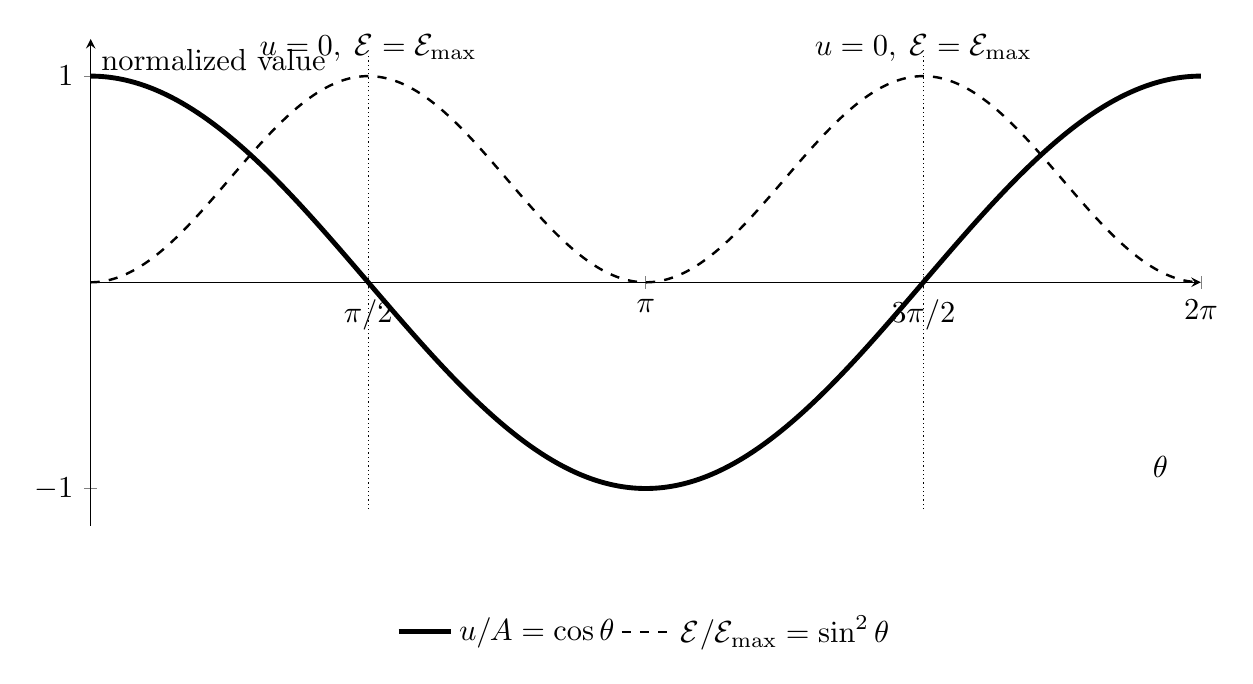
Figure. Normalized displacement and normalized local energy density for a sinusoidal
traveling wave.
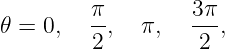
For each phase
state the values of u∕A and ℰ∕ℰmax. Identify the phases where displacement magnitude is
maximum but energy density is zero, and where displacement is zero but energy density is
maximum.
Exercise 6: Energy from motion and deformation
At one point on an ideal string,
and measurements give
Find:
- the kinetic energy density 𝒦,
- the elastic potential energy density 𝒰,
- the total local energy density ℰ.
Does the displacement u need to be known to answer this problem?
Exercise 7: Sinusoidal average energy and power
A right-moving sinusoidal wave has
Find:
- ω,
- ⟨ℰ⟩,
- ⟨P⟩,
- the maximum instantaneous local energy density ℰmax.
Compare ℰmax with ⟨ℰ⟩.
Exercise 8: A standing-wave node can store energy
Consider the Standing Wave
with
At a node,
- What is the displacement at that point for all time?
- Show that the maximum elastic energy density at the node is
- Evaluate 𝒰max numerically.

Figure. At a standing-wave node the displacement vanishes, but the local slope can be
large, so elastic energy need not vanish.
Exercise 9: Destructive displacement interference does not erase energy
A right-moving component F(x−ct) and a left-moving component G(x + ct) overlap. At one event
their displacements cancel exactly,
but their profile derivatives are
The string Tension is
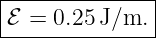
Using
find the local energy density. Explain why the answer is consistent with zero total displacement at
that event.
Exercise 10: Infer amplitude from a target power
A right-moving sinusoidal wave has
What amplitude is required for
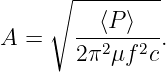
Use
Give the answer in meters and millimeters.
Exercise 11: Diagnose conceptual statements
For each statement, decide whether it is correct. If it is incorrect, rewrite it accurately.
- “If the displacement is zero at a point, the local wave energy must be zero.”
- “If two waves have equal amplitude, they carry equal power.”
- “On the same string at the same frequency, doubling amplitude quadruples average
power.”
- “A standing-wave node has zero displacement amplitude, so it can never contain elastic
energy.”
- “Destructive interference of displacement means the component-wave energies have
been destroyed.”
Exercise 12: Trade amplitude against frequency at fixed power
Two sinusoidal traveling waves propagate on the same string and must carry the same average
power. The second wave has twice the frequency of the first:
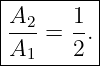
Find the required amplitude ratio
Explain why this result would be impossible to obtain from amplitude information alone without
knowing that the powers are equal and the medium is unchanged.
Exercise 13: Compare two waves when everything changes
Two right-moving sinusoidal waves have the following properties:
| μ1 | = 0.010 kg/m, | c1 | = 80 m/s, | A1 | = 2.0 mm, | f1 | = 30 Hz, | (35)
|
| μ2 | = 0.015 kg/m, | c2 | = 100 m/s, | A2 | = 1.0 mm, | f2 | = 60 Hz. | (36) |
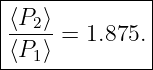
Without separately calculating both powers, use a ratio to find
Which wave carries more average power?
Exercise 14: Synthesis - amplitude is one input, not the whole answer
A sinusoidal traveling wave propagates on a string with
and has
Find:
- the wave speed c,
- the angular frequency ω,
- the average energy density ⟨ℰ⟩,
- the average power ⟨P⟩,
- the new average power if only the amplitude is doubled,
- the new average power if only the frequency is doubled,
- the new average power if both amplitude and frequency are doubled.
Use this example to summarize why amplitude alone cannot determine wave power.
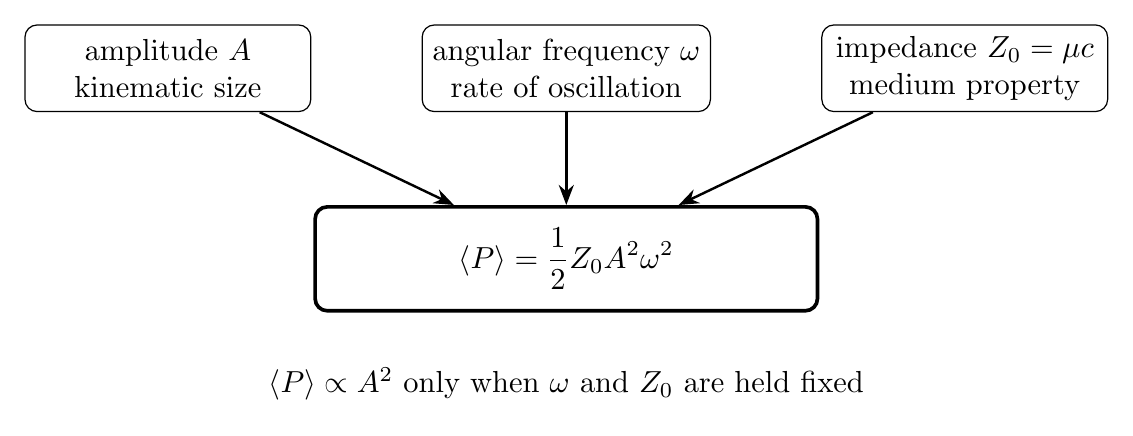
Figure. For a sinusoidal traveling wave, average power depends on amplitude, frequency,
and the medium. The A2 statement is a conditional scaling law.
Part II: Complete Worked Solutions
Solution 1: Amplitude, energy density, and power are different quantities
- The amplitude A is a displacement scale. Its SI unit is
- The local energy density ℰ for a string is energy per unit length:
- Total wave energy has units
- Average power is energy transported per unit time:
The quantity A2 has units m2, which are neither joules, joules per meter, nor watts. Therefore A2
cannot literally be energy. It can only appear as one factor inside an energy or power formula that
also contains the necessary physical parameters.
Solution 2: The conditional square law
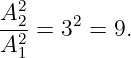
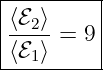
For the same medium and the same frequency,
and
Because
we have
Therefore
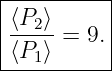
and
The frequency ω and the relevant medium quantities, such as μ and c or equivalently Z0, had to
remain fixed.
Solution 3: Equal amplitude, unequal frequency
On the same string at fixed amplitude,
Thus
 | =  2 2 | (51)
|
| =  2 2 | (52)
|
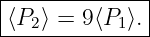
| = 9. | (53) |
Hence
The average energy density also scales as f2 for fixed A and μ:
Therefore the second wave also has nine times the average energy density. Equal amplitude is not
enough to make the energy measures equal.
Solution 4: Equal amplitude and frequency, unequal medium
With A and ω fixed,
Therefore
 | =  | (57)
|
| =  | (58)
|
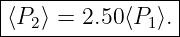
| = 2.50. | (59) |
Thus
The displacement amplitude and frequency are identical, but the media present different
mechanical impedances. The power therefore differs.
Solution 5: Displacement phase versus energy phase
We use
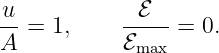
At 𝜃 = 0,
At 𝜃 = π∕2,
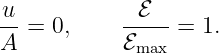
At 𝜃 = π,
At 𝜃 = 3π∕2,
Therefore maximum displacement magnitude occurs at 𝜃 = 0 and 𝜃 = π, where the local energy
density is zero. Zero displacement occurs at 𝜃 = π∕2 and 3π∕2, where the local energy density is
maximum.
Solution 6: Energy from motion and deformation
The kinetic term is
| 𝒦 | =  μut2 μut2 | (66)
|
| =  (0.012)(0.40)2 (0.012)(0.40)2 | (67)
|
| = 9.60 × 10⁻⁴ J/m. | (68) |
Thus
The elastic term is
| 𝒰 | =  Tux2 Tux2 | (70)
|
| =  (120)(0.025)2 (120)(0.025)2 | (71)
|
| = 3.75 × 10⁻² J/m. | (72) |
Therefore
The total is
| ℰ | = 𝒦 + 𝒰 | (74)
|
| = 0.000960 + 0.0375 | (75)
|
| = 0.03846 J/m. | (76) |
Hence
The displacement u itself was not needed. The local energy depends on the local velocity ut and
slope ux.
Solution 7: Sinusoidal average energy and power
The angular frequency is
| ω | = 2πf | (78)
|
| = 2π(50) | (79)
|
| = 100π rad/s | (80)
|
| ≈ 314.16 rad/s. | (81) |
Thus
The average energy density is
| ⟨ℰ⟩ | =  μA2ω2 μA2ω2 | (83)
|
| =  (0.010)(0.0020)2(314.16)2 (0.010)(0.0020)2(314.16)2 | (84)
|
| ≈ 1.974 × 10⁻³ J/m. | (85) |
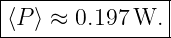
Therefore
The average power is
| ⟨P⟩ | = c⟨ℰ⟩ | (87)
|
| = 100(1.974 × 10⁻³) | (88)
|
| ≈ 0.197 W. | (89) |
Thus
The instantaneous energy density is proportional to sin 2𝜃, so its maximum is twice its cycle
average:
Hence
Solution 8: A standing-wave node can store energy
At a node,
so
for all time.
The spatial derivative is
At a node, | sin(kx)| = 1, so
Therefore
| 𝒰 | =  Tux2 Tux2 | (97)
|
| = 2TA2k2 cos 2(ωt). | (98) |
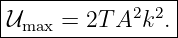
The maximum is
Numerically,
| 𝒰max | = 2(80)(0.0015)2(8.0)2 | (100)
|
| = 0.02304 J/m. | (101) |
Thus
The node never moves away from zero displacement, yet the local string can be strongly tilted and
therefore store elastic energy.
Solution 9: Destructive displacement interference does not erase energy
Use
Then
| ℰ | = 100(0.040)2 + 100(0.030)2 | (104)
|
| = 100(0.0016 + 0.0009) | (105)
|
| = 0.25 J/m. | (106) |
Therefore
The condition F + G = 0 concerns the values of the two displacement fields at that event. Energy
depends on their derivatives and on the corresponding motion and deformation. Displacement
cancellation therefore does not require the energy density to vanish.
Solution 10: Infer amplitude from a target power
Starting from
solve for A:
Substituting the data,
| A | = 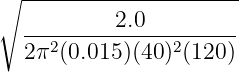 | (110)
|
| ≈ 5.93 × 10⁻³ m. | (111) |
Therefore
The amplitude can be inferred only because the frequency and medium properties are also
known.
Solution 11: Diagnose conceptual statements
- Incorrect. Zero displacement does not imply zero local energy. For a sinusoidal traveling
wave, zero displacement occurs when the local energy density is maximum.
- Incorrect. Equal amplitude does not imply equal power unless the relevant frequency
and medium quantities are also equal.
- Correct. On the same string at the same frequency,
so doubling amplitude multiplies average power by four.
- Incorrect. A standing-wave node has zero displacement but can have nonzero and even
maximum elastic energy density because ux need not vanish there.
- Incorrect. Destructive interference cancels the displacement field locally; it does not
destroy the energy carried or stored by the component waves in a lossless linear
system.
Solution 12: Trade amplitude against frequency at fixed power
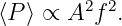
On the same string,
Equal average power therefore requires
With
we obtain
Thus
and
The higher-frequency wave needs only half the amplitude to carry the same average power on the
same string.
Solution 13: Compare two waves when everything changes
For sinusoidal traveling waves,
Therefore
 | =  | (121)
|
| = 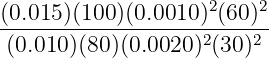 | (122)
|
| = 1.875. | (123) |
Hence
Wave 2 carries more average power even though its amplitude is only half as large. Its higher
frequency and different medium more than compensate for the smaller amplitude.
Solution 14: Synthesis - amplitude is one input, not the whole answer
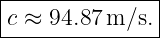
The wave speed is
| c | =  | (125)
|
| =  | (126)
|
| =  | (127)
|
| ≈ 94.87 m/s. | (128) |
Thus
The angular frequency is
| ω | = 2πf | (130)
|
| = 2π(25) | (131)
|
| = 50π rad/s | (132)
|
| ≈ 157.08 rad/s. | (133) |
So
The average energy density is
| ⟨ℰ⟩ | =  μA2ω2 μA2ω2 | (135)
|
| =  (0.010)(0.0012)2(157.08)2 (0.010)(0.0012)2(157.08)2 | (136)
|
| ≈ 1.78 × 10⁻⁴ J/m. | (137) |
Therefore
The average power is
| ⟨P⟩ | = c⟨ℰ⟩ | (139)
|
| ≈ (94.87)(1.7765 × 10⁻⁴) | (140)
|
| ≈ 1.685 × 10⁻² W. | (141) |
Thus
If only amplitude doubles, A2 increases by four:
If only frequency doubles, f2 also increases by four:
If both amplitude and frequency double, the two factors multiply:
Hence
This synthesis problem shows the central WM23 lesson: amplitude affects power strongly, but it is
only one input among several. Frequency and medium properties matter independently.
Common mistakes
- Mistake: saying “energy equals amplitude squared.” The dimensions and the physics
are incomplete.
- Mistake: using ⟨P⟩∝ A2 while also changing frequency or medium properties.
- Mistake: treating zero displacement as zero local energy.
- Mistake: assuming a standing-wave node contains no energy because its displacement
is always zero.
- Mistake: assuming displacement cancellation destroys conserved energy.
- Mistake: forgetting that the energy density of a string depends on ut and ux, not
directly on u alone.
What WM23E1 reinforces
The central results are
and, for a sinusoidal traveling wave,
These formulas show exactly why the phrase “energy is proportional to amplitude squared” is
useful but conditional. The correct broader lesson is
References
[1] A. P. French, Vibrations and Waves, M.I.T. Introductory Physics Series, W. W.
Norton & Company, 1971.
[2] Frank S. Crawford, Jr., Waves, Berkeley Physics Course, Volume 3, McGraw-Hill,
1968.
[3] Howard Georgi, The Physics of Waves, Prentice Hall, 1993.
[4] William Moebs, Samuel J. Ling, and Jeff Sanny, University Physics, Volume 1,
OpenStax, 2016, Section 16.4, “Energy and Power of a Wave.”
[5] Richard P. Feynman, Robert B. Leighton, and Matthew Sands, The Feynman Lectures
on Physics, Volume I, Chapters 47–49 on wave motion and modes.
[6] Massachusetts Institute of Technology, 8.03SC Physics III: Vibrations and Waves,
MIT OpenCourseWare, materials on traveling waves, standing waves, and energy
transport.

![[parent]](https://images.physicslibrary.org/images/uparrow.png)






























![[A ] = m.](https://images.physicslibrary.org/cache/objects/1194/make4ht/ExampleOfWaveMechanicsWhyAmplitudeIsNotEnergy37x.png)
![[ℰ] = J/m.](https://images.physicslibrary.org/cache/objects/1194/make4ht/ExampleOfWaveMechanicsWhyAmplitudeIsNotEnergy38x.png)
![[E ] = J.](https://images.physicslibrary.org/cache/objects/1194/make4ht/ExampleOfWaveMechanicsWhyAmplitudeIsNotEnergy39x.png)
![[⟨P⟩] = W = J/s.](https://images.physicslibrary.org/cache/objects/1194/make4ht/ExampleOfWaveMechanicsWhyAmplitudeIsNotEnergy40x.png)