From the Eight Lectures on theoretical physics delivered at Columbia University in 1909 by Max
Planck.
My problem today is to utilize the general fundamental laws concerning the concept of
irreversibility, which we established in the lecture of yesterday, in the solution of a definite
problem: the calculation of the entropy of an ideal monatomic gas in a given state, and the
derivation of all its Thermodynamic properties. The way in which we have to proceed is prescribed
for us by the general definition of entropy:
(13)
The chief part of our problem is the calculation of W for a given state of the gas, and in this
connection there is first required a more precise investigation of that which is to be understood as
the state of the gas. Obviously, the state is to be taken here solely in the sense of the conception
which we have called macroscopic in the last lecture. Otherwise, a state would possess neither
probability nor entropy. Furthermore, we are not allowed to assume a condition of equilibrium for
the gas. For this is characterized through the further special condition that the entropy
for it is a maximum. Thus, an unequal distribution of density may exist in the gas;
also, there may be present an arbitrary number of different currents, and in general
no kind of equality between the various velocities of the molecules is to be assumed.
The velocities, as the coordinates of the molecules, are rather to be taken a priori as
quite arbitrarily given, but in order that the state, considered in a macroscopic sense,
may be assumed as known, certain mean values of the densities and the velocities must
exist. Through these mean values the state from a macroscopic standpoint is completely
characterized.
The conditions mentioned will all be fulfilled if we consider the state as given in such manner that
the number of molecules in a sufficiently small macroscopic space, both which, however, contains a
very large number of molecules, is given, and furthermore, that the (likewise great) number of
these molecules is given, which are found in a certain macroscopically small velocity
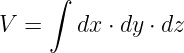
domain, i.e., whose velocities lie within certain small intervals. If we call the coordinates
x,y,z, and the velocity components ẋ,ẏ,ż, then this number will be proportional to
[1]
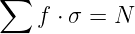
It will depend, besides, upon a finite factor of proportionality which may be an arbitrarily given
functionf(x,y,z,ẋ,ẏ,ż) of the coordinates and the velocities, and which has only the one
condition to fulfill that
(14)
where N denotes the total number of molecules in the gas. We are now concerned with the
calculation of the probability W of that state of the gas which corresponds to the arbitrarily given
distribution function f.
The probability that a given molecule possesses such coordinates and such velocities that it lies
within the domain σ is expressed, in accordance with the final result of the previous lecture, by the
magnitude of the corresponding elementary domain:
Now we divide the whole of the six dimensional ”state domain” containing all the molecules into
suitable equal elementary domains of the magnitude m3σ. Then the probability that a given
molecule fall in a given elementary domain is equally great for all such domains. Let P denote the
number of these equal elementary domains. Next, let us imagine as many dice as there are
molecules present, i.e., N, and each die die to be provided with P equal sides. Upon these P sides
we imagine numbers 1, 2, 3,⋅⋅⋅P, so that each of the P sides indicates a given elementary
domain. Then each throw with the N dice corresponds to a given state of the gas, while
the number of dice which show a given number corresponds to the molecules which
lie in the elementary domain considered. In accordance with this, each single die can
indicate with the same probability each of the numbers from 1 to P, corresponding to the
circumstance that each molecule may fall with equal probability in any one of the P elementary
domains. The probability W sought, of the given state of the molecules, corresponds,
therefore, to the number of different kinds of throws (complexions) through which is
realized the given distribution f. Let us take, e.g., N equal to 10 molecules dice) and
P = 6 elementary domains (sides) and let us imagine the state so given that there are
3 molecules in 1st elementary domain
4 molecules in 2d elementary domain
0 molecules in 3d elementary domain
1 molecules in 4th elementary domain
0 molecules in 5th elementary domain
2 molecules in 6th elementary domain
then this state, e.g., may be realized through a throw for which the 10 dice indicate the following
numbers:
1st
2d
3d
4th
5th
6th
7th
8th
9th
10th
2
6
2
1
1
2
6
2
1
4
(15)
Under each of the characters representing the ten dice stands the number which the die indicates
in the throw. In fact,
3 dice show the figure 1
4 dice show the figure 2
0 dice show the figure 3
1 dice show the figure 4
0 dice show the figure 5
2 dice show the figure 6
The state in question may likewise be realized through many other complexions of this kind. The
number sought of all possible compliexions is now found through consideration of the number
series indicated in (15). For, since the number of molecules (dice) is given, the number series
contains a fixed number of elements (10 = N). Furthermore, since the number of molecules falling
in an elementary domain is given, each number, in all permissible complexions, appears equally
often in the series. Finally, each change of the number configuration conditions a new complexion.
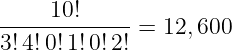
The number of possible complexions or the probability W of the given state is therefore equal to
the number of possible permutations with repetition under the conditions mentioned. In
the simple example chosen, in accordance with a well known formula, the probability
is
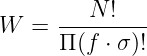
Therefore, in the general case:
The sign Π denotes the product extended over all of the P elementary domains.
From this there results, in accordance with equation (13), for the entropy of the gas in the given
state:
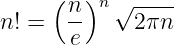
The summation is to be extended over all domains σ. Since f ⋅ σ is a large quantity,
Stirling’s formula may be employed for its factorial, which for a large number n is expressed
by:
(16)
therefore, neglecting unimportant terms:
and hence:
(17)
The quantity is, to the universal factor (−k), the same as that which L. Boltzmann
denoted by H, and which he showed to vary in one direction only for all changes of
state.
In particular, we will now determine the entropy of a gas in a state of equilibrium, and inquire first
as to that form of the law of distribution which corresponds to thermodynamic equilibrium. In
accordance with the second law of thermodynamics, a state of equilibrium is characterized
by the condition that with given values of the total volumeV and the total energyE, the entropy S assumes its maximum value. If we assume the total volume of the
gas
and the total energy
(18)
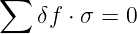
as given, then the condition:
must hold for the state of equilibrium, or, in accordance with (17):
(19)
wherein the variation δf refers to an arbitrary change in the law of distribution, compatible with
the given values of N, V and E.
Now we have, on account of the constancy of the total number of molecules N, in accordance with
(14):
and, on account of the constancy of the total energy, in accordance with (18):
Consequently, for the fulfillment of condition (19) for all permissible values of δf, it is sufficient
and necessary that
or:
wherein α and β are constants. In the state of equilibrium, therefore, the space distribution of
molecules is uniform, i.e., independent of x,y,z, and the distribution of velocities is the well known
Maxwellian distribution.
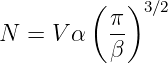
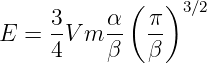
The values of the constants α and β are to be found from those of N, V, and E. For the
substitution of the value found for f in (14) leads to:
and the substitution of f in (18) leads to:
From these equations it follows that:
and hence finally, in accordance with (17), the expression for the
entropy S of the gas in a state of equilibrium with given values for N, V and E is:
(20)
The additive constant contains terms in N and m, but not in E and V.
The determination of the entropy here carried out permits now the specification directly of the
complete thermodynamic behavior of the gas, viz., of the equation of state, and of the values of the
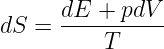
specific heats. From the general thermodynamic definition of entropy:
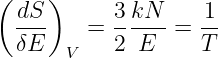
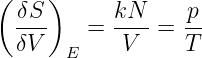
and obtained the partial differential quotients of S with regard to E and V respectively:
Consequently, with the aid of (20):
(21)
and
(22)
The second of these equations:
contains the laws of Boyle, Gay Lussac and Avogadro, the latter because the pressure depends only
upon the number N, and not upon the constitution of the molecules. Writing it in the ordinary
form:
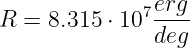
where n denotes the number of gram molecules or mols of the gas, referred to O2 = 32g, and R the
absolute gas constant:
we obtain by comparison:
(23)
If we denote the ratio of the mol number to the molecular number by ω, or, what is the same
thing, the ratio of the molecular mass to the mol mass:
and hence:
(24)
From this, if ω is given, we can calculate the universal constantk, and conversely.
The equation (21) gives:
(25)
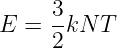
Now since the energy of an ideal gas is given by:
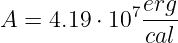
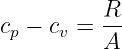
wherein cv denotes in calories the heat capacity at constant volume of a mol, A the mechanical
equivalent of heat:
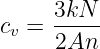
it follows that:
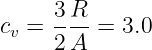
and, having regard to (23), we obtain:
(26)
the mol heat in calories of any monatomic gas at constant volume.
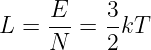
The mean kinetic energy L of a molecule is obtained from (25):
(27)
You notice that we have derived all these relations through the identification of the mechanical
with the thermodynamic expression for the entropy, and from this you recognize the fruitfulness of
the method here proposed.
But a method can first demonstrate fully its usefulness when we utilize it, not only to derive laws
which are already known, but when we apply it in domains for whose investigation there
at present exist no other methods. In this connection its application affords various
possibilities. Take the case of a monatomic gas which is not sufficiently attenuated to have the
properties of the ideal state; there are here, as pointed out by J.D. van der Waals, two
things to consider: (1) the finite size of the atoms, (2) the forces which act among the
atoms. Taking account of these involves a change in the value of the probability and
in the energy of the gas as well, and, so far as can now be shown, the corresponding
change in the conditions for thermodynamic equilibrium leads to an equation of state
which agrees with that of van der Waals. Certainly there is here a rich field for further
investigations, of greater promise when experimental tests of the equation of state exist in larger
number.
Another important application of the theory has to do with heat radiation, with which we shall be
occupied the coming week. We shall proceed then in a similar way as here, and shall be able from
the expression for the entropy of radiation to derive the thermodynamic properties of radiant
heat.
Today we will refer briefly to the treatment of polyatomic gases. I have previously, upon
good grounds, limited the treatment to monatomic molecules; for up to the present real
difficulties appear to stand in the way of a generalization, from the principles employed
by us, to include polyatomic molecules; in fact, if we wish to be quite frank, we must
say that a satisfactory mechanical theory of polyatomic gases has not yet been found.
Consequently, at present we do not know to what place in the system of theoretical physics to
assign the processes within a molecule - the intra-molecular processes. We are obviously
confronted by puzzling problems. A noteworthy and much discussed beginning was, it
is true, made by Boltzmann, who introduced the most plausible assumption that for
intra-molecular processes simple laws of the same kind hold as for the motion of the
molecules themselves, i.e., the general equations of dynamics. It is easy then, in fact,
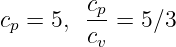
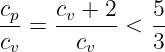
to proceed to proof that for a monatomic gas the molecular heat cv must be greater
than 3 and that consequently, since the difference cp− cv is always equal to 2, the ratio
is
This conclusion is completely confirmed by experience. But his in itself does not confirm the
assumption of Boltzmann; for, indeed, the same conclusion is reached very simply from the
assumption that there exists intra-molecular energy which increases with the temperature. For
then the molecular heat of a polyatomic gas must be greater by a corresponding amount than that
of a monatomic gas.
Nevertheless, up to this point the Boltzmann theory never leads to contradiction with experience.
But so soon as one seeks to draw special conclusions concerning the magnitude of the specific heats
hazardous difficulties arise; I will refer to only one of them. If one assumes the Hamiltonian
equations of mechanics as applicable to intra-molecular motions, he arrives of necessity at the law
of ”uniform distribution of energy,” which asserts that under certain conditions, not essential to
consider here, in a thermodynamic state of equilibrium the total energy of the gas is distributed
uniformly among all the individual energy phases corresponding to the independent
variables of state, or, as one may briefly say; the same amount of energy is associated with
every independent variable of state. Accordingly, the mean energy of motion of the
molecules kT, corresponding to a given direction in space, is the same as for any other
direction, and, moreover, the same for all the different kinds of molecules, and ions; also
for all suspended particles (dust) in the gas, of whatever size, and, furthermore, the
same for all kinds of motions of the constituents of a molecule relative to its centroid. If
one now reflects that a molecule commonly contains, so far as we know, quite a large
number of different freely moving constituents, certainly, that a normal molecule of a
monatomic gas, e.g., mercury, possesses numerous freely moving electrons, then, in
accordance with the law of uniform energy distribution,k the intra-molecular energy must
constitute a much larger fraction of the whole specific heat of the gas, and therefore
cp∕cv must turn out much smaller, than is consistent with the measured values. Thus,
e.g., for an atom of mercury, in accordance with the measured value of cp∕cv = 5∕3,
no part whatever of the heat added may be assigned to the intra-molecular energy.
Boltzmann and others, in order to eliminate this contradiction, have fixed upon the
possibility that, within the time of observation of the specific heats, the vibrations of the
constituents (of a molecule) do not change appreciable with respect to one another, and come
later with their progressive motion so slowly into heat equilibrium that this process is
no longer capable of detection through observation. Up to now no such delay in the
establishment of a state of equilibrium has been observed. Perhaps it would be productive of
results if in delicate measurements special attention were paid the question as to whether
observations which take a longer time lead to a greater value of the mol-heat, or, what
comes to the same thing, a smaller value of cp∕cv, than observations lasting a shorter
time.
If one has been made mistrustful through these considerations concerning the applicability of the
law of uniform energy distribution to intra-molecular processes, the mistrust is accentuated
upon the inclusion of the laws of heat radiation. I shall make mention of this in a later
lecture.
When we pass from stable atoms to the unstable atoms of radioactive substances, the principles
following from the kinetic gas theory lose their validity completely. For the striking failure of all
attempts to find any influence of temperature upon radioactive phenomena shows us that an
application here of the law of uniform energy distribution is certainly not warranted. It will,
therefore, be safest meanwhile to offer no definite conjectures with regard to the nature and the
laws of these noteworthy phenomena, and to leave this field for further development to
experimental research alone, which, I may say, with every day throws new Light upon the
subject.
0.3 Footnotes
[1] We can call σ a ”macro-differential” in contradistinction to the micro-differentials which are
infinitely small with reference to the dimensions of a molecule. I prefer this terminology for the
discrimination between ”physical” and ”mathematical” differentials in spite of the inelegance of
phrasing, because the macro-differential is also just as much mathematical as physical and the
micro-differential just as much physical as mathematical.
0.4 References
This article is a derivative from the public domain work in [2].
[2] Planck, M. ”Eight Lectures on Theoretical Physics” Delivered at Columbia University in 1909,
translated by A.P. Wills. Columbia University Press, New York, 1915.
"The Equation of State for a Monatomic Gas" is owned by bloftin.