|
|
|
|||||||
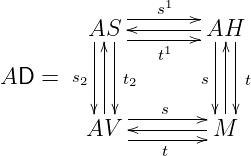
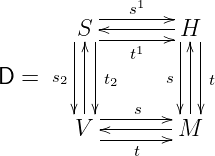
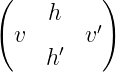
where M is a set of ‘points’, H,V are ‘horizontal’ and ‘vertical’ groupoids, and S is a set of ‘squares’ with two compositions. The laws for a double groupoid make it also describable as a groupoid internal to the category of groupoids. Given two groupoids H,V over a set M, there is a double groupoid □(H,V ) with H,V as horizontal and vertical edge groupoids, and squares given by quadruples
for which we assume always that h,h′∈ H, v,v′∈ V and that the initial and final points of these edges match in M as suggested by the notation, that is for example sh = sv,th = sv′,…, etc. The compositions are to be inherited from those of H,V , that is
This construction is right adjoint to the forgetful functor which takes the double groupoid as
above, to the pair of groupoids H,V over M. Now given a general double groupoid as above, we
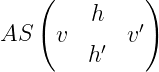
can define S This allows us to construct for at least a commutative C*–algebra A a double algebroid (i.e. a set with two algebroid structures)
for which
is the free A-module on the set of squares with the given boundary. The two compositions are then bilinear in the obvious sense. Alternatively, we can use the convolution construction ĀD induced by the convolution C*–algebra over H and V . These ideas about algebroids need further development in the Light of the algebra of crossed modules of algebroids, developed in (Mosa, 1986, Brown and Mosa, 1986) as well as crossed cubes of (C*) algebras following Ellis (1988). "double groupoid geometry" is owned by bci1. This object's parent. Cross-references: modules, Light, convolution, boundary, algebroid, double algebroid, commutative C*--algebra, functor, category of groupoids, groupoids, double groupoid, representation, compositions, squares This is version 4 of double groupoid geometry, born on 2010-01-28, modified 2010-02-13. Object id is 830, canonical name is DoubleGroupoidGeometry. Accessed 1883 times total. Classification:
|
|
|
|
Pending Errata and AddendaNone.
|
DiscussionNo messages.
|
Interact |
![[parent]](https://images.physicslibrary.org/images/uparrow.png)

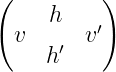 to be the set of squares with these as horizontal and vertical
edges.
to be the set of squares with these as horizontal and vertical
edges.