Electromagnetic Waves, Antennas, and RF: The Laplacian and the 3D Wave Equation - Exercises
and Complete Worked Solutions
This companion article provides self-study exercises for EM04, The Laplacian and the 3D
wave equation. All exercises are stated first. Complete worked solutions follow in Part
II.
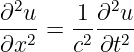
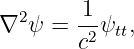
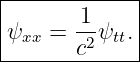
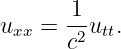
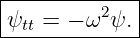
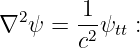
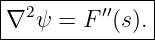
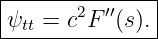
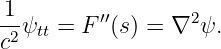
The exercises reinforce the central bridge from the one-dimensional wave equation
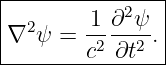
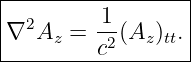
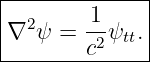
to the three-dimensional equation
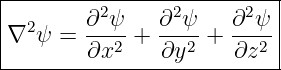
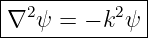
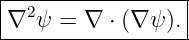
The Laplacian in Cartesian Coordinates is
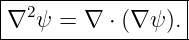
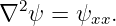
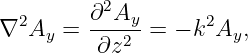
and can also be written
For the plane wave
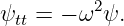
EM04 showed that
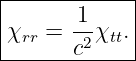
and
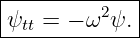
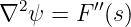
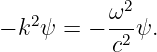
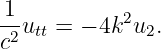
Therefore a nondispersive wave satisfying the three-dimensional wave equation must
obey
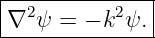
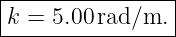
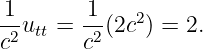
with
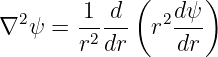
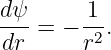
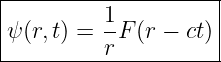
For an outgoing spherically spreading wave in three dimensions,
These results follow the notation and scope of EM04 [3, 2, 6, 7].
How to use this problem set
Attempt all exercises in Part I before reading Part II. In each problem, first identify the spatial
operator and the dimensionality of the field. Then check the result against the structure of the
wave equation. For plane-wave problems, keep the scalar Wavenumber k = |k| distinct from the
vector k.
Part I: Exercises
Exercise 1: compute a Cartesian Laplacian
Let
Compute ∇2ψ.
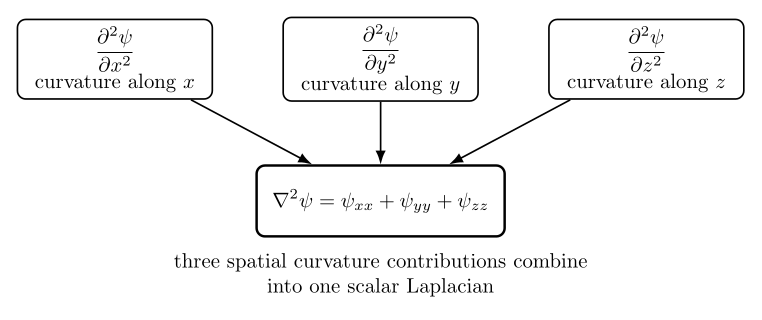
Figure. The Cartesian Laplacian adds the second-derivative contributions from the three
spatial directions.
Exercise 2: recover the Laplacian as divergence of the gradient
For
find:
- ∇ϕ;
- ∇⋅ (∇ϕ);
- ∇2ϕ directly from second derivatives.
Verify that the answers in parts (b) and (c) agree.
Exercise 3: Laplace’s equation
Determine whether each scalar field satisfies Laplace’s equation
- ψ1 = x2 − y2;
- ψ2 = x2 + y2 + z2;
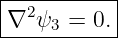
- ψ3 = xy + yz + zx.
Exercise 4: reduction from 3D to 1D
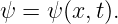
Suppose a field depends only on x and t:
Starting from
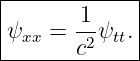
show explicitly that the equation reduces to
Exercise 5: verify a plane-wave solution
Let
Show that
and
Then substitute into the three-dimensional wave equation and derive the required dispersion
relation.
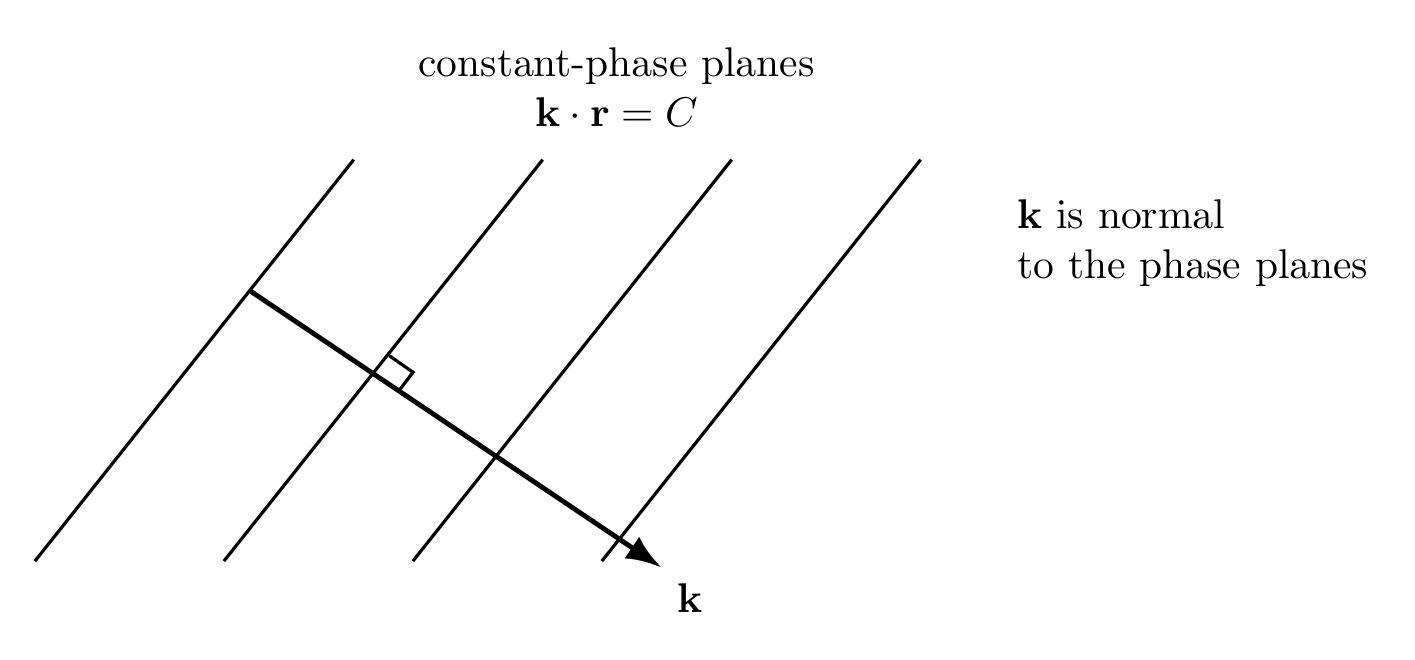
Figure. The wave vector k is normal to constant-phase planes. Its magnitude k enters the
plane-wave dispersion relation.
Exercise 6: wave vector, wavelength, and frequency
A plane wave propagates with
in a medium where
Find:
- k = |k|;
- the wavelength λ;
- the angular frequency ω;
- the ordinary frequency f;
- the unit propagation direction k.
Exercise 7: wavelength of a GPS-frequency radio wave
Treat a radio wave in vacuum as propagating at
For the GPS L1 carrier frequency
find:
- the wavelength λ;
- the scalar wavenumber k.
This problem uses the wave-equation relation c = fλ only; detailed electromagnetic physics is
reserved for later entries.
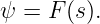
Exercise 8: arbitrary traveling profile in three dimensions
Let
where n is a constant unit vector.
Using the chain rule, show that
and
Conclude that any sufficiently smooth profile F of this form satisfies the 3D wave equation.
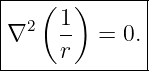
Exercise 9: the radial Laplacian
For a spherically symmetric scalar field
use the radial Laplacian
to compute ∇2(1∕r) for r > 0.
Exercise 10: spherical-wave amplitude spreading
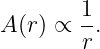
An outgoing spherical wave has amplitude proportional to 1∕r. At radius r1, the amplitude is A1.
At radius
find:
- A2∕A1;
- the corresponding ratio of a quantity proportional to amplitude squared.
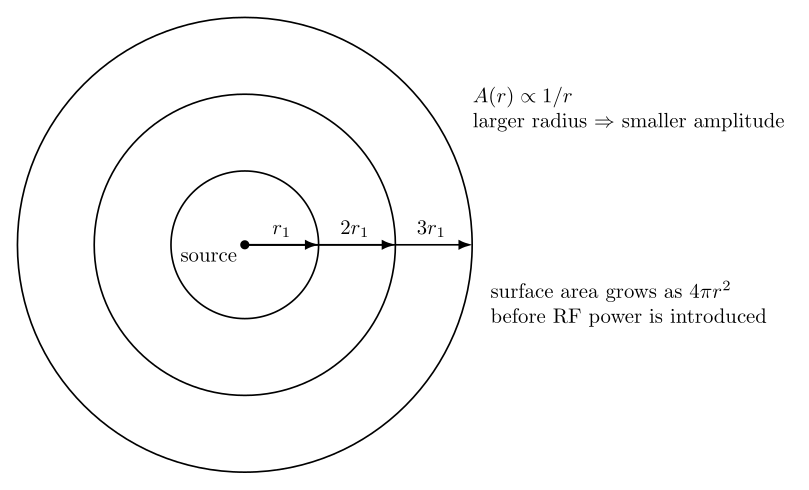
Figure. A spherical disturbance spreads over larger spherical surfaces as radius increases.
The wave amplitude scales as 1∕r in the ideal outgoing solution.
Exercise 11: reduce a spherical wave to a 1D radial equation
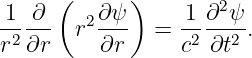
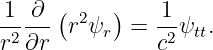
For a spherically symmetric wave ψ(r,t), the wave equation is
Define
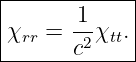
Show that for r > 0 the equation becomes
Exercise 12: vector wave equation component by component
Suppose a vector field is
If
write the three scalar component equations explicitly.
Then verify that
satisfies the vector wave equation when ω = ck.
Exercise 13: identify which functions satisfy the 1D wave equation
For each candidate below, determine whether it satisfies
Assume all constants are nonzero unless stated otherwise.
- u1 = A cos(kx − ckt);
- u2 = A cos(kx − 2ckt);
- u3 = F(x − ct) for a twice-differentiable F;
- u4 = x2 + c2t2.
Exercise 14: synthesis - geometry, phase, wavelength, and frequency
A plane wave is
with
Find:
- k;
- k;
- λ;
- ω;
- f;
- the phase at r = (1, 2, 0) m and t = 2.0 ns.
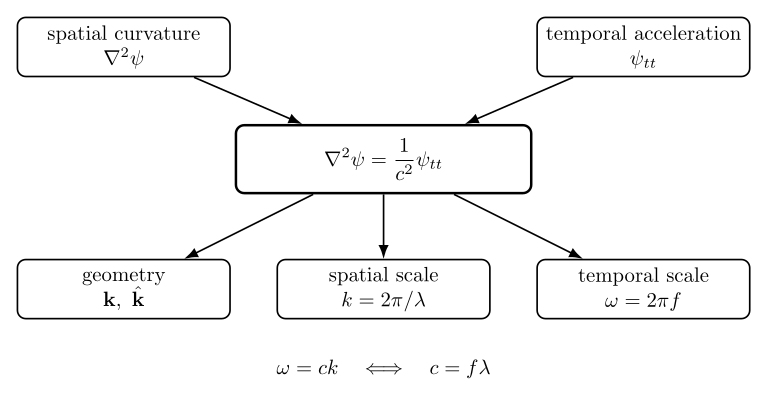
Figure. The 3D wave equation links spatial curvature, temporal acceleration, propagation
geometry, wavelength, and frequency.
Part II: Complete Worked Solutions
Solution 1: compute a Cartesian Laplacian
Given
we compute the second derivatives one coordinate at a time:
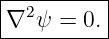
The mixed term 4xy contributes nothing to any pure second derivative. Therefore,
Hence
This field is harmonic: it satisfies Laplace’s equation.
Solution 2: recover the Laplacian as divergence of the gradient
The scalar field is
Its gradient is
| ∇ϕ | = x + y + y + z + z | (44)
|
| = 2xyx + (x2 + z2)y + 2yzz. | (45) |
Thus
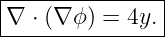
Now take the divergence:
| ∇⋅ (∇ϕ) | =  + + 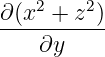 + +  | (47)
|
| = 2y + 0 + 2y | (48)
|
| = 4y. | (49) |
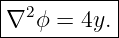
Therefore,
Directly,
Hence
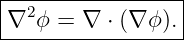
The two methods agree, verifying
Solution 3: Laplace’s equation
For
we have
Thus
For
we obtain
Therefore,
For
all pure second derivatives vanish, so
Hence ψ3 also satisfies Laplace’s equation.
Solution 4: reduction from 3D to 1D
The Cartesian Laplacian is
If ψ depends only on x and t, then
and therefore
Thus
Substituting into the 3D wave equation gives
This is exactly the one-dimensional wave equation developed in the Wave mechanics
series.
Solution 5: verify a plane-wave solution
Let
so that
Because
the gradient is
Taking one more spatial derivative gives
For time derivatives,
and
Substitute these into
For a nonzero wave field,
Taking the positive-frequency branch gives
Solution 6: wave vector, wavelength, and frequency
The wave vector is
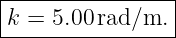
Its magnitude is
Therefore,
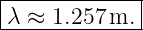
The wavelength is
Thus
The angular frequency is
Hence
The ordinary frequency is
| f | =  | (85)
|
| = 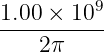 | (86)
|
| ≈ 1.5915 × 10⁸ Hz. | (87) |
Therefore,
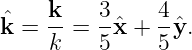
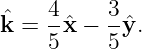
The unit propagation direction is
Thus
Solution 7: wavelength of a GPS-frequency radio wave
Use
With
and
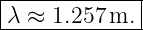
we obtain
Thus
The scalar wavenumber is
Therefore,
Solution 8: arbitrary traveling profile in three dimensions
Let
and
Because n is constant,
Then
Taking the divergence,
Since n is constant,
Because n is a unit vector,
For time derivatives,
and
Therefore,
Hence any sufficiently smooth profile of the form
satisfies the three-dimensional wave equation.
Solution 9: the radial Laplacian
Let
Then
Multiply by r2:
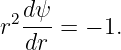
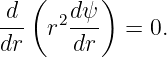
Differentiate again:
Therefore, for r > 0,
The restriction r > 0 matters because 1∕r is singular at the origin.
Solution 10: spherical-wave amplitude spreading
For an outgoing spherical wave,
Thus
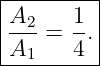
Since r2 = 4r1,
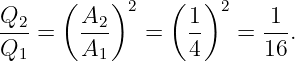
If another quantity is proportional to amplitude squared, then
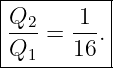
Hence
This is the mathematical precursor of inverse-square power-density spreading discussed later in the
RF sequence.
Solution 11: reduce a spherical wave to a 1D radial equation
Begin with
Define
so that
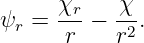
Differentiate with respect to r:
Multiply by r2:
Differentiate again:
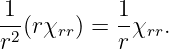
Thus the left side becomes
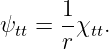
Because r is independent of time,
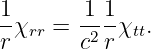
Therefore,
For r > 0, multiply by r:
So the transformed quantity χ = rψ obeys the ordinary 1D wave equation in the radial
coordinate.
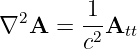
Solution 12: vector wave equation component by component
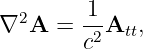
The vector equation
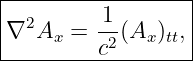
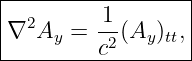
means that each Cartesian component obeys its own scalar wave equation:
and
For
only the y component is nonzero:
Its spatial Laplacian is
while
Thus the component equation requires
or
The x and z component equations are satisfied trivially because those components are
zero.
Solution 13: identify which functions satisfy the 1D wave equation
For
we have angular frequency ω = ck, so the required relation is satisfied. Therefore,
For
we have ω = 2ck. Then
but
These are not equal, so
For
the chain rule gives
and
Therefore,
For
we find
and
Thus
This last result is a useful reminder: not every solution of the wave equation must look sinusoidal
or like a localized traveling pulse.
Solution 14: synthesis - geometry, phase, wavelength, and frequency
The wave vector is
Its magnitude is
Thus
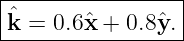
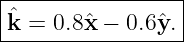
The unit propagation direction is
Therefore,
The wavelength is
Thus
The angular frequency follows from ω = ck:
Hence
The ordinary frequency is
Therefore,
At
we have
At
Therefore the phase is
| 𝜃 | = k ⋅ r − ωt + ϕ0 | (168)
|
| = −2 − 3 +  | (169)
|
| ≈−4.215 rad. | (170) |
Thus
Adding any integer multiple of 2π gives an equivalent phase representation.
Common mistakes
- Confusing the vector k with its magnitude k = |k|.
- Forgetting one or more Cartesian second derivatives when computing ∇2ψ.
- Treating ∇2 as an ordinary algebraic square rather than a differential operator.
- Using ω = ck without checking that the governing wave equation is nondispersive with
speed c.
- Forgetting that 1∕r is singular at r = 0 when evaluating its Laplacian.
- Forgetting the 1∕r amplitude factor in the usual outgoing spherical-wave solution.
- Assuming every solution of the wave equation must be sinusoidal.
What EM04E reinforces
The central operator is
with
The scalar 3D wave equation is
For a plane wave,
leads directly to
For spherical waves,
introduces the geometric spreading that later becomes central to radio link budgets and the Friis
equation.
The next main lesson, EM05, introduces Electric Charge and the electric field.
References
[1] H. M. Schey, Div, Grad, Curl, and All That, 4th ed., W. W. Norton & Company,
2005.
[2] David J. Griffiths, Introduction to Electrodynamics, 4th ed., Cambridge University
Press, 2017.
[3] Walter A. Strauss, Partial Differential Equations: An Introduction, 2nd ed., Wiley,
2007.
[4] Gilbert Strang and Edwin “Jed” Herman, Calculus, Volume 3, OpenStax, 2016,
chapters on vector calculus and second-order differential operators.
[5] Samuel J. Ling, Jeff Sanny, and William Moebs, University Physics, Volume 2,
OpenStax, 2016, chapters on electromagnetic waves.
[6] Frank S. Crawford, Jr., Waves, Berkeley Physics Course, Volume 3, McGraw-Hill,
1968.
[7] Massachusetts Institute of Technology, 8.03SC Physics III: Vibrations and Waves,
MIT OpenCourseWare, materials on wave equations and traveling waves.

![[parent]](https://images.physicslibrary.org/images/uparrow.png)