Houstoun in [1] in 1929 estimates the age of the Earth using heat conduction and Earth
temperature. Let’s see how close the estimate comes to current day estimate of 4.54 ± 0.05109 years
[2].
The general formula for linear flow in a semi-infinite solid is
For this problem let f(ξ) be constant and equal to c, f(ξ) = c.
Then
sub in β = ξ − x
since e− is an even function of β. Write α2 = β2∕(4κt); then the result takes the simpler
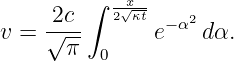
form
is an even function of β. Write α2 = β2∕(4κt); then the result takes the simpler
form
Tables of values of this integral have been drawn up, and hence v can be determined as a function
of the upper limit.
If we descend into the earth we find that after we pass the points where the diurnal and annual
variation cease to be appreciable, the temperature begins to increase. The rate of increase varies
from place to place, but may be taken roughly as 1∘F for every 50 feet of descent for depths up to
about 1 mile. This increase of temperature is easily explained on the assumption that
the center of the earth is at a high temperature and that heat is flowing outwards.
If we assume that the earth was originally at a uniform temperature c and that its
surface has been always at a constant temperature zero, we can use the above result
to find how long it has taken to cool. We neglect the convexity of the earth’s surface.
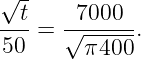
We find from (3) that
Kelvin found by the method indicated in paragraph 81 (need to reference new entry) that κ for the
material of the earth’s surface has the value 400, the units of length and time being the foot and
year. Assume that the earth was initially at the temperature of molten rock, i.e. about 7000∘F.
Insert the value for the gradient at the surface, namely,  = 1∘F for every 50 feet. Then, writing
x = 0 in the exponential, we obtain
= 1∘F for every 50 feet. Then, writing
x = 0 in the exponential, we obtain
i.e.
If we write x = 100 miles,
At that depth the gradient is only  of its surface value after 108 years. We see, therefore, from
the first result, that according to our assumptions 108 years have elapsed since the earth was at a
temperature of 7000∘F, and we see from the second result that it is permissible to neglect the
convexity of the earth’s surface. The assumption throughout all the temperature change of
constant conductivity, specific heat and density is, of course, open to questions. Also, the earth
may have taken much longer to cool, owing to the liberation of heat due to the radioactive
disintegration of some of its material.
of its surface value after 108 years. We see, therefore, from
the first result, that according to our assumptions 108 years have elapsed since the earth was at a
temperature of 7000∘F, and we see from the second result that it is permissible to neglect the
convexity of the earth’s surface. The assumption throughout all the temperature change of
constant conductivity, specific heat and density is, of course, open to questions. Also, the earth
may have taken much longer to cool, owing to the liberation of heat due to the radioactive
disintegration of some of its material.
So 108 vs 4.54 × 10⁹ is not such a bad estimate.
This article is a derivative work of the public domain in [1].
References
[1] Houstoun, R.A., ”An Introduction to Mathematical Physics” Longmans, Green and
CO., London, 1929.
[2] Wikipedia contributors, ”Age of Earth,” Wikipedia, The Free Encyclopedia (accessed
February 20, 2025).

![[∫ ∞ 2 ∫ ∞ 2 ]
v = -√-c--- f(ξ)e− (ξ−4κxt)-dξ − f(ξ)e− (ξ+4xκ)t-dξ
2 π κt 0 0](https://images.physicslibrary.org/cache/objects/936/make4ht/AgeOfTheEarthUsingHeatConduction0x.png)
![[ ∫ ∞ (ξ−x)2 ∫ ∞ (ξ+x)2 ]
v = -√-c--- e− -4κt--dξ − e− -4κt--dξ
2 π κt 0 0](https://images.physicslibrary.org/cache/objects/936/make4ht/AgeOfTheEarthUsingHeatConduction1x.png)
![[ ∫ ∞ 2 ∫ ∞ 2 ] ∫ ∞ 2
v = --√c--- e− β4κt d β − e− β4κt d β = √--c-- e− β4κt dβ,
2 π κt −x +x π κt 0](https://images.physicslibrary.org/cache/objects/936/make4ht/AgeOfTheEarthUsingHeatConduction2x.png)