Let us multiply the equation of motion of the kth particle scalarly with  , and sum over all the
particles. Then
, and sum over all the
particles. Then
Integrating between the times t0 and t:
The left member represents the total change in kinetic energy of the system, the right member
gives the work done by the internal and external forces. But it is by no means the case that the
work done by the internal forces cancels out in calculating the energy, as one might expect it to do.
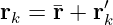
The kinetic energy may be divided into two parts, each of which has a physical meaning. If we
introduce a second coordinate system, whose origin O′ is at the center of gravity of
the system, and if we denote all radius vectors referred to this system by primes, we
have
Then, identically,
The second sum on the right vanishes, however, since ∑
mkrk∕M is, by equation (3), the radius
vector of the center of gravity, and this, by hypothesis, is zero in the primed coordinates. The first
term on the right represents the kinetic energy of the system, considering the entire mass to be
concentrated at the center of gravity. The last term gives the kinetic energy of motion of
the system referred to the center of gravity, when considered at rest. Thus, we may
say:
The total kinetic energy is equal to the translational kinetic energy of the entire mass,
considered concentrated at the center of gravity, plus the energy of motion of the
parts of the system relative to the center of gravity.
We further assume that the internal forces are such that they are derivable from a potential. The
potential of the force operating between the points j and k is a function of the distance between
the two points, and therefore of their coordinates:
The force acting on k is obtained by taking j to be fixed, and considering k to move in the
potential field given by the point function Ujk; i.e. we consider the coordinates of j to be fixed,
those of k to be variable. Then
in like manner,
The work done in causing small displacements of j and k is
The negative of the sum of Fjkdrk and Fkjdrj is therefore obtained by forming the total differential
of Ujk, defined as a funtion of the six coordinates of the two points, in (11). If, then, we
wish to introduce the internal potential into the right member of equation (9), we must
write
It is readily seen that the factor 1∕2 enters: If we start with point 1, and calculate the mutual
energy Ujk between this and all the other points, k runs from 2 to N; but when we take point 2,
we must start counting with 3, since the mutual effect of points 1 and 2 was already taken into
account in dealing with point 1, and so on. Thus, in extending the summation over all
combinations j and k, we must divide by two.
If the external forces have also a potential, the energy equation (9) becomes
where T denotes the kinetic energy. The sum of the kinetic energy and of the external and
internal potential energy of a system is constant, if the external as well as the internal
forces are conservative.
0.1 References
[1] Joos, Georg. ”Theoretical physics” 3rd Edition, Hafner Publishing Company; New York,
1954.
This entry is a derivative of the Public domain work [1].