|
|
|
|||||||
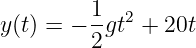
Integrate again to get equation for position of the stone
 Once, again plug in the initial condition that at t = 0, y = 0 to get C2
 therefore
Next we know that at the stone’s highest point h its velocity will be 0. So from equation (1) we can then find the time th at this point

 Now we can plug this result into equation (2) to get the height
 Therefore
![h = 20[m ]](https://images.physicslibrary.org/cache/objects/510/make4ht/ConstantAccelerationProblems10x.png) Ans b) This is straight forward since equation 2 gives us the position of the first stone at some given time. So at t = 2
![1 2
y (2) = − -g(2) + 20(2) = 40 − 20 = 20 [m ]
2](https://images.physicslibrary.org/cache/objects/510/make4ht/ConstantAccelerationProblems11x.png) which, makes sense from question a. Ans c) The stones will hit when first stone is 3 seconds into its flight. Its height is then determined from equation 2
![1- 2
y = − 2(10)(3) + 20(3) = − 45 + 60 = 15[m ]](https://images.physicslibrary.org/cache/objects/510/make4ht/ConstantAccelerationProblems12x.png) If we now look back to see how we got the constant in equation (1), we see that C1 is equal to the initial velocity v0
 Integrate to get position
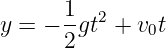 We want to find v0 at 1 second into the second stone’s flight which we know occurs at 15 [m]. So set y = 15 and solve for v0 at t = 1

 So we see that the initial velocity needed for second stone is
![v0 = 20 [m ∕s]](https://images.physicslibrary.org/cache/objects/510/make4ht/ConstantAccelerationProblems17x.png) There is another way of finding the speed without making any calculations. At t = 3, the first stone is at the same height as it was at t = 1 sec. Since the stones have to collide at this height exactly 1 sec after the second stone is thrown, the second stone should also begin with a speed of 20 m/sec. References This is a derivative work from [1] a Creative Commons Attribution-Noncommercial-Share Alike 3.0 work. [1] MIT OpenCourseWare, 8.01 Physics I: Classical Mechanics, Fall 1999. "constant acceleration problems" is owned by bloftin. This object's parent. Cross-references: Classical Mechanics, work, position, velocity, force, drag, speed There is 1 reference to this object. This is version 3 of constant acceleration problems, born on 2009-02-11, modified 2009-02-11. Object id is 510, canonical name is ConstantAccelerationProblems. Accessed 2058 times total. Classification:
|
|
|
|
Pending Errata and AddendaNone.
|
DiscussionNo messages.
|
Interact |
![[parent]](https://images.physicslibrary.org/images/uparrow.png)