category of automata(Topic)
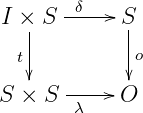
Definition 0.1. A classical automaton 𝒜, (or simply automaton, or sequential machine, is
defined as a quintuple of sets, I,O and S, and set-theoretical mappings,
with δ being called the transition function and λ being called the output function.
Definition 0.2. A categorical automaton 𝒜C or discrete and finite/countable, categorical
dynamic system is defined by a commutative square diagram containing all of the above
components and assuming that SA is either a countable or finite set of discrete states:
With the above definition one can now define morphisms between automata and their composition.
If the automata are defined by square diagrams such as the one shown above, and diagrams are
defined by their associated functors, then automata homomorphisms are in fact defined as natural
transformations between diagram functors. One also has a consistent, simpler definition as
follows.
Definition 0.3. A homomorphism of automata is a morphism of automata quintuples that
preserves commutativity of the set-theoretical mapping compositions of both the transition
function δ and the output function λ.
With the above two definitions now we have sufficient data to define the category of automata and
automaton homomorphisms.
Definition 0.4. The category of automata is a category of automata quintuples
(IX,OX,X,δX : IX × X → X; λX : X × X → O) and automata homomorphisms
h : 𝒜i →𝒜j, such that these homomorphisms commute with both the transition and the
output functions of any automata 𝒜i and 𝒜j.
Remarks:
-
1.
- Automata homomorphisms can be considered also as automata transformations or as
semigroup homomorphisms, when the state space, X, of the automaton is defined as
a semigroup 𝒮.
-
2.
- Abstract automata have numerous realizations in the real world as : machines,
robots, devices, computers, supercomputers, always considered as discrete state space
sequential machines.
-
3.
- Fuzzy or analog devices are not included as standard automata.
-
4.
- Similarly, variable (transition function) automata are not included, but Universal
Turing (UT) machines are.
Definition 0.5. An alternative definition of an automaton is also in use: as a five-tuple
(S, Σ,δ,I,F), where Σ is a non-empty set of symbols α such that one can define a
configuration of the automaton as a couple (s,α) of a state s ∈ S and a symbol α ∈ Σ.
Then δ defines a “next-state relation, or a transition relation” which associates to each
configuration (s,α) a subset δ(s,α) of S- the state space of the automaton. With this
formal automaton definition, the category of abstract automata can be defined by specifying
automata homomorphisms in terms of the morphisms between five-tuples representing such
abstract automata.
Example 0.1. A special case of automaton is when all its transitions are reversible; then
its state space is a groupoid. The category of reversible automata is then a 2-category, and
also a subcategory of the 2-category of groupoids, or the groupoid category.
0.1 Remarks:
Other definitions of automata, sequential machines, semigroup automata or cellular automata lead
to subcategories of the category of automata defined above. On the other hand, the
category of quantum automata is not a subcategory of the automata category defined
here.
"category of automata" is owned by bci1.(view preamble)
See Also: category of quantum automata, computer, supercomputer, automaton, categories of quantum automata and quantum computers, supercomputers
| Other names: |
Universal Turing (UT) machines, UTs |
| Also defines: |
automaton, sequential machine, categorical automaton, automata homomorphism, automaton configuration, sequential machine, fuzzy automaton, computer simulations, Universal Turing (UT) machines, UT, abstract automata theory (AAT), AAT, abstract computer programming theory (ACPT), automaton square diagram, automata homomorphism as natural transformation |
| Keywords: |
categories of automata and their transformations, algebraic theories, structure and semantics, universal Turing machines, variable automata, fuzzy automata, semigroups, semigroup homomorphisms, automata homomorphisms, Cartesian closed category |
Cross-references: category of quantum automata, groupoid category, 2-category, groupoid, category, supercomputers, computers, robots, state space, commute, commutativity, natural transformations, functors, diagrams, square diagrams, composition, commutative square diagram, dynamic system, output function, transition function
There are 18 references to this object.
This is version 33 of category of automata, born on 2009-01-25, modified 2010-06-09.
Object id is 430, canonical name is CategoryOfAutomata.
Accessed 13356 times total.
Classification:
|