Time dilation is the difference in time intervals between inertial frames of reference moving with
respect to each other. This is usually studied in Physics, but here is the mathematics behind it.
Consider a train moving with speedu and an observer standing still. Let the station (where
observer is standing) be inertial frame of reference S, and train be inertial frame of reference S′. A
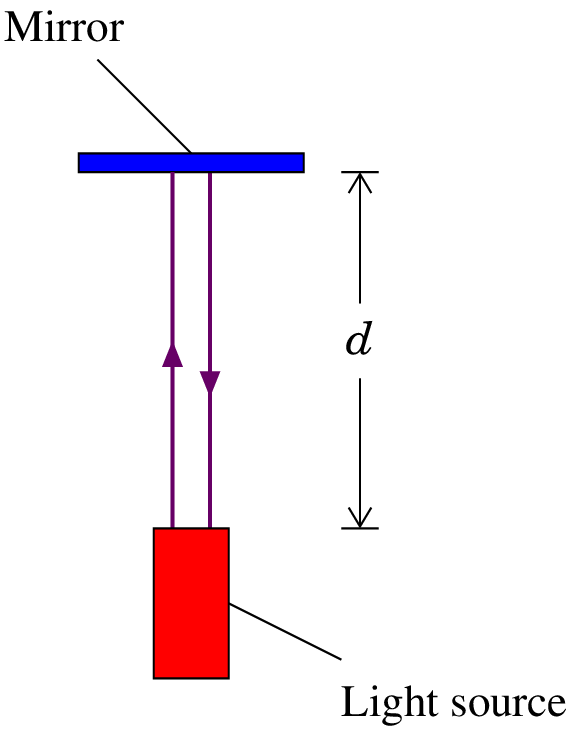
Light source and a mirror are placed vertically above each other in the train as shown.
Figure 1:Path of light according to a person in the train
Let Δt0 denote the time taken for light to travel from the source back to the source according to a
person on the train. In other words, in frame of reference S′ the time taken for light to travel is
given by:
where c is the speed of light. The round-trip time measured by the observer in frame S is a
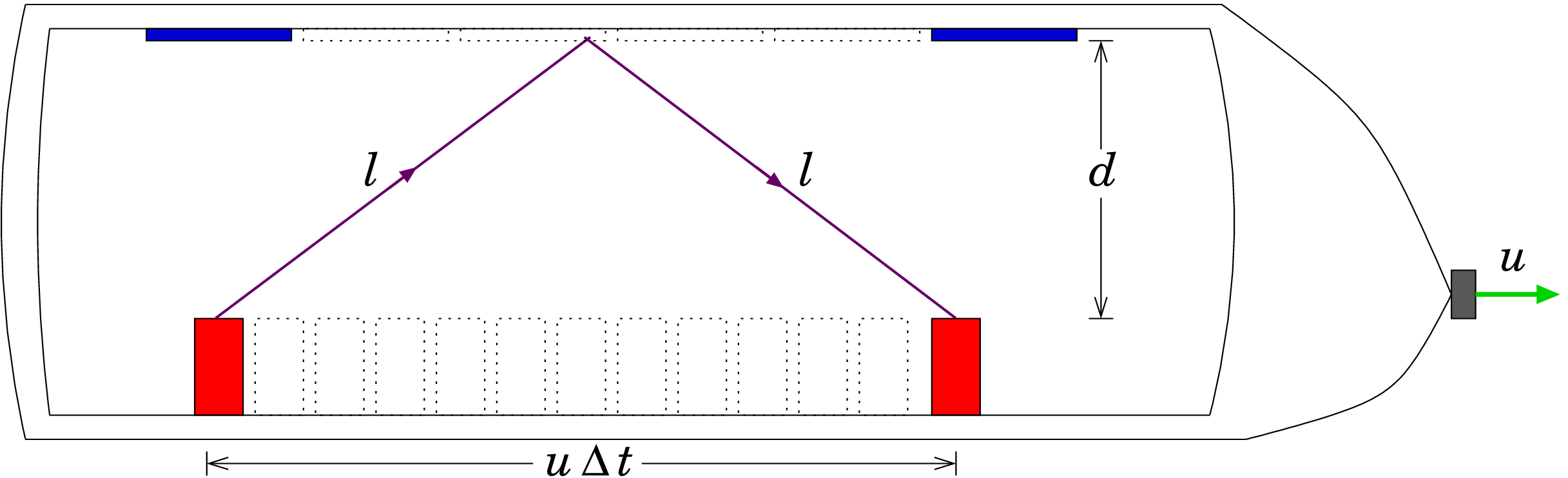
different interval Δt. This is what he would observe:
Figure 2:Path of light according to observer
To the observer, the events of light leaving the source and coming back occur at different
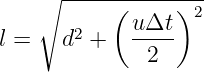
points in space. The distance travelled by light in this case is 2l, and by the Pythagorean
theorem:
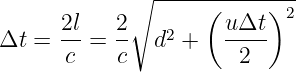
Now the time for light to travel, according to observer, is:
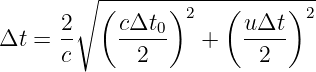
But we know from the equation above that Δt0 = 2d∕c, and by rearranging, d = cΔt0∕2. Now we
substitute to get:
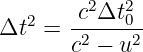
Now lets rearrange and solve for Δt:
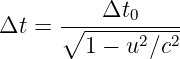
Dividing the numerator and denominator by c2 and taking the square root yields:
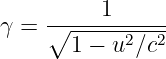
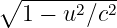
Since the expression 1∕ occurs quite frequently in relativity, sometimes it is preferable
to use the letter γ to represent it. Therefore:
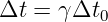
The equation for time dilation can then be written this way:
History and Uses
This is a very famous result in relativity, and in fact it was the basis for the evolvement of
relativistic mechanics, in which Albert Einstein defiantly challenged Newton’s equations for objects
with very high speeds. From this, mechanics was classified into two branches: Newtonian mechanics
and Relativistic mechanics. It was also the basis of Einstein’s theory of relativity E = mc2, and
many other equations in relativity. The time dilation equation can be used to calculate the
difference in time intervals between two inertial frames moving with respect to each
other.




 occurs quite frequently in relativity, sometimes it is preferable
to use the letter
occurs quite frequently in relativity, sometimes it is preferable
to use the letter