
|
|
|
|||||||
For z > 0 differentiate:
The derivative changes from positive to negative at z = a∕ Check. The field vanishes at the center and tends to the radial point-charge field for |z|≫ a. The exact numerator changes sign when z does.
3 Practice variationHow does the slope at the center change when the radius doubles and Q is fixed? Solution. For small z, Ez ≃ (keQ∕a3)z. Doubling a reduces the slope by a factor of eight.
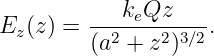
4 Build the axial field from source coordinatesWrite r′ = a(cos ϕ, sin ϕ, 0), r = (0, 0,z) and dq = (Q∕2π)dϕ. The axial field is the component of E parallel to the symmetry axis. With R = (−a cos ϕ,−a sin ϕ,z) the denominator R3 = (a2 + z2)3∕2 is constant. The cosine and sine integrals vanish over 0 ≤ ϕ ≤ 2π and the integral of z gives 2πz. This recovers the signed axial field. Its derivative follows by differentiating z(a2 + z2)−3∕2 as a product:
At z = a∕
5 Worked example 2: use the potential as a second methodThe axial potential is V (z) = keQ(a2 + z2)−1∕2, since every source contributes at the same distance. The chain rule gives −dV∕dz = keQz(a2 + z2)−3∕2. At |z|≫ a, factor out |z|3 from the field denominator. Multiplying by (1 + a2∕z2)−3∕2 gives the relative correction −3a2∕(2z2) + O(a4∕z4) to the signed point-charge field.
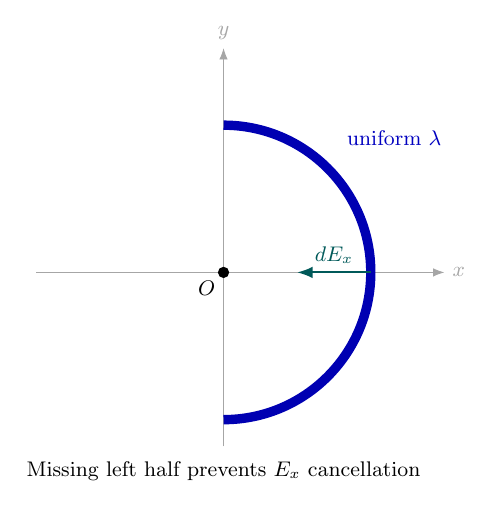
Figure 2. Removing half the ring eliminates left-right symmetry. A transverse field survives even at the original ring center.
6 Worked example 3: a uniformly charged semicircular arcRemove the left half of the ring and keep a uniform right semicircle with line density λ > 0, occupying −π∕2 ≤ ϕ ≤ π∕2. At the observation point (0, 0,z),
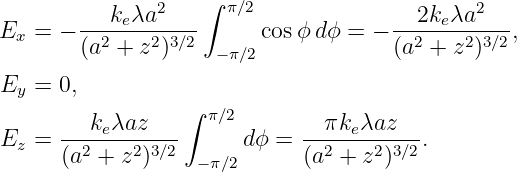
All elements still have the same denominator R3 = (a2 + z2)3∕2, but the transverse cancellations are incomplete. Integrating the three components gives
At z = 0, the vertical component vanishes, but Ex = −2keλ∕a remains. Therefore the field on the symmetry axis of a semicircle is generally not axial. The cancellation pattern must be inferred from the actual occupied arc rather than from the circle it could complete.
7 Worked example 4: classify the center equilibrium of a charged ringFor a uniformly positively charged ring, the field on the axis obeys
Near the center, expand the denominator:
A positive test charge on the axis is pushed away from z = 0, making the center axially unstable. A negative test charge experiences restoring axial force, but the ring does not provide three-dimensional stable electrostatic trapping. The local axial conclusion must not be confused with overall three-dimensional stability, which is constrained by Earnshaw’s theorem.
8 Worked example 5: two coaxial ringsPlace two identical rings at z = ±b, each of radius a and charge Q > 0. Their individual axial fields superpose:
At z = 0, the two terms cancel, because the geometry is symmetric about the origin. At large |z|, the total charge is 2Q, so the leading field behaves as 2keQ sgn(z)∕z2. The zero at z = 0 does not imply the field is zero nearby. For sources with opposite charges, the symmetry changes and the axial center field generally does not vanish.
9 ExercisesExercise 1. Find the field at z = a as a fraction of the positive-side maximum. Solution.
It is (1∕(2 Exercise 2. The ring radius doubles at fixed Q. What happens to the location and magnitude of each maximum? Solution.
The maximizing distance a∕
10 Further exercises and complete solutions
References
References
"Example of Electric Field on the Axis of a Charged Ring" is owned by bloftin.
This object's parent. Cross-references: vector field, theorem, force, test charge, observation point, transverse field, magnitude, charge This is version 1 of Example of Electric Field on the Axis of a Charged Ring, born on 2026-11-27. Object id is 1614, canonical name is ExampleOfElectricFieldOnTheAxisOfAChargedRing. Accessed 14 times total. Classification:
|
|
|
|
Pending Errata and AddendaNone.
|
DiscussionNo messages.
|
Interact |

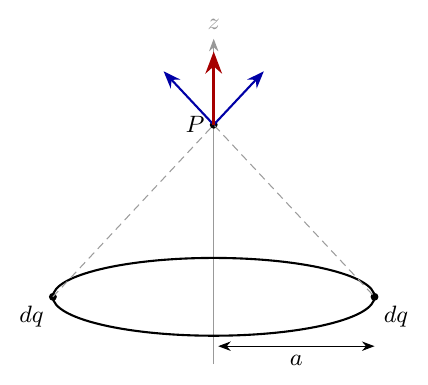
 with its sign.
 . Opposite elements cancel the transverse components, and
each axial contribution is
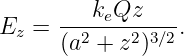
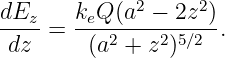
 . Odd symmetry gives the other
maximum of the magnitude at
 . The magnitude there is 2


 , the factor (
 by this yields 2




 ))
 )) = 3

 )
 doubles, while the peak field proportional to

 because
potentials add without cancellation.