|
|
|
|||||||
with
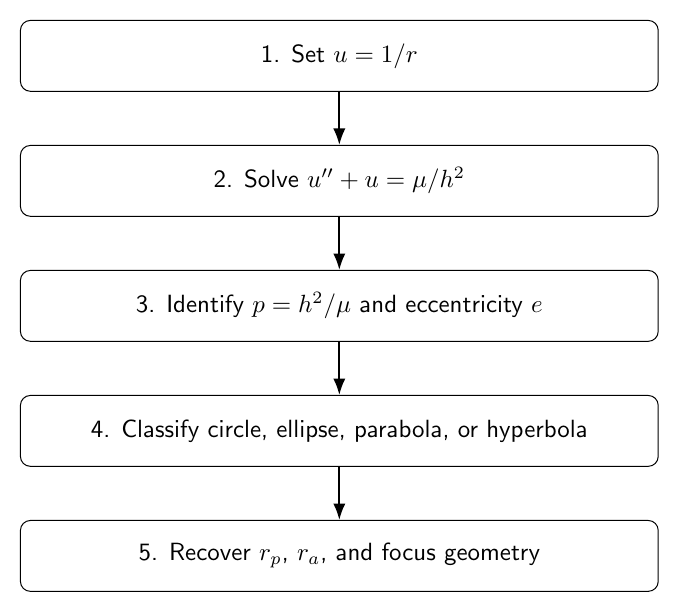
Figure 1. A compact orbit-equation strategy: use u = 1∕r, solve Binet’s equation, identify p and e, then classify the conic and recover apsidal radii.
1 High-value GRE facts
Part I: Original GRE-style problems
Problem 1: reciprocal radiusBinet’s substitution defines
Problem 2: Newtonian Binet equationFor inverse-square gravity, the orbit equation for u(𝜃) is
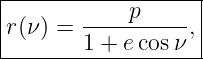
Problem 3: semilatus rectumFor a gravitational conic,
equals
Problem 4: ellipse conditionA bound noncircular ellipse has eccentricity
Problem 5: parabolic conditionThe escape-threshold conic has
Problem 6: periapsis radiusFor
the periapsis radius is
Problem 7: ellipse eccentricity from apsidesFor an ellipse,
equals
Problem 8: semilatus rectum of ellipseFor an ellipse,
equals
Problem 9: energy and eccentricityThe correct energy-eccentricity relation is
Problem 10: focus locationIn a Keplerian ellipse, the attracting body lies
Problem 11: hyperbolic asymptoteFor a hyperbolic orbit, the asymptotic true anomaly satisfies
Problem 12: first lawKepler’s first law for ideal Newtonian bound two-body motion states that the orbit is
Part II: Complete worked solutions
Solution 1Binet’s substitution is
Answer: (C).
Solution 2Inverse-square gravity makes the right-hand side constant:
Answer: (A).
Solution 3Comparing the conic solution with Binet’s solution gives
Answer: (C).
Solution 4A noncircular bound ellipse has
Answer: (C).
Solution 5The parabolic escape threshold is
Answer: (C).
Solution 6Periapsis occurs at
so
Answer: (B).
Solution 7Using
gives
Answer: (B).
Solution 8For an ellipse,
Answer: (C).
Solution 9Substitution into the energy equation yields
Answer: (A).
Solution 10The polar origin of the Keplerian conic is the occupied focus, not the ellipse center. Answer: (B).
Solution 11The hyperbolic radius diverges when
so
Answer: (C).
Solution 12Negative-energy inverse-square gravitational motion is elliptic, with the attracting body at a focus. Answer: (B).
2 GRE checklist
References
References
"GRE Physics Companion: Orbit Equation, Conic Sections, and Kepler's First Law" is owned by bloftin.
This object's parent. Cross-references: energy, Kepler's first law, true anomaly, hyperbolic orbit, position, relation, Binet's equation, orbit equation This is version 1 of GRE Physics Companion: Orbit Equation, Conic Sections, and Kepler's First Law, born on 2026-10-31. Object id is 1564, canonical name is GREPhysicsCompanionOrbitEquationConicSectionsAndKeplersFirstLaw. Accessed 4 times total. Classification:
|
|
|
|
Pending Errata and AddendaNone.
|
DiscussionNo messages.
|
Interact |