Orbit Equation, Conic Sections, and Kepler’s First Law
M07-05 classified gravitational motion using orbital energy.
M07-06 introduced the effective potential and radial turning points.
M07-07 showed that angular momentum conservation gives constant areal velocity.
We now derive the actual shape of the orbit in the orbital plane.
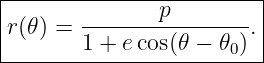
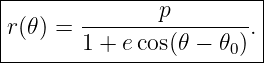
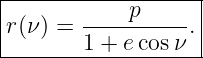
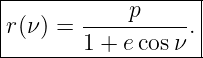
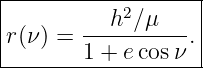
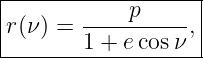
For Newtonian inverse-square gravity, the result is
This is the polar equation of a conic section with the attracting body at a focus.
The parameters are:
- p, the semilatus rectum,
- e, the eccentricity,
- 𝜃0, the direction of periapsis.
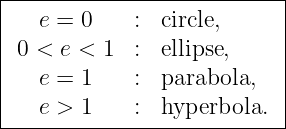
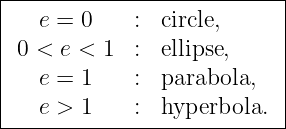
The value of
determines the orbit type:
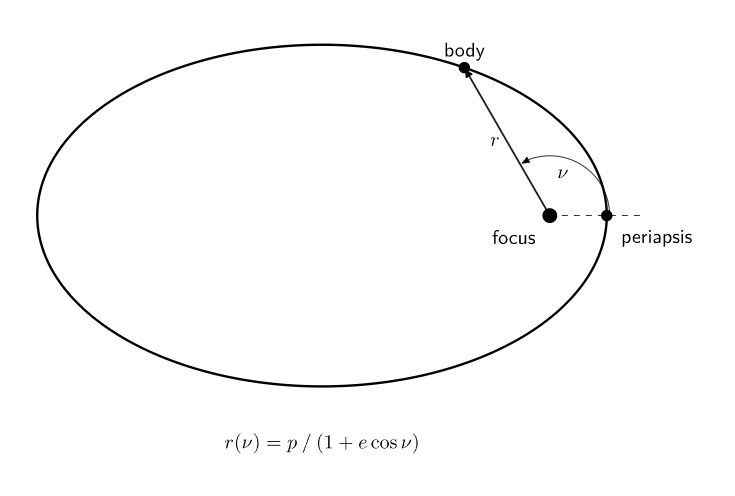
Figure 1. Orbital geometry in the plane. The polar angle is measured from the periapsis direction,
and the attracting body lies at the focus of the conic.
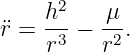
1 Start from the radial equation
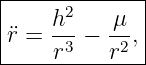
M07-06 gave the radial equation for Newtonian central gravity:
where
in the fixed-central-body approximation and
is the conserved specific angular momentum.
Our goal is not
Instead, we seek
the geometric orbit.
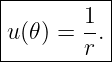
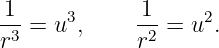
2 Reciprocal-radius substitution
Introduce
Then
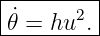
Since
we have
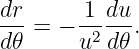
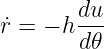
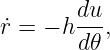
Use the chain rule:
Because
Therefore
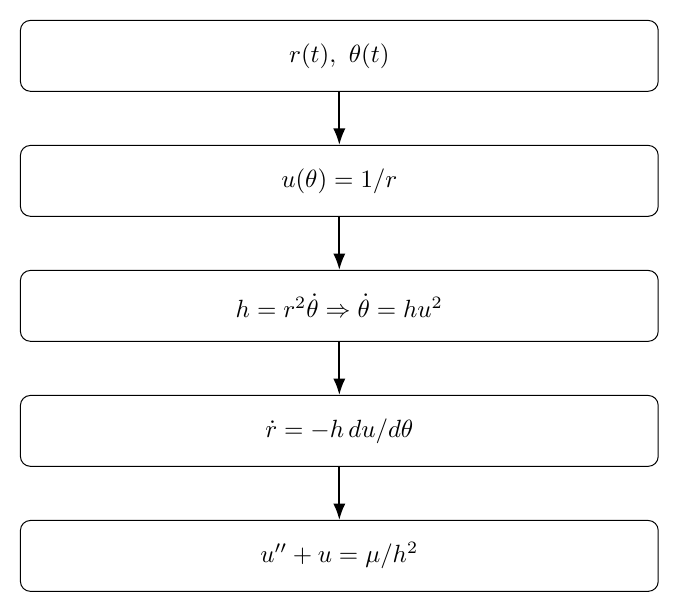
Figure 2. Binet’s substitution replaces the radial coordinate r by the reciprocal radius u = 1∕r and
uses angular momentum to exchange time derivatives for derivatives with respect to orbital angle.
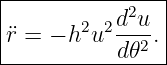
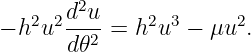
3 Second radial derivative
Differentiate
with respect to time.
Since
is constant,
Using
we obtain
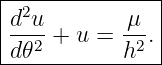
4 Substitute into Newton’s radial equation
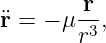
The radial equation is
Since
Therefore
For
divide by
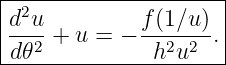
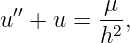
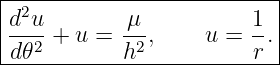
This is the Binet equation specialized to Newtonian inverse-square gravity.
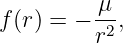
5 General Binet equation
For a general central radial acceleration
defined by
the corresponding orbit equation can be written
For Newtonian gravity,
so
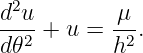
which gives the constant right-hand side
This special simplification is what makes inverse-square gravity produce conic sections.
6 Solve the orbit differential equation
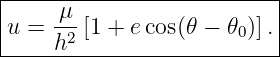
We must solve
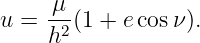
A particular solution is
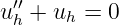
The homogeneous equation
has solution
Therefore
The two sinusoidal constants can be combined into one amplitude and one phase:
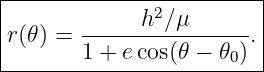
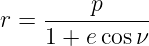
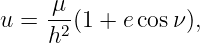
7 The gravitational orbit equation
Since
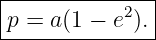
Define the semilatus rectum
Then
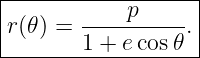
Choose the angular origin at periapsis:
Then the standard form is
8 Semilatus rectum and angular momentum
The conic parameter
has a direct dynamical interpretation:
Thus angular momentum sets the orbital length scale.
For fixed
larger
means larger
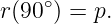
For a circle,
and
Therefore
reduces to the circular radius found in M07-06.
9 True anomaly
The angle measured from periapsis is conventionally called the true anomaly.
Denote it by
Then
In the planar derivation above,
Using
makes the orbit equation independent of the arbitrary orientation of the coordinate
axes.
10 Conic-section classification
The polar equation
is the focus-centered equation of a conic section.
The eccentricity determines the type:
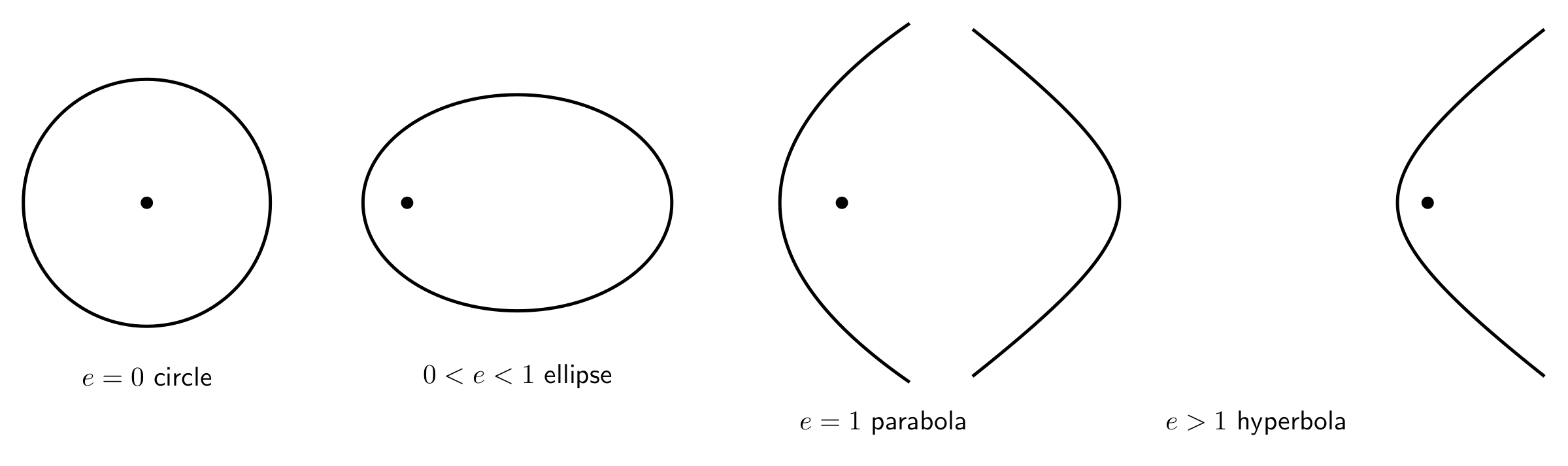
Figure 3. The same orbit equation produces the conic family. Eccentricity e controls the transition
from circle to ellipse, parabola, and hyperbola.
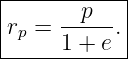
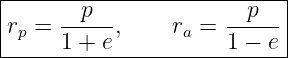
11 Periapsis radius
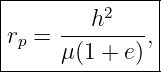
At periapsis,
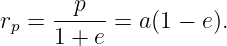
Since
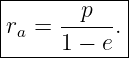
This formula applies to ellipse, parabola, and hyperbola.
12 Apoapsis radius for an ellipse
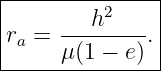
For an ellipse,
Apoapsis occurs at
Since
The finite apoapsis exists because
For
there is no finite apoapsis.
13 Ellipse geometry
For an ellipse with semimajor axis
and eccentricity
the focal distance is
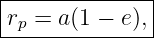
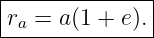
The periapsis and apoapsis radii measured from the occupied focus are
and
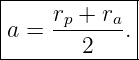
Therefore
Also,
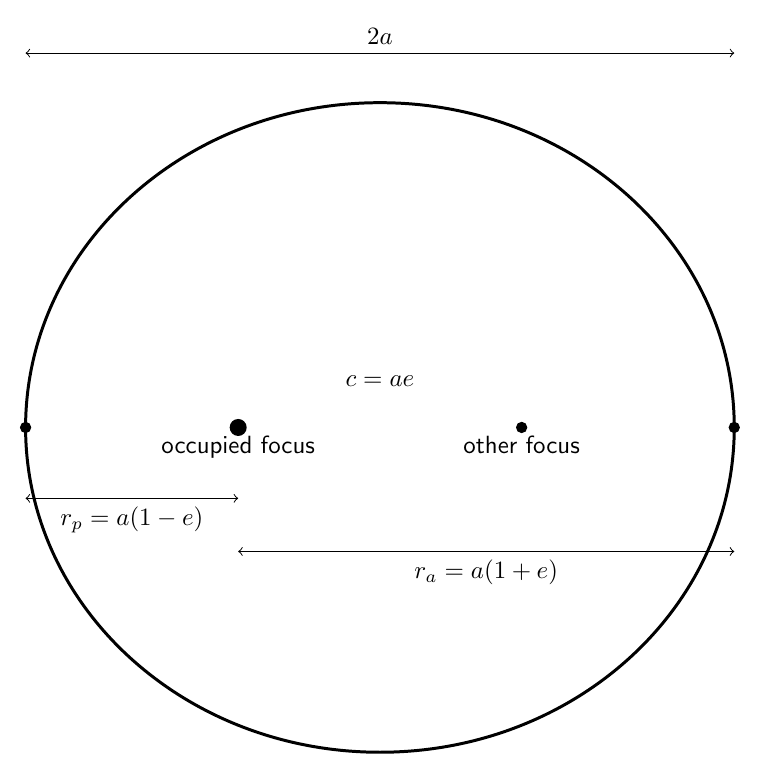
Figure 4. Ellipse geometry with the attracting body at one focus. The periapsis and apoapsis radii
are a(1 − e) and a(1 + e).
14 Semilatus rectum of an ellipse
Use
Multiply by
Thus
Since the semiminor axis satisfies
we also have
15 Kepler’s first law
For a gravitationally bound orbit,
We will shortly show that this implies
Therefore every noncollision bound Newtonian two-body orbit is an ellipse, with the circle as
the
special case.
This is Kepler’s first law:
For planetary motion in the two-body approximation, the Sun occupies one focus of the planetary
ellipse.
16 Connect eccentricity to energy
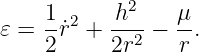
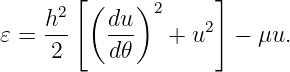
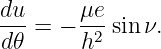
M07-06 gave the radial energy equation
Using
and
we obtain
For
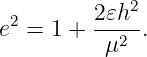
Substitution and simplification give
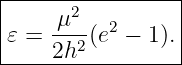
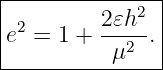
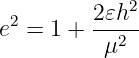
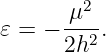
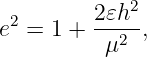
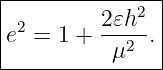
Therefore
17 Energy and conic type
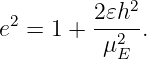
The relation
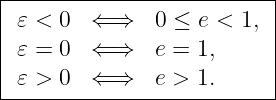
connects M07-05’s energy classification directly to the conic geometry.
For
- 𝜀 < 0 gives e < 1: ellipse.
- 𝜀 = 0 gives e = 1: parabola.
- 𝜀 > 0 gives e > 1: hyperbola.
Thus
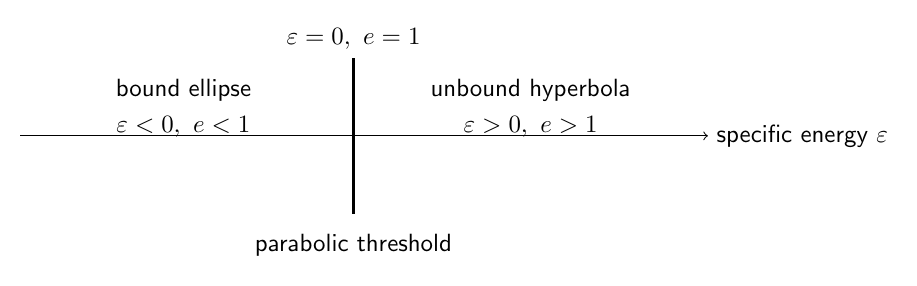
Figure 5. Orbital energy and eccentricity describe the same bound-unbound transition. Negative
energy corresponds to ellipses, zero energy to the parabola, and positive energy to hyperbolas.
18 Circular orbit as the minimum-eccentricity case
For
the orbit equation becomes
Thus the radius is constant.
The energy relation becomes
This is exactly the minimum effective-potential energy from M07-06.
Therefore the circular orbit is the
limit of the ellipse family and the minimum-energy orbit at fixed
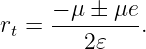
19 Turning radii from the conic equation
For an ellipse,
Using
and
These are the same two positive radial turning points obtained from the effective-potential
quadratic in M07-06.
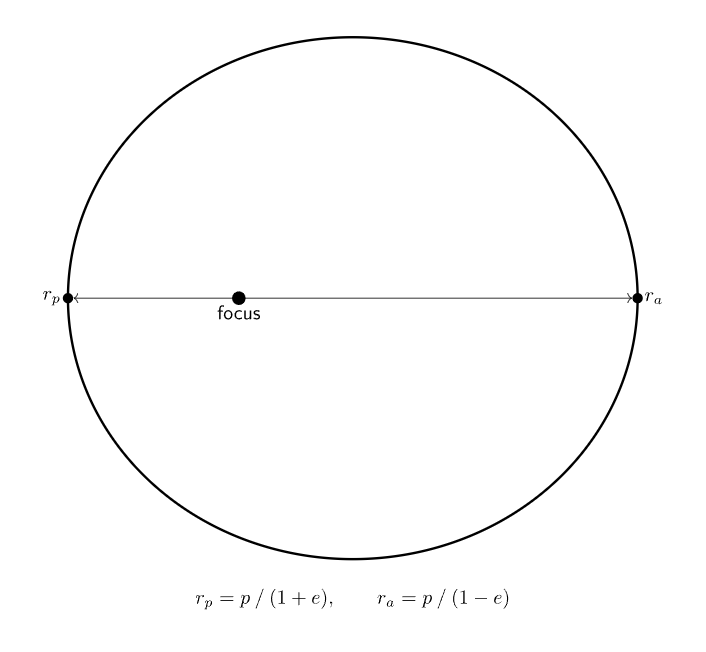
Figure 6. The ellipse reaches its minimum radius at true anomaly ν = 0 and maximum radius at
ν = π. These are the periapsis and apoapsis turning radii.
20 Recover the effective-potential roots
M07-06 gave the turning-point equation
Using
the square root in the quadratic solution becomes
Therefore
After using the energy-eccentricity relation, these roots reduce to
for
Thus the geometric orbit equation and the radial-energy method are completely consistent.
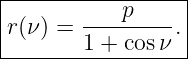
21 Parabolic orbit
For
The periapsis radius is
As
the denominator approaches zero and
This is the zero-energy escape trajectory.
22 Hyperbolic orbit
For
The denominator vanishes at the asymptotic true anomaly
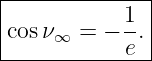
satisfying
Therefore
As the trajectory approaches this angle,
The orbit has one finite periapsis and two asymptotic branches.
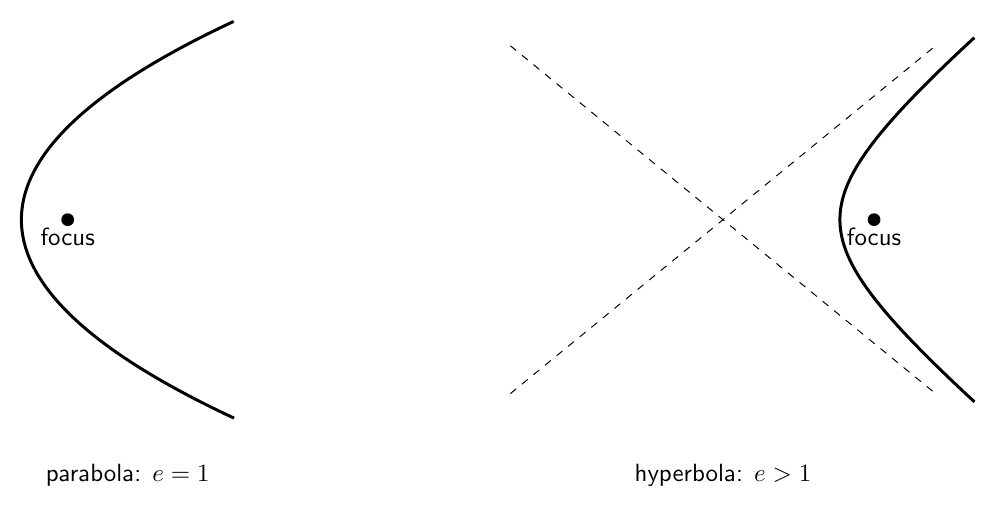
Figure 7. Parabolic and hyperbolic gravitational trajectories are unbounded conics with the
attracting body at a focus. The hyperbola approaches finite asymptote angles determined by
cosν∞ = −1∕e.
23 Hyperbolic excess speed and eccentricity
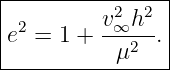
For an unbound orbit,
Insert this into
Then
Thus both asymptotic speed and angular momentum determine the hyperbola’s eccentricity.
24 Example 1: determine an ellipse from turning radii
Suppose
The semimajor axis is
| a | =  | (130)
|
| = 8000 km. | (131) |
The eccentricity is
| e | =  | (132)
|
| = 0.125. | (133) |
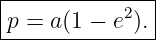
The semilatus rectum is
| p | = a(1 − e2) | (134)
|
| = 7875 km. | (135) |
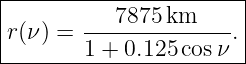
The orbit equation is therefore
25 Example 2: orbital radius at a given true anomaly
For the previous orbit, evaluate the radius at
Since
Therefore
The semilatus rectum is literally the orbital radius at true anomaly
and
for an ellipse.
26 Example 3: continuing the M07-06 Earth orbit
M07-06 used
and found
Therefore
| a | =  | (145)
|
| ≈ 7.9903 × 10⁶ m. | (146) |
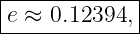
The eccentricity is
| e | =  | (147)
|
| ≈ 0.12394. | (148) |
Using
and
the semilatus rectum is
| p | =  | (151)
|
| ≈ 7.8675 × 10⁶ m. | (152) |
These values satisfy
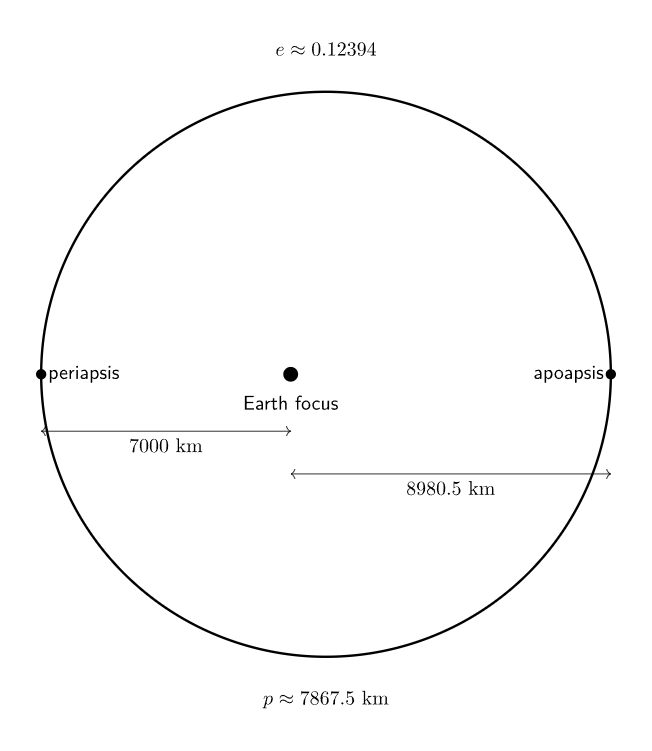
Figure 8. The continuing Earth example is a modest-eccentricity ellipse. The focus is at Earth,
with periapsis near 7000 km and apoapsis near 8980.5 km.
27 Example 3 energy check
The M07-06 specific energy was approximately
Use
Substituting the numerical values gives
in agreement with the eccentricity found from the turning radii.
This provides an independent consistency check between:
- energy,
- angular momentum,
- turning radii,
- conic geometry.
28 Focus versus geometric center
For an ellipse, the attracting body is not generally at the geometric center.
The distance from the ellipse center to either focus is
The two foci lie symmetrically about the ellipse center.
In the gravitational two-body orbit equation, the origin of polar coordinates is placed at the
occupied focus.
This is why the radius
is measured from the attracting body rather than from the ellipse center.
29 Why the inverse-square law matters
The area law followed from any central force.
The conic orbit equation is more specific.
Newtonian gravity gave
whose right-hand side is constant.
That produces a sinusoidal reciprocal radius:
Other central force laws generally produce different differential equations and different orbit
shapes.
Thus:
while
30 Exact two-body interpretation
For two finite masses,
and
the relative coordinate obeys
with
Therefore the exact relative orbit is
The same conic equation applies, but the gravitational parameter contains the sum of the two
masses.
When one mass is much smaller than the other,
31 Relation to the Laplace-Runge-Lenz direction
The phase angle
fixes the orientation of the conic in the orbital plane.
For inverse-square gravity there is an additional conserved vector, the Laplace-Runge-Lenz vector,
that points toward periapsis and encodes both:
- the eccentricity,
- the periapsis direction.
We do not need that vector to derive Kepler’s first law, so it is deferred to a later advanced
article.
32 Common mistakes
- Confusing u = 1∕r with u = r.
- Forgetting to use angular-momentum conservation when converting time derivatives
to angular derivatives.
- Dropping the minus sign in ṙ = −hdu∕d𝜃.
- Writing the Newtonian Binet equation with a nonconstant right-hand side.
- Confusing semilatus rectum p with semimajor axis a.
- Forgetting that p = h2∕μ.
- Treating eccentricity as having units.
- Assuming all conics are bound.
- Forgetting that e = 1 is the parabolic escape threshold.
- Forgetting that e > 1 corresponds to positive orbital energy.
- Placing the attracting body at the geometric center of an ellipse.
- Using ra = p∕(1 − e) for a parabola or hyperbola.
- Confusing true anomaly with an angle measured from the ellipse center.
- Forgetting that the circular orbit is the e = 0 ellipse.
- Assuming Kepler’s first law follows from every central force rather than specifically the
inverse-square law.
33 Practice exercises
- Starting from h = r2𝜃, derive ṙ = −hdu∕d𝜃 for u = 1∕r.
- Derive r = −h2u2d2u∕d𝜃2.
- Derive the Newtonian Binet equation u′′ + u = μ∕h2.
- Solve the Binet equation and obtain the conic orbit equation.
- Show that p = h2∕μ.
- Derive the periapsis radius rp = p∕(1 + e).
- For an ellipse, derive ra = p∕(1 − e).
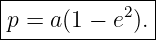
- Show that p = a(1 − e2).
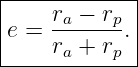
- Derive e = (ra − rp)∕(ra + rp).
- Derive e2 = 1 + 2𝜀h2∕μ2 from the energy equation.
- Use the energy-eccentricity relation to classify ellipse, parabola, and hyperbola.
- For a parabolic orbit, show that rp = p∕2.
- For a hyperbola, derive cos ν∞ = −1∕e.
- Reproduce the 7000 km by 9000 km ellipse example.
- Reproduce the eccentricity and semilatus rectum of the continuing M07-06 Earth
example.
34 Summary
Newtonian central gravity and angular-momentum conservation reduce the orbit problem
to
Its solution is
where
The eccentricity determines the conic:
For an ellipse,
and
Energy and eccentricity are linked by
Therefore negative-energy Newtonian gravitational orbits have
and are ellipses with the attracting body at one focus.
That is Kepler’s first law.
References
References
[1] PhysicsLibrary, M07-07, Angular Momentum, Areal Velocity, and Kepler’s Second
Law.
[2] PhysicsLibrary, M07-06, Effective Potential and Radial Motion in Central Gravity.
[3] PhysicsLibrary, M07-05, Orbital Energy, Escape Speed, and Bound versus Unbound
Motion.
[4] PhysicsLibrary, M04-08, Conservation of Angular Momentum and Central Force
Motion.
[5] J. Kepler, Astronomia Nova, 1609.
[6] J. R. Taylor, Classical Mechanics, University Science Books, 2005.