Physics Library
 An open source physics library
Encyclopedia | Forums | Docs | Random  

[parent] GRE Physics Companion: Simple Harmonic Motion

(Example)

GRE Physics Companion: Simple Harmonic Motion

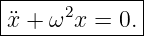
The defining equation is

|-----2------|
x¨+-ω--x-=-0.-
(1)

For initial state

x (0) = x0,    v(0) = v0,
(2)

|---------------------------|
|                 v0        |
x (t) = x0 cosωt +  ω sin ωt. |
----------------------------
(3)

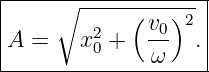
The amplitude is

|----∘-------------|
|        2  ( v0)2 |
A  =   x 0 +  ω   .|
--------------------
(4)

PIC

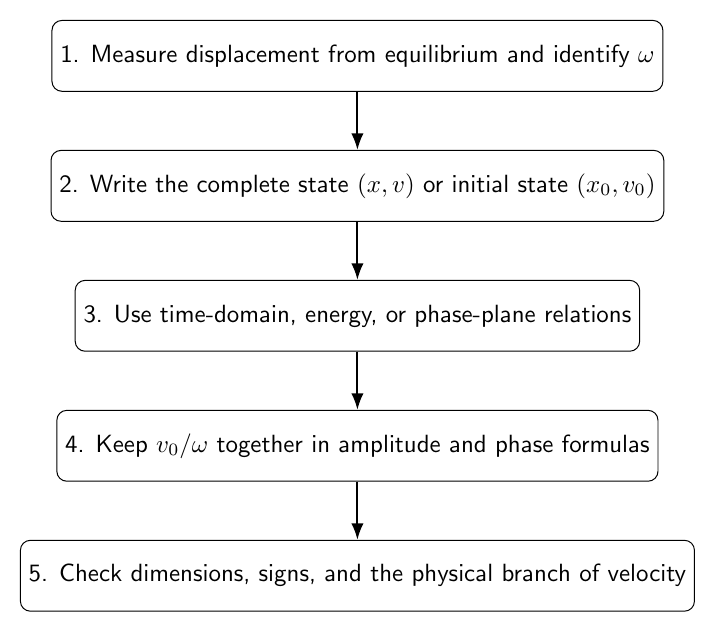
Figure 1. A compact SHO strategy: identify equilibrium and ω, use the complete state (x,v), choose the time-domain, energy, or phase-plane relation, and check dimensions.

1 High-value GRE facts

  1. SHM requires a = −ω2x.
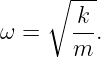
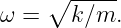
  2. For a spring mass oscillator, ω = ∘ -----
  k∕m.
  3. T = 2π∕ω and f = ω∕(2π).
  4. The complete one-dimensional oscillator state is (x,v).
  5. Initial velocity enters the displacement solution as v0∕ω.
  6. A2 = x 02 + v 02∕ω2.
  7. The phase-plane curve is x2 + v2∕ω2 = A2.
  8. vmax = ωA.
  9. amax = ω2A.
  10. E = 1
2kA2 for an ideal spring oscillator.

Part I: Original GRE-style problems

Problem 1: defining condition

Which acceleration law defines simple harmonic motion?

  1. a = ωx
  2. a = −ωx
  3. a = −ω2x
  4. a = ω2∕x
  5. a = −ω2v

Problem 2: spring angular frequency

For mass m on an ideal spring of constant k,

  1. ω = k∕m
  2. ω = ∘k -∕m--
  3. ω = ∘  -----
   m ∕k
  4. ω = 2πk∕m
  5. ω = km

Problem 3: period

If

ω = 5 rad∕s,
(5)

the period is

  1. 0.20 s
  2. 0.40 s
  3. 2π∕5 s
  4. 5∕(2π) s
  5. 10π s

Problem 4: initial-value solution

Which expression satisfies

x(0) = x ,     v(0) = v ?
         0             0
(6)

  1. x = x0 cos ωt + v0 sin ωt
  2. x = x0 sin ωt + (v0∕ω) cos ωt
  3. x = x0 cos ωt + (v0∕ω) sin ωt
  4. x = x0eωt
  5. x = (x0 + v0)t

Problem 5: amplitude from state

At

t = 0,
(7)

an oscillator has

x =  3cm,      v =  40cm ∕s,     ω = 20 rad∕s.
 0              0
(8)

Its amplitude is

  1. 2 cm
  2. 3 cm
  3. √ ---
  13 cm
  4. 5 cm
  5. 43 cm

Problem 6: maximum speed

An SHO has amplitude

A =  0.30m
(9)

and

ω = 4 rad∕s.
(10)

Its maximum speed is

  1. 0.075 m/s
  2. 0.30 m/s
  3. 0.75 m/s
  4. 1.2 m/s
  5. 4.3 m/s

Problem 7: phase plane

The ideal SHO phase-plane trajectory in (x,v) is

  1. a parabola
  2. an ellipse
  3. a straight line
  4. a hyperbola
  5. a logarithmic spiral

Problem 8: kinetic energy maximum

kinetic energy is maximum when

  1. x = A
  2. x = −A
  3. x = 0
  4. v = 0
  5. a is maximum in magnitude

Problem 9: speed at displacement

An oscillator has

A =  0.10 m,     ω =  10rad ∕s.
(11)

At

x = 0.06 m,
(12)

the speed magnitude is

  1. 0.4 m/s
  2. 0.6 m/s
  3. 0.8 m/s
  4. 1.0 m/s
  5. 1.6 m/s

Problem 10: vertical spring

For an ideal vertical spring-mass oscillator, gravity

  1. doubles the angular frequency
  2. halves the angular frequency
  3. shifts equilibrium but leaves ω = ∘ -----
  k∕m
  4. removes oscillation
  5. makes the period depend on amplitude

Problem 11: small-angle pendulum

For a pendulum of length ℓ at sufficiently small amplitude,

  1. ω = ∘  ----
   g∕ℓ
  2. ω = ∘  ----
   ℓ∕g
  3. ω = g∕ℓ
  4. ω = 2π∘g-∕ℓ-
  5. ω = ℓg

Problem 12: state description

Why is position alone insufficient to specify the state of a one-dimensional SHO?

  1. mass is unknown
  2. the same position can occur with two opposite velocity directions
  3. position is not measurable
  4. acceleration is always zero
  5. energy is always zero

Part II: Complete worked solutions

Solution 1

The acceleration must be proportional to displacement and opposite in direction:

        2
a =  − ω x.
(13)

Answer: (C).

Solution 2

From

m ¨x = − kx,
(14)

ω2 =  k-.
      m
(15)

Therefore

    ∘ ---
       k
ω =    --.
       m
(16)

Answer: (B).

Solution 3

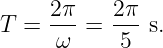
T =  2π-=  2π-s.
     ω     5
(17)

Answer: (C).

Solution 4

At

t = 0,
(18)

the cosine term gives

x(0) = x0.
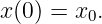
(19)

Differentiation gives

v(0) = v0
(20)

only when the sine coefficient is

v0∕ω.
(21)

Answer: (C).

Solution 5

v    40
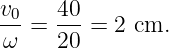
-0=  ---=  2 cm.
ω    20
(22)

Therefore

A = √ -------
  32 + 22 (23)
= √ ---
  13 cm. (24)

Answer: (C).

Solution 6

vmax = ωA  = (4)(0.30) = 1.2 m ∕s.
(25)

Answer: (D).

Solution 7

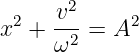
 2   v2-    2
x  + ω2 =  A
(26)

is an ellipse in the unscaled

x − v
(27)

plane. Answer: (B).

Solution 8

At equilibrium,

x = 0,
(28)

the spring potential energy is minimum and speed is maximum. Answer: (C).

Solution 9

|v| = ω√ --2----2
  A  −  x (29)
= 10√ -------------
  0.102 − 0.062 (30)
= 10(0.08) (31)
= 0.8 m∕s. (32)

Answer: (C).

Solution 10

Gravity changes the equilibrium extension:

kyeq = mg.
(33)

Measured from that equilibrium, the motion obeys

m ¨x = − kx.
(34)

Thus

    ∘  -----
ω =    k∕m.
(35)

Answer: (C).

Solution 11

For small angles,

sin𝜃 ≈ 𝜃,
(36)

so

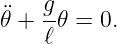
    g
¨𝜃 + -𝜃 =  0.
    ℓ
(37)

Therefore

     ∘ --
       g
ω =    -.
       ℓ
(38)

Answer: (A).

Solution 12

During one cycle the oscillator passes through most positions twice, once with positive velocity and once with negative velocity. Thus

(x,v)
(39)

is needed to identify the state. Answer: (B).

2 GRE checklist

  1. Measure displacement from equilibrium.
  2. Identify ω before using period, energy, or phase formulas.
  3. Keep v0∕ω together in initial-condition formulas.
  4. Use dimensions to catch incorrect amplitude expressions.
  5. Use energy when time is irrelevant.
  6. Use the phase-plane ellipse when position and speed are related directly.
  7. Remember the sign of velocity is not determined by position alone.
  8. Apply the pendulum SHO formula only in the small-angle limit.

References

References

[1]   PhysicsLibrary, simple harmonic oscillator, canonical object SimpleHarmonicOscillator.

[2]   A. P. French, Vibrations and Waves, W. W. Norton, 1971.

[3]   J. R. Taylor, Classical Mechanics, University Science Books, 2005.


"GRE Physics Companion: Simple Harmonic Motion" is owned by bloftin.
(view preamble)
View style:
Other names:  M06-01G
Keywords:  GRE physics, simple harmonic motion, harmonic oscillator, amplitude, phase, initial conditions, phase plane, spring mass oscillator, energy, small-angle pendulum

This object's parent.

Cross-references: dimensions, formulas, phase, potential energy, energy, position, equilibrium, angular frequency, magnitude, kinetic energy, speed, period, simple harmonic motion, acceleration, displacement, velocity, oscillator state, oscillator, mass, amplitude

This is version 1 of GRE Physics Companion: Simple Harmonic Motion, born on 2026-10-17.
Object id is 1489, canonical name is GREPhysicsCompanionSimpleHarmonicMotion.
Accessed 5 times total.

Classification:
Physics Classification: 45.50.-j (Dynamics and kinematics of a particle and a system of particles)
 45.05.+x (General theory of classical mechanics of discrete systems)

Pending Errata and Addenda

None.

Discussion

No messages.

Interact