|
|
|
|||||||
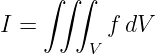
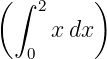
Evaluate
over the box
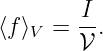
Also calculate the average value
Exercise 2: volume beneath a paraboloidFind the volume enclosed between
and
Use cylindrical coordinates and derive the integration bounds from the geometry.
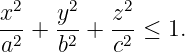
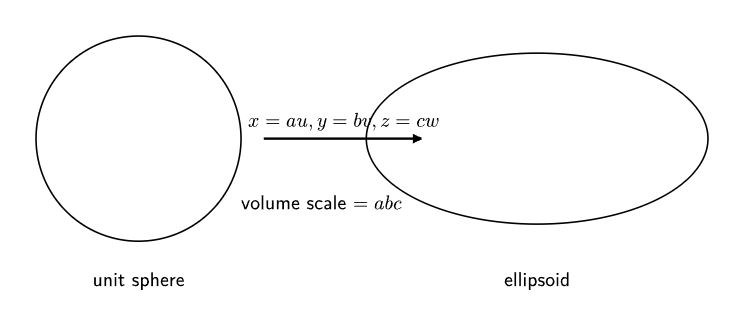
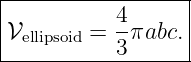
Exercise 3: ellipsoid volume from a JacobianConsider the ellipsoid
Use the transformation
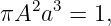
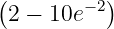
to derive its volume. Then evaluate the result for
Figure 1. A linear coordinate transformation stretches the unit sphere into an ellipsoid, while the Jacobian accounts for the corresponding volume scaling.
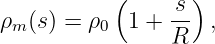
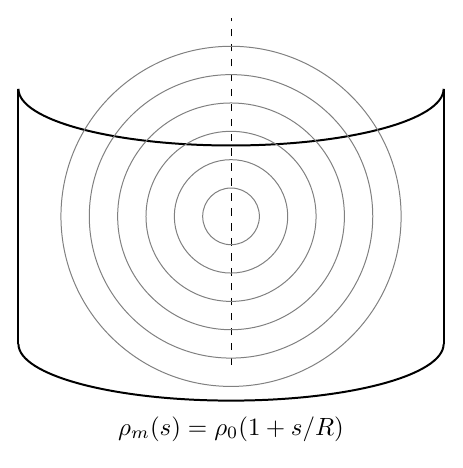
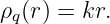
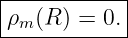
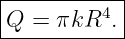
Exercise 4: mass of a radially graded cylinderA solid cylinder has radius R, height H, and mass density
where s is cylindrical distance from the axis. Find:
Figure 2. In a cylindrically symmetric body, cylindrical coordinates make both the geometry and a radial density law natural.
Exercise 5: mass of a radially graded sphereA sphere of radius R has density
Find:
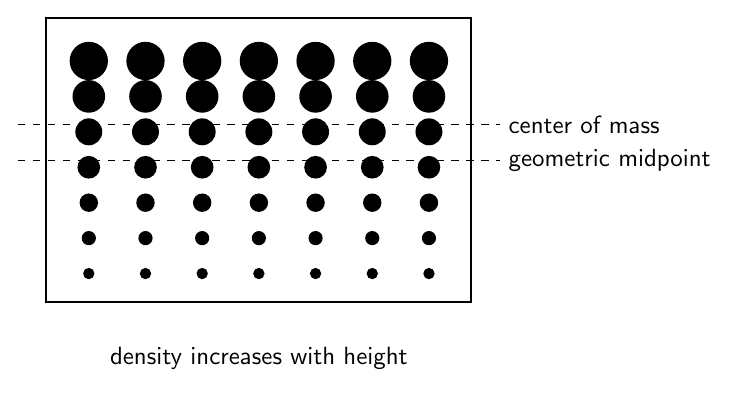
Exercise 6: center of mass of a graded blockA rectangular block occupies
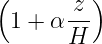
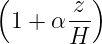
Its density is
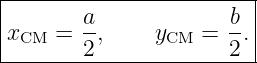
Derive the center of mass. Then evaluate
for
Figure 3. A density gradient weights the upper and lower parts of a block differently and shifts the center of mass away from the geometric center.
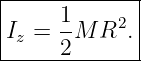
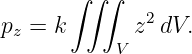
Exercise 7: moment of inertia of a uniform solid cylinderA uniform solid cylinder has mass M, radius R, and height H. Use a volume integral to derive its moment of inertia about its symmetry axis. Do not quote the standard result.
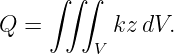
Exercise 8: charge from a spherical volume charge densityA spherical region of radius R contains charge density
Find the total charge. Evaluate numerically for
Exercise 9: electromagnetic energy in a capacitorAn ideal parallel-plate capacitor has:
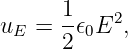
Ignore fringing. Using
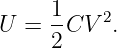
calculate the total electromagnetic energy by integrating over the field-filled volume. Then independently verify the answer with
Use
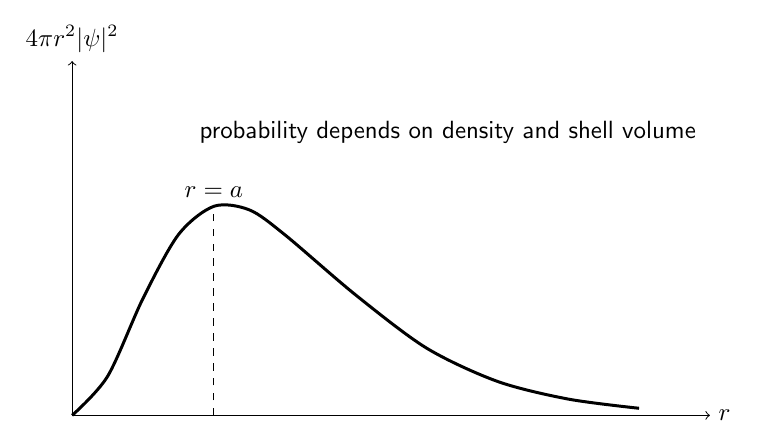
Exercise 10: normalization of a three-dimensional quantum stateConsider the spherically symmetric wavefunction
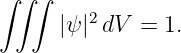
where a > 0. Normalize the wavefunction over all space:
Then calculate the probability that the particle lies inside the sphere
Figure 4. For a spherically symmetric quantum state, the radial probability includes both the wavefunction magnitude and the increasing volume of spherical shells.
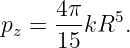
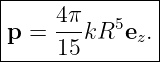
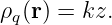
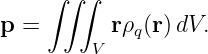
Exercise 11: a vector-valued volume integral and electric dipole momentA sphere of radius R contains charge density
The electric dipole moment is
Find:
Use symmetry wherever possible before integrating.
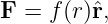
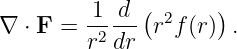
Exercise 12: divergence theorem for a nonlinear radial fieldLet
For a sphere of radius R centered at the origin:
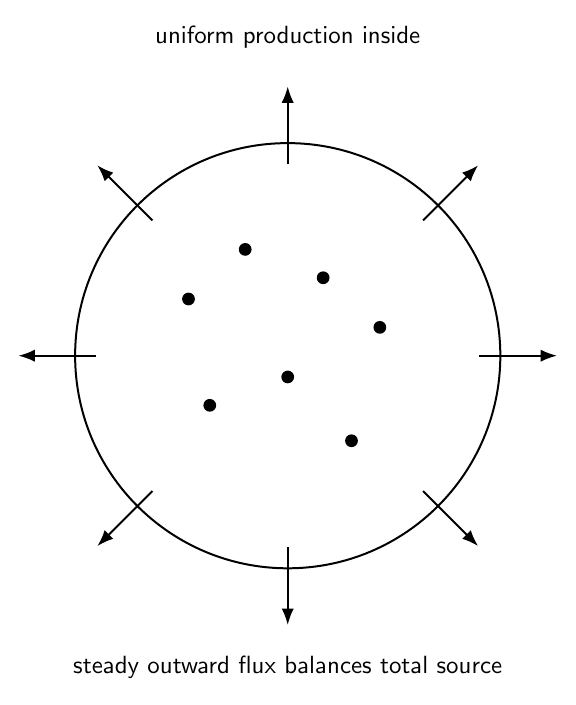
Exercise 13: steady source and outward fluxA sphere of radius R contains a uniform volumetric production rate
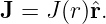
Assume steady state and spherical symmetry. The outward flux field inside the sphere is
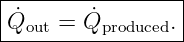
Use the integral conservation law on an arbitrary sphere of radius r ≤ R to find J(r). Then show that the total outward flow through the outer surface equals the total production throughout the volume.
Figure 5. A distributed source inside a volume produces an outward flux whose integrated boundary flow balances the total production in steady state.
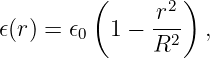
Exercise 14: luminosity from a stellar volume emissivityA spherical star of radius R has a simplified bolometric volume emissivity
where 𝜖 has units of power per unit volume. Assume all generated radiation ultimately escapes. Find:
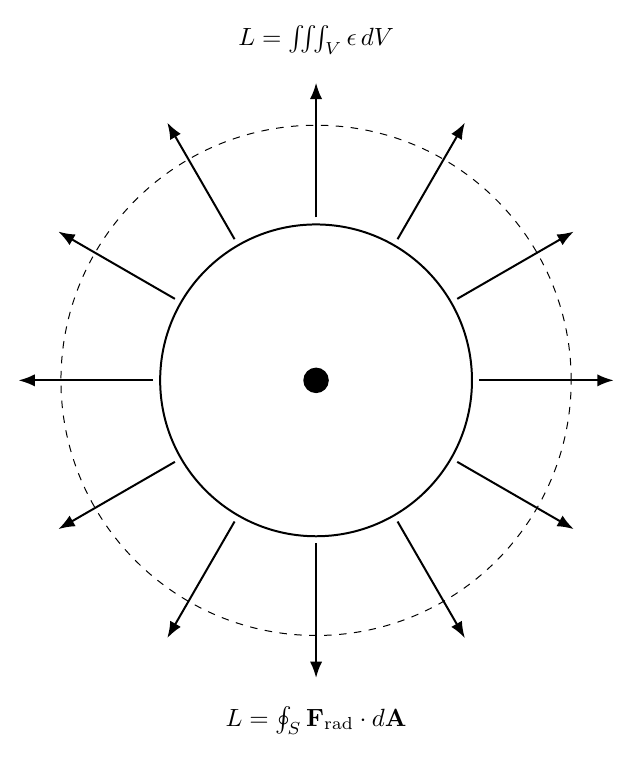
Explain how this problem connects a volume integral inside the source to a surface flux outside the source.
Figure 6. A distributed power density inside a spherical source integrates to a total luminosity, which later appears as conserved outward flux through surrounding spheres.
Part II: Complete Solutions
Solution 1The volume is
Now
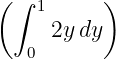
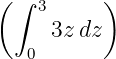
It is convenient to integrate each term separately. For the x term,
For the 2y term,
For the 3z term,
Therefore
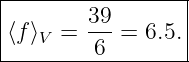
The average value is
As a check, because f is linear, the average also equals the value at the geometric center:
Solution 2The upper surface is
It meets z = 0 when
Thus
Using
Therefore
Solution 3Use
The ellipsoid becomes
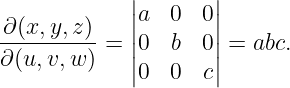
The Jacobian matrix is diagonal:
Therefore
Hence
For
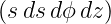
Solution 4Use cylindrical radius s so that the density symbol ρm remains unambiguous. The volume element is
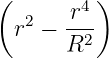
The mass is
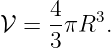
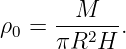
The geometric volume is
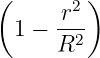
Therefore
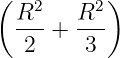
This lies between the axis density ρ0 and the surface density 2ρ0, as expected.
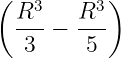
Solution 5The mass is
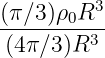
The sphere volume is
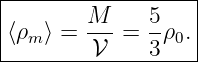
Hence
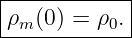
At the center,
At the surface,
The average density is much less than the central density because the outer layers occupy most of the sphere’s volume.
Solution 6By symmetry,
The total mass is
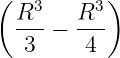
The first moment about the xy plane is
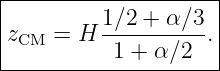
Therefore
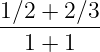
For
The center of mass lies above the geometric midpoint because density increases with height.
Solution 7Let the uniform mass density be
About the symmetry axis,
Thus
Since
we obtain
Solution 8The total charge is
Therefore
For
Solution 9The electric-energy density is
The field-filled volume is
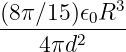
Therefore
Now verify using circuit quantities. The capacitance is
The potential difference is
Then
The field-energy volume integral and circuit formula agree.
Solution 10The normalization condition is
Because the state is spherically symmetric,
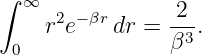
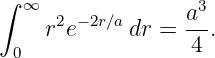
Use
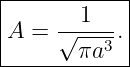
With
Therefore
Hence
Now calculate the probability inside r ≤ a:
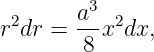
Let
Then
so
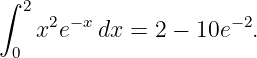
The definite integral is
Using
we get
Thus about 32.3 percent of the probability lies within one scale length a.
Solution 11First calculate total charge:
The spherical region is symmetric under
while the integrand changes sign. Therefore
Now
The x component contains xz, which is odd under x →−x. The y component contains yz, which is odd under y →−y. Thus
The z component is
Therefore
The angular integral is
Hence
Thus
The distribution has zero net charge but a nonzero dipole moment.
Solution 12On the sphere r = R,
Thus
For a radial field
the divergence for r > 0 is
Here
so
Now integrate through the sphere:
Therefore
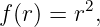
Solution 13At steady state,
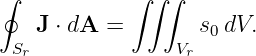
Apply the integral conservation law to a sphere of radius r:
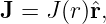
By spherical symmetry,
and J(r) is constant over the spherical surface. Thus
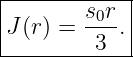
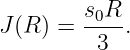
Solving,
At the outer surface,
The total outward flow is
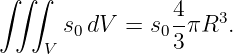
The total production throughout the sphere is
Therefore
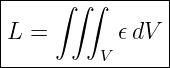
Solution 14The luminosity is the volume integral of power generated per unit volume:
Using spherical coordinates,
Outside the source, assume isotropic free propagation. The same luminosity crosses every centered sphere:
Thus
This problem joins two kinds of integral. Inside the star,
adds distributed power production throughout a volume. Outside the star,
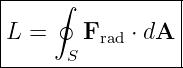
expresses conservation of that total power as a surface flux. The volume source therefore produces the luminosity, while the surface integral describes how that luminosity crosses surrounding spheres.
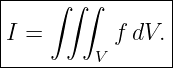
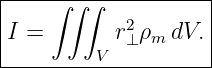
Part III: Compact Formula SheetFor a scalar field,
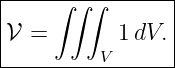
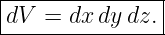
The volume itself is
In cylindrical coordinates,
In spherical coordinates,
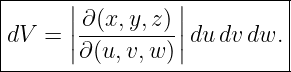
For a general coordinate change,
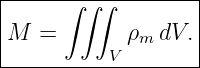
Mass is
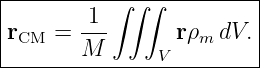
Center of mass is
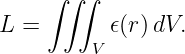
Moment of inertia is
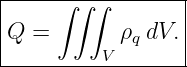
Charge is
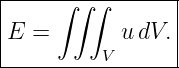
Energy from energy density is
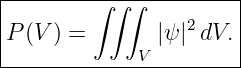
Quantum probability is
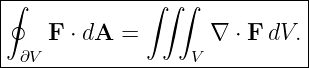
The divergence theorem is
A local conservation law gives
References
References
[1] J. Stewart, Calculus: Early Transcendentals, Cengage Learning. [2] H. M. Schey, Div, Grad, Curl, and All That, W. W. Norton. [3] J. E. Marsden and A. J. Tromba, Vector Calculus, W. H. Freeman. [4] G. B. Arfken, H. J. Weber, and F. E. Harris, Mathematical Methods for Physicists, Academic Press. [5] D. J. Griffiths, Introduction to Electrodynamics, 4th ed., Pearson, 2013. [6] D. J. Griffiths and D. F. Schroeter, Introduction to Quantum Mechanics, 3rd ed., Cambridge University Press, 2018. "examples of volume integral" is owned by bloftin.
This object's parent. Cross-references: Cartesian coordinates, scalar, spherical coordinates, formula, capacitance, volume element, matrix, Jacobian, radiation, power, units, theorem, divergence, surface integral, flux, vector, particle, energy, solid, cylindrical coordinates, volume, section, luminosity, field energy, charge, moments of inertia, center of mass, mass, volume integrals This is version 1 of examples of volume integral, born on 2026-10-07. Object id is 1436, canonical name is ExamplesOfVolumeIntegral. Accessed 8 times total. Classification:
|
|
|
|
Pending Errata and AddendaNone.
|
DiscussionNo messages.
|
Interact |
![[parent]](https://images.physicslibrary.org/images/uparrow.png)















![s [quantity m −3 s− 1].
0](https://images.physicslibrary.org/cache/objects/1436/make4ht/ExamplesOfVolumeIntegral25x.png)













![[ ]
2r2 − 1r4
4](https://images.physicslibrary.org/cache/objects/1436/make4ht/ExamplesOfVolumeIntegral49x.png)






























 (8
(8




 (8
(8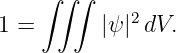












![[∫ π ]
cos2𝜃 sin 𝜃d 𝜃
0](https://images.physicslibrary.org/cache/objects/1436/make4ht/ExamplesOfVolumeIntegral129x.png)