GRE Physics Companion: Spring Force and Hooke’s Law
Spring questions are usually tests of sign discipline, proportional reasoning, and equilibrium. The
fastest reliable method is to identify the spring deformation first, decide the direction of the
restoring force, and only then write Newton’s second law.
1 Core relation
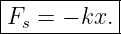
For an ideal linear spring,
The magnitude is
The force points toward the spring’s undeformed configuration.

Figure 1. A compact spring-problem workflow: define deformation, determine the restoring
direction, apply Hooke’s law, then use Newton’s second law or equilibrium.
2 High-value results
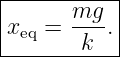
For a hanging mass in static equilibrium,
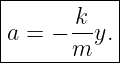
For a mass displaced by y from its vertical equilibrium position,
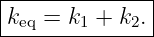
For two springs in parallel,
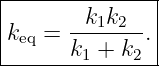
For two springs in series,
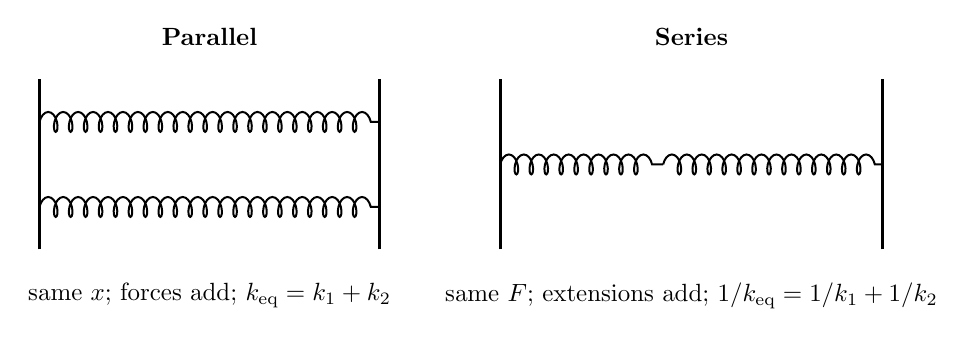
Figure 2. For parallel springs, deformation is shared and forces add. For series springs, force is
shared and deformations add.
3 Worked GRE example 1: graph interpretation
A spring-force graph passes through the points (x,Fs) = (0, 0) and (0.060 m,−18.0 N). Find the
spring constant.
The slope is
Since the slope equals −k,
4 Worked GRE example 2: spring versus static friction
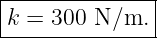
A 2.00 kg block rests on a horizontal surface with μs = 0.400 and is attached to a horizontal spring
with k = 100 N∕m. How far can the spring be stretched before the block begins to
move?
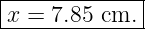
At the threshold of slipping,
Therefore
Thus
5 GRE speed questions
- A spring is stretched twice as far while remaining in its linear range. The spring-force
magnitude becomes (A) half as large (B) unchanged (C) twice as large (D) four times
as large.
- A spring has a force-displacement graph with slope −250 N∕m. Its spring constant is
(A) −250 N∕m (B) 0 (C) 250 N∕m (D) 500 N∕m.
- A mass hangs at rest from a vertical spring. If the mass is doubled while k is unchanged,
the equilibrium extension (A) halves (B) is unchanged (C) doubles (D) quadruples.
- Two identical springs of constant k are connected in parallel. Their equivalent spring
constant is (A) k∕2 (B) k (C) 2k (D) k2.
- Two identical springs of constant k are connected in series. Their equivalent spring
constant is (A) k∕2 (B) k (C) 2k (D) k2.
6 Answers and rationales
- C. Within the Hooke-law range, force magnitude is proportional to deformation.
- C. The graph slope is −k, so k is the positive magnitude of the slope.
- C. xeq = mg∕k.
- C. Parallel stiffnesses add.
- A. For two identical springs in series, 1∕keq = 2∕k.
7 Common GRE traps
- Confusing the spring’s natural-length position with the vertical equilibrium position.
- Treating the minus sign in Fs = −kx as though the spring constant were negative.
- Assuming static friction is always at its maximum value.
- Adding spring constants for springs in series.
- Forgetting that the slope of an Fs versus x graph is negative for the usual sign
convention.
References
[1] PhysicsLibrary, M02-09, Spring Force and Hooke’s Law.
[2] PhysicsLibrary, M02-07, Friction.
[3] OpenStax, University Physics, Volume 1, CC BY 4.0.

![[parent]](https://images.physicslibrary.org/images/uparrow.png)