Variational Principles in the Mathematical Theory of
Plasticity
D. C. Drucker
The results presented in this paper were obtained in the course of research conducted under Contract Nonr
562(10) between the Office of Naval Research and Brown University.
1. Introduction
The fundamental definitions of work hardening and perfect plasticity have been shown to have
strong implications with respect to uniqueness of solution for elastic-plastic bodies. It is not
surprising, therefore, to find that they lead rather directly to the variational principles as well.
Perfect-plasticity theory and both the incrementally linear and the incrementally nonlinear
theories for work-hardening materials are considered. The several counterparts of the
minimum-potential-energy and the minimum-complementary-energy theorems are derived in a
unified manner for stress-strain relations of great generality. Absolute-minimum principles rather
than relative ones are established.
There are any number of approaches to the establishment of variational principles. One is to state
the principles directly and then proceed to prove them. Although clear and precise statements can
be made, the motivation for the original inspiration does not appear. A newcomer to
the field then frequently will be unable to appreciate the development and generally
will not see how to produce appropriate theorems or modifications of his own. The
approach to be followed here does not suppose the result to be known in advance. It is
synthetic in a sense, because the basic theorems have been stated and proved for a
number of special materials [2, 3, 4, 5, 6, 7]. Nevertheless, it is a procedure which arises
logically from fundamental postulates in elasticity and in plasticity theory, and it is
systematic.
In the theory of elasticity, whether linear or nonlinear, the steps are reasonably straightforward.
The equation of virtual work is written first under the implicit assumption of continuity of
displacement and what may be termed equilibrium continuity of the stresses (surface tractions
must be continuous across any surface, but the normal stress components parallel to the
surface may be discontinuous). In a common notation, repeated subscripts indicate
summation:
The starred quantities are related through equilibrium, and the unstarred are compatible. There
need be no relation between the two sets of quantities. For convenience, the surface area A is
divided into the region AT , on which the surface tractions Ti are specified, and the
region Au, over which displacements ui are given. The true and unique solution (no
buckling, no initial stress) to the boundary-value problem with given body forces Fi thus
satisfies
If approximate solutions are sought, two procedures suggest themselves immediately. One is to
choose a compatible strain-displacement field 𝜖ijc,u
ic and satisfy the boundary conditions on A
u.
The other is to select an equilibrium stress field σijE which satisfies the surface-traction boundary
conditions on AT . More elaborate mixed schemes may be devised, but they cannot be classed as
obvious [4].
The value of an approximation procedure, or of a guess, must be determined by comparison of
the approximate solution with the unknown true answer. The real difficulty and the
intuitive heart of the problem lie in the decision on what should be compared. The
equation of virtual work will be satisfied if the natural strains and displacements are
replaced by any chosen set satisfying compatibility and the boundary conditions on Au.
Therefore
| ∫
V σijt𝜖
ijc dV −∫
ATTiuic dA −∫
V Fiuic dV | |
|
| = ∫
V σijt𝜖
ijt dV −∫
ATTiuit dA −∫
V Fiuit dV. | (3) |
Transposing and calling the difference between the true and assumed solution Δ𝜖ij, Δui,
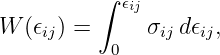
This form suggests strongly a consideration of the elastic-strain energy density written as a
function of strain alone,
because dW = (∂W∕∂𝜖ij)d𝜖ij = σijd𝜖ij. Equation (4) can then be restated as
where δ𝜖 is the first variation of the expression in brackets (the potential energy) as ui
and 𝜖ij are varied in accordance with compatibility and the boundary conditions on
ui.
A variational principle is not necessarily very helpful in solving problems. The assumed state may
not be close to the true one. What is required instead is an absolute-maximum or -minimum
principle, a comparison of the value of the potential energy for the assumed state with that
of the true state, without restriction on the magnitude of the difference between the
states. The presentation here is, however, within the framework of small-displacement
theory.
A comparison may be made with the aid of the identity
| ∫
V W(𝜖ijc) dV −∫
ATTiuic dA −∫
V Fiuic dV | |
|
| = ∫
V W(𝜖ijt) dV −∫
ATTiuit dA −∫
V Fiuit dV | |
|
| + ∫
V [W(𝜖ijc) − W(𝜖
ijt)] dV −∫
ATTiΔui dA −∫
V FiΔui dV. | (7) |
In view of (4), therefore, the potential energy of any admissible compatible state is algebraically
more than the potential energy of the true state by
The integrand may be rewritten as
The rectangles in Fig. 1 symbolize σijtΔ𝜖
ij. The shaded triangles represent (9), the integrand of
(8). In Fig. 1(a)–(c) the triangles are on the positive-strain-energy side of the symbolic
stress-strain curves for any magnitude Δ𝜖ij.
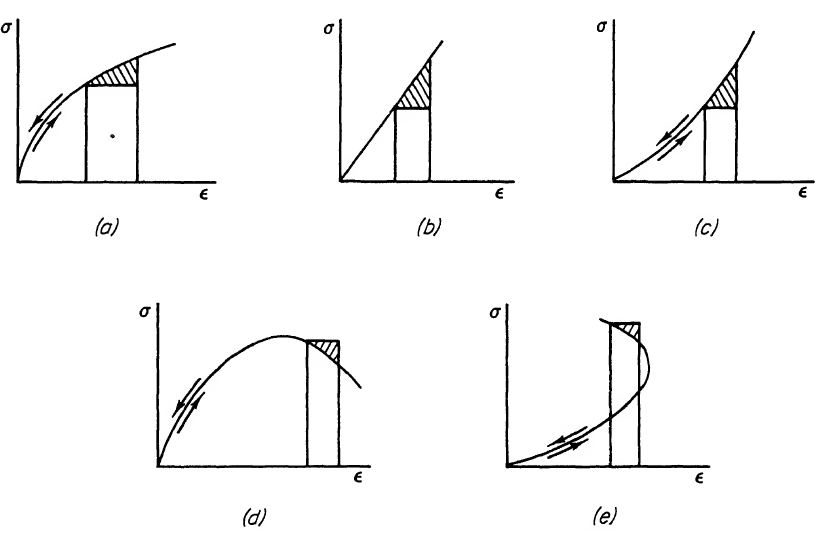
Figure 1. Potential energy is a minimum for a stable elastic material (a to c). Curves in (d) and
(e) are for an unstable material.
The potential energy is an absolute minimum for a linear or for a stable nonlinear elastic material.
For an unstable material [Fig. 1(d) and (e)], the shaded triangles are on the negative side for some
Δ𝜖ij, and the potential energy is not an absolute minimum.
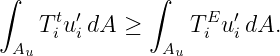
A similar set of steps leads to the principle of minimum complementary energy. Equation (2) is
satisfied if the σij,Ti,Fi system is replaced by any other in equilibrium. For any state of
stress σijE which satisfies the boundary conditions on A
T and is in equilibrium with
Fi,
where σijE − σ
ijt = Δσ
ij and ΔTi is the corresponding change in surface traction on
Au.
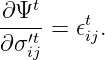
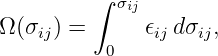
The complementary-energy density as a function of stress alone is suggested by the first
integral:
because dΩ = (∂Ω∕∂σij)dσij = 𝜖ijdσij. Equation (10) can then be restated as
where δσ is the first variation of the expression in brackets (complementary energy) as σij and
Ti are varied in accordance with equilibrium with Fi and the boundary conditions on
AT .
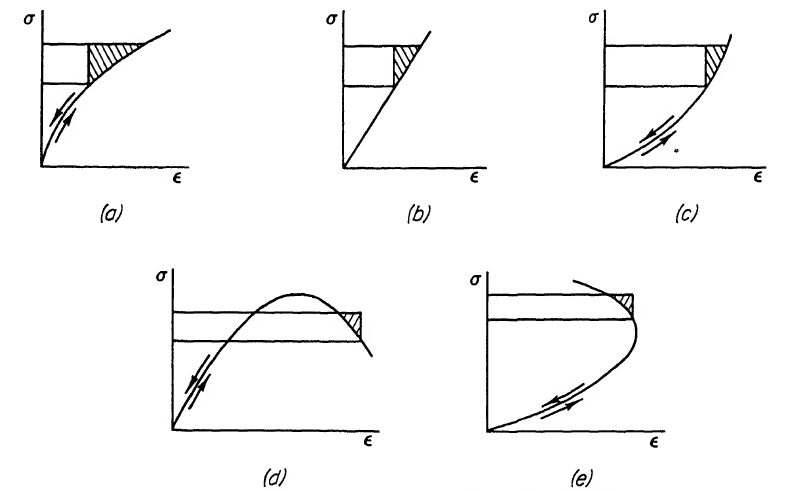
Figure 2. Complementary energy is a minimum for a stable elastic material (a to c). Curves in (d)
and (e) are for an unstable material.
Figure 2 is symbolic of the fact that the complementary energy is an absolute minimum for a
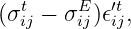
stable material. Corresponding to (8) and (9),
where the integrand may be rewritten as
The symbolic representation of the stress and strain tensors by one dimension each in
Figs. 1 and 2 and the terms stable and unstable can be given general meaning and made
precise.
2. The fundamental postulate for elasticity and plasticity
A basic postulate has been formulated for both elastic and plastic media without time effects [5]. It
is essentially a definition of a stable material and may be stated as follows:
No work can be extracted from the material and the system of forces acting upon
it.
A more useful statement is in terms of an external agency which applies a set of additional forces
to the body under a given load and then removes the added forces. The external agency must do
positive work in the application of force. Over the cycle of application and removal the work done
by the external agency must be positive if plastic deformation occurs in work-hardening material
and will be zero if only elastic changes take place. For a perfectly plastic material, the work done
by the external agency may also be zero when plastic deformation takes place, although generally
it will be positive.
The basic postulate may be applied to a homogeneous material under homogeneous stress σija and
strain 𝜖ija. Suppose that the external agency changes the state of stress by Δσ
ij to σijb. The strain
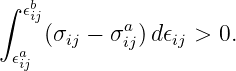
will change by Δ𝜖ij to 𝜖ijb. Then the postulate requires
The value of the integral is strongly path-dependent in the plastic range but is, of course,
independent of path for any elastic material.
3. Absolute-minimum principles in elasticity
The inequality (15) is a formal expression of the requirement that the shaded triangles of Fig. 1 be
on the positive-strain-energy side of the stress-strain curve. Although for a nonlinear elastic
material 𝜖ijb depends upon 𝜖
ija as well as upon Δσ
ij, the integral is path-independent. Choosing a
straight-line path in stress space from σija to σ
ijb, it is obvious that inequality (15) may be
continued as
Also, from
| (σijb − σ
ija)(𝜖
ijb − 𝜖
ija) | = ∫
abd[(σ
ij − σija)(𝜖
ij − 𝜖ija)] | |
|
| = ∫
𝜖ija𝜖ijb
(σij − σija) d𝜖
ij + ∫
σijaσijb
(𝜖ij − 𝜖ija) dσ
ij, | (17) |
we obtain
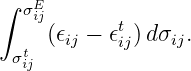
Inequality (18) expresses the requirement that the shaded triangles be as shown in Fig. 2(a)–(c)
and not as in Fig. 2(d) and (e).
Materials of the type of Figs. 1(d),(e) and 2(d),(e) are thus excluded from our consideration,
although not necessarily from physical reality. For elastic materials which follow the
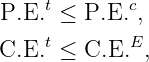
postulated behavior, comparison of (16) with (9) and of (18) with (14) proves that the
potential energy and the complementary energy of the true state are both an absolute
minimum:
with equality only in the trivial case of the admissible state c or E coinciding with the true
state.
4. Deformation or total theories of plasticity
If no distinction is made between loading and unloading, or if each point of the body is assumed to
be at the maximum load intensity in its history, deformation theories postulate a unique relation
between stress and total strain. Although physically unacceptable, in general, because plastic
deformation is path-dependent and irreversible, such theories do in some instances lead
to very useful results. Under the assumptions mentioned, there is no need to consider
deformation theory further, as the theory is indistinguishable from nonlinear elasticity. No
matter how elaborate the stress-strain relation, if the material postulated is stable, the
principles of minimum potential and minimum complementary energy apply without any
change.
If, on the other hand, loading is taken to be nonlinear whereas unloading is assumed to follow
a linear elastic relation, the inconsistency of deformation theory becomes of primary
importance. The mathematical and physical meaning of solutions then becomes quite
obscure.
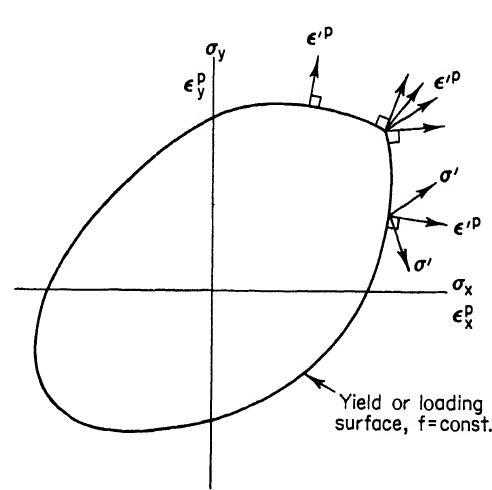
Figure 3. Normality of plastic-strain increment (rate).
5. Work-hardening relations involving increments of stress and strain
The fundamental postulate of positive work by an external agency has very far-reaching
implications. As shown in Fig. 3, the plastic-strain increment or strain-rate vector 𝜖ij′p must be
normal to the yield or loading surface at a smooth point and between normals to adjacent points
at a corner. At a smooth point
where Cijklσkl′ is the elastic response and G and f are functions of the state of the material, which
may include strain and the history of loading as well as the existing state of stress. G may, in
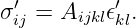
addition, be a homogeneous function of order zero in the stress rate σij′. In pictorial terms
(Fig. 3), G may depend upon the direction of σij′, but doubling σij′ doubles 𝜖ij′. In all
stress-strain relations in use in the paper, G is taken as completely independent of σij′, so that in
the form
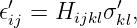
the Hijkl likewise are independent of σkl′. The coefficients Hijkl, which appear similar to the Cijkl
of linear anisotropic elasticity, may be complicated functions of the present state and prior
history.
If a corner is considered to be a set of intersecting loading surfaces [8, 9, 10, 11], each of which
makes its independent contribution to the plastic-strain rate (Fig. 4), then
| 𝜖ij′ = | Cijklσkl′ + (1)H
ijklσkl′ + (2)H
ijklσkl′ +  + (m)H
ijklσkl′ + + (m)H
ijklσkl′ +  | |
|
| = | (Cijkl + Bijkl)σkl′. | (22) |
It is important to keep in mind that the coefficients (m)H
ijkl are to be taken as zero unless σij′ has
an outward-pointing normal component, just as in (20), where the plastic term must be chosen as
zero if unloading takes place. Stress-rate vectors having different directions often will activate
different loading surfaces, so that, despite the apparent linearity of (22), it is not true in general
that the strain rate produced by two stress rates acting simultaneously is the sum of the strain
rates for each individually.
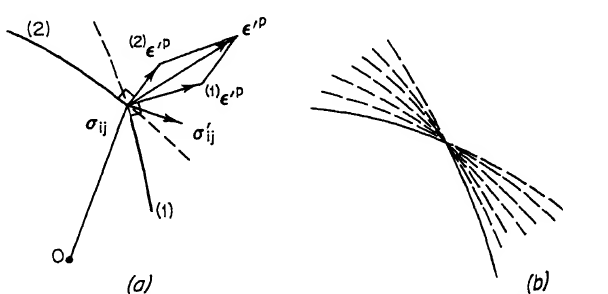
Figure 4. A corner as an intersection of two or more loading surfaces. Two only are drawn in (a),
but there may be infinitely many, as symbolized in (b).
In fact, at a corner the combination of two stress rates, each of which individually produces plastic
action, may result in an unloading (Fig. 5). Even when the (m)H
ijkl are independent of σij′, the
Bijkl will be functions of the stress rate (order zero).
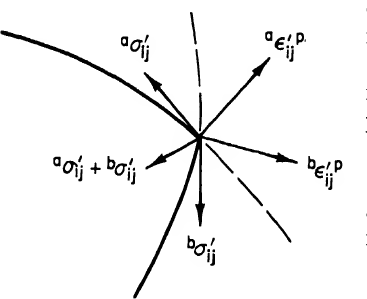
Figure 5. Two loadings may combine to form an unloading at a corner.
The basic postulate requires the initial rate of work by the external agency to be positive;
therefore
and because the elastic component is recoverable,
for a work-hardening material, unless 𝜖ij′p = 0.
In the demonstration of the uniqueness theorem for stress and strain rates [8, 9, 10, 11], the entire
point lies in the proof of
where a and b are two assumed solutions for the rates from the stress point σijL. If an infinitesimal
time, arbitrarily chosen as unity, is permitted to elapse, the two stress states are σijL + aσ
ij′ and
σijL + bσ
ij′ (Fig. 6).
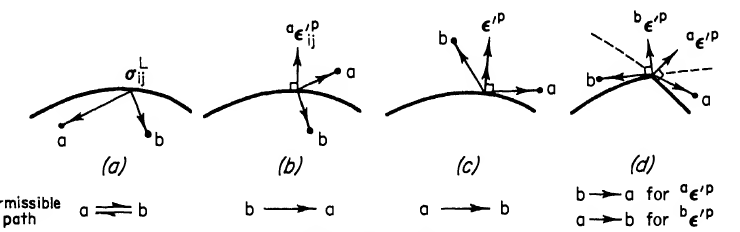
Figure 6. Permissible paths.
At a smooth point of the loading surface it is possible to go from stress point b to stress point a
[Fig. 6(a),(b)] or from stress point a to b [Fig. 6(a),(c)] and change the strain by a𝜖
ij′−b𝜖
ij′ or
b𝜖
ij′−a𝜖
ij′, respectively, in accord with (20) and (23). The work postulate for the b-to-a case then
gives [see (9)]
The result (25) therefore is established [8], but the value of the integral itself is of interest
here:
so that, as for (18),
For the a-to-b path, (27) and (28) merely interchange, and the result is therefore unaffected. When
there are two or more loading surfaces at a corner [Fig. 6(d)], the permissible path
may be from b to a for one set of plastic-strain rates and from a to b for another. As
both (27) and (28) apply to each path, with the elastic-strain rates being counted only
once, it is clear that (27) and (28) apply just as they are, even for this complicated
case.
6. Two minimum theorems for incremental work-hardening theories
In general, theorems which hold in the elastic range cannot be expected to apply in the plastic. As
a consequence of irreversibility, the uniqueness theorem for work-hardening theories of plasticity is
in terms of the increments or rates of stress and strain and not of the stresses and strains
themselves. The equivalent variational or minimum principles likewise will be in terms of rates.
Following the procedure established previously, the principle of virtual work is written for the
rates
Equation (29) applies to the actual rates, as it does for any compatible strain-rate distribution and
any stress-rate field in equilibrium.
When the true stress rates are varied under the restriction that they satisfy equilibrium and the
boundary conditions on AT (Ti′ = 0), the analogue to (10) is
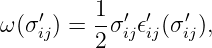
The analogue to complementary-energy density (11) is simply
corresponding to linear elasticity, because the stress-strain relations are time-independent, as
exhibited by (21). The form suggested for a variational principle similar to (12) is
This complementary rate principle will be valid whenever the Hijkl of (21) are independent of
stress rate. All forms (20) for smooth loading surfaces considered here are in this category. At a
corner, however, as previously explained, the Hijkl of (22) which are nonzero depend upon the
direction of σij′. Therefore, δσ′Hijkl≠0 for some or all directions of loading, and (32) is not
valid.
A complementary rate minimum principle in a form equivalent to (19) would be much more
valuable:
The right-hand side is algebraically larger than the left by
| ∫
V [ω(σij′E) − ω(σ
ij′t)]dV −∫
Au(Ti′E − T
i′t)u
i′dA | |
|
| = ∫
V ![[1 ]
--(σ ′Eij 𝜖′iEj − σ′itj𝜖′tij) − (σ′Eij − σ ′tij)𝜖′tij
2](https://images.physicslibrary.org/cache/objects/1293/make4ht/VariationalPrinciplesInTheMathematicalTheoryOfPlasticity31x.png) dV, dV, | (34) |
where 𝜖ij′E is computed from σ
ij′E [equation (22)]. The integrand of (34) may be rewritten
as
Comparison with (28) shows that the fundamental work postulate requires (35) to be positive and
thus guarantees the minimum principle (33), although (32) does not apply.
If now the strain rates are varied in the virtual-work expression for the true rate state while the
condition ui′ = 0 on Au is satisfied, the equivalent of (4) is
The analogue to strain-energy density (5) would be
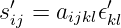
if (22) can be inverted as
Such inversion is not possible if the material is incompressible in either the elastic or the
elastic-plastic range. This difficulty can be circumvented for such materials by solving for the
stress-rate deviation
and writing
It can be shown, then, that a minimum-potential rate principle holds:
| ∫
V w(𝜖ij′t) dV −∫
ATTi′ui′t dA −∫
V Fi′ui′t dV | |
|
| ≤∫
V w(𝜖ij′c) dV −∫
ATTi′ui′c dA −∫
V Fi′ui′c dV. | (41) |
PhysicsLibrary conversion note. In the original printing of (41), the two body-force-rate integrals
over V end with dA. Since their domain is the volume V and the corresponding terms in (29) and
(36) use dV , the volume element dV is used here; this correction is made explicitly rather than
silently.
The right-hand side exceeds the left by
when the surface-traction-rate and body-force-rate integrals are replaced by volume integrals of
stress rates. The sum of the integrands is
Comparison of (43) with (27) proves (41) and once again demonstrates that the minimum
principles follow from the fundamental postulate or definition of work hardening.
Incrementally nonlinear stress-strain relations have not been studied in any detail. If G in (20) or
Hijkl in (21) depends on the direction of σij′, the usual proof of the uniqueness theorem breaks
down. On the other hand, if uniqueness is assured, the basic postulate in the form of (26) or the
first inequality (28) will ensure the validity of the absolute-minimum principles (33) and (41),
corresponding to complementary and potential energy. A simple assumption which leads to
uniqueness is that the plastic-strain rate is a monotonically increasing function of the normal
component of σij′. Although apparently a very reasonable postulate, as a consequence of the
proportionality between rates of stress and strain for a given direction of σij′, it is equivalent,
unfortunately, to a reduction to linearity.
7. Restricted minimum theorems
The complete parallelism of the developments of the minimum principles for the elastic and
for the elastic-plastic cases may have blurred the basic approach. There are but a few
independent combinations possible for stress, stress rate, strain, and strain rate, and it is
worthwhile running through some of them. Since uniqueness of rates only is guaranteed, it
is not likely that any new theorems of true generality will result for work-hardening
materials.
Suppose a theorem is desired for the plastic range which contains the stresses and the strains
themselves. Equations (2)–(4) and (10) are written exactly as for elastic bodies. Again (5) and (11)
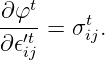
would be suggested by the form of (4) and (10). Now, however, the path of loading is important,
and it is not true in general that ∫
0𝜖ijσ
ij d𝜖ij = W is a function of final strain only, nor is∫
0σij𝜖
ij dσij a function of stress only. Nevertheless, if at each point of the material there has been
no unloading from any of the loading surfaces, the irreversibility is not apparent to the material. In
this very limited sense, minimum-complementary-energy and minimum-potential-energy theorems
hold for a very restricted and yet possibly useful class of alternative admissible states
[12].
Next suppose that a theorem is desired for strain rates and stress. Virtual work is then written in
the form
Varying the strain-rate system from the true state without changing the displacement-rate
boundary conditions leads to
The variational principle suggested is
where
Such a principle can have meaning only if 𝜖ij′ determines σij or at least σij𝜖ij′. As this will not be
true in general, (46) can be valid for a restricted set of loading paths or special materials at
most.
Varying the equilibrium system in the familiar manner results in
which has meaning only if σij determines 𝜖ij′ or at least σij𝜖ij′ so that
Therefore, (48) cannot apply to a work-hardening material.
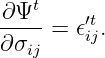
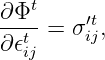
Another possible set of theorems relates stress rates and strain. The corresponding equations
then are found by interchanging primes and no primes in (44)–(49), and the end results
are
where (and only if 𝜖ij determines σij′)
and
where (and only if σij′ determines 𝜖ij)
Such theorems as these are therefore inappropriate for work-hardening materials as defined. They
will have limited validity at least for materials whose state is described by surfaces in strain space
rather than in stress space [13, 14].
8. Elastic-perfectly plastic material
A perfectly plastic material may be defined directly or may equally well be considered as the
limiting case of a work-hardening material for which all subsequent loading surfaces
coincide with the initial yield surface, f = k, bounding purely elastic action. Unlimited
plastic deformation may occur at yield. As no stress increment is required for flow at
yield, the work done by an external agency may be zero when plastic deformation takes
place. The plastic-strain-rate vector is normal to the yield surface in the extended sense
(Fig. 3).
The stress-strain relation at a smooth point on the yield surface is
and at a corner
where each fixed intersecting yield surface makes its own contribution. The λ are homogeneous of
degree −1 in time, because the stress-strain relations are independent of time. Each λ is to be
taken as zero unless the stress point is on its yield surface and remains there in the
interval under consideration. They are otherwise indeterminate for a homogeneous state of
stress.
As a consequence of a fixed yield surface and normality,
for all permissible σij′. Therefore
Also, the total-strain-rate vector is resolved uniquely into an elastic and a plastic component at
each stress point on the yield surface. At an interior point, the strain rate is, of course, purely
elastic. Therefore, when the existing stress is known and the strain rate is given, the stress rate is
determined except, again, for an incompressible material, in which the stress deviation rate is
determined [as in (38) and (39)] by
All the equations (26)–(43) are valid, therefore, with ωp replacing ω and wp replacing w. The
discussion of what happens at a corner is simplified for a perfectly plastic material. If the
strain-rate vector points outward from the yield surface and lies between the normals to adjacent
points (see Fig. 3), it is purely plastic, and the stress rate is identically zero. If the strain-rate
vector points outward but has a component tangent to the adjacent surface, that portion of the
surface governs, and the stress point is then effectively at a smooth point on the yield
surface.
It is not surprising that a minimum-complementary rate principle and a minimum-potential rate
principle apply. As has been stated, a perfectly plastic material is a limiting case of a
work-hardening one as all successive loading surfaces approach the initial yield surface. The lack of
limitation on 𝜖ij′p for a homogeneous state of stress does not matter because, at a given stress
point, σij′𝜖ij′p is zero when the strain rate and the stress rate are related and is zero or negative
when they represent two independent states.
Additional theorems of some generality would be expected for a perfectly plastic material, because
the yield surface does not depend upon loading. The plastic-strain-rate vector is normal to the
surface and so determines the stress point itself, or at worst a straight line or plane of the
surface (Fig. 7). Actually, 𝜖ij′p determines the rate of dissipation, σ
ij𝜖ij′p, uniquely. The
total-strain-rate vector by itself does not provide any such information for an elastic-plastic
material. However, for a plastic-rigid material or for an elastic-plastic material at the
limit load [15], the elastic-strain rates are identically zero. The total-strain rates are
then plastic only and do determine the dissipation and the stress to a considerable
extent.
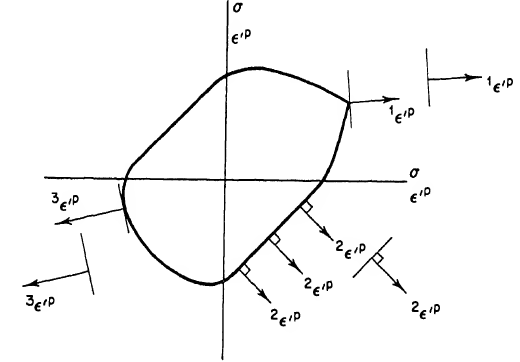
Figure 7. The plastic-strain-rate vector determines the rate of dissipation of energy σij𝜖ij′p and
the stress point σij itself, except at a flat spot.
Under the restriction of zero elastic-strain rate, following steps (44)–(47), 𝜖ij′ does determine
σij𝜖ij′ = φ, and the principle (46) is established. Following steps (48) and (49), σij′𝜖ij′ is now zero,
so that Ψ = 0 and (48) applies.
Absolute-minimum principles can be established which are generalizations of the Markov [16] and
Hill [17] principles and are in fact equivalent to the limit theorems [15]. The minimum principle for
(46) is
| ∫
V φ(𝜖ij′t) dV −∫
ATTiui′t dA −∫
V Fiui′t dV | |
|
| ≤∫
V φ(𝜖ij′c) dV −∫
ATTiui′c dA −∫
V Fiui′c dV, | (59) |
where 𝜖ij′c,u
i′c is any compatible system taken as plastic only and where φ = [σ
ij(𝜖ij′)]𝜖ij′ is the
dissipation function. The right-hand side is algebraically greater than the left by the volume
integral of
which is positive or zero in accordance with the basic work postulate [5], or equally well from the
convexity of the yield surface and the normality of the plastic-strain-rate vector, which themselves
are consequences of the postulate.
The upper-bound limit theorem [15] may be obtained from (59) by observing that, if ui′t vanishes
on Au, the left-hand side is zero from virtual work, and
The minimum principle corresponding to (48) may be written as a maximum principle by
multiplying through by −1:
Proof follows directly from virtual work, as the left-hand side exceeds the right by the volume
integral of
which is positive or zero just as (60) was. It is (63) which is the key in the lower-bound theorem of
limit analysis [15].
The yield value and the yield criterion as well need not be the same at each point of the material,
since nowhere in the proofs do such restrictions appear. Therefore (59) and (62) apply equally well
to a rigid work-hardening material at each stage of loading.
As mentioned in the previous section, theorems involving total strain are not appropriate for the
types of materials postulated in the paper [14]; hence the list of simple minimum principles seems
exhausted.
9. Conclusion
A systematic procedure is presented for establishing variational and minimum principles. The
virtual-work expression is written in terms of the quantities for which a theorem is sought, and a
variation is tried which suggests a possible principle. Use is then made of a basic postulate for
stable materials without time effects, which had been formulated previously [5]: in the very
strictest sense, work cannot be extracted from the stressed material and the system of forces acting
upon it. Substitution of the relation between the quantities which is given directly by
the fundamental postulate provides immediate proof of the valid absolute-minimum
principles.
Minimum-potential-energy and minimum-complementary-energy theorems (19) are established for
linear and nonlinear elastic bodies and for deformation theories of plasticity by virtual work
(2), the appropriate variation (4) or (10), and inequalities (16) or (18), as given by the
postulate.
Corresponding theorems [3, 6] in which rates replace total quantities, (41) and (33), are
established for work-hardening and for perfectly plastic materials by virtual work (29), the
appropriate variation (36) or (30), and inequalities (27) or (28) given by the postulate. All
incrementally linear and the most complicated combinations of incrementally linear forms (Fig. 4)
are included.
Extended theorems (59) and (62) involving stress quantities and strain and displacement rates
[16, 17] are established for rigid-perfectly plastic materials or elastic-perfectly plastic materials at
limit loading or collapse. The steps are virtual work (44), the variations (45) or (48), and
inequalities given by the postulate, as indicated following (60) or (63).
Brown University, Providence, R.I.
Source note
This PhysicsLibrary entry is a conversion of the public-domain material in Reference [1].
References
[1] D. C. Drucker, “Variational Principles in the Mathematical Theory of Plasticity,” in
Lawrence M. Graves (ed.), Calculus of Variations and Its Applications: Proceedings of
the Eighth Symposium in Applied Mathematics of the American Mathematical Society,
McGraw-Hill Book Company, New York, 1958, pp. 7–22.
[2] W. Prager and J. L. Synge, “Approximations in elasticity based on the concept
of function space,” Quarterly of Applied Mathematics, vol. 5, 1947, pp. 241–269; J.
B. Diaz and H. J. Greenberg, “Upper and lower bounds for the solution of the first
boundary value problem of elasticity,” Quarterly of Applied Mathematics, vol. 6, 1948,
pp. 326–331.
[3] H. J. Greenberg, On the Variational Principles of Plasticity, ONR Report A11-S4,
Brown University, March 1949.
[4] E. Reissner, “On a variational theorem in elasticity,” Journal of Mathematics and
Physics, vol. 29, no. 2, July 1950, pp. 90–95; K. Washizu, On the Variational Principles
of Elasticity and Plasticity, ONR Report 25-18, Massachusetts Institute of Technology,
March 1955.
[5] D. C. Drucker, “Some implications of work-hardening and ideal plasticity,” Quarterly
of Applied Mathematics, vol. 7, no. 4, January 1950, pp. 411–418; and “A more
fundamental approach to plastic stress-strain relations,” Proceedings of the First U.S.
National Congress of Applied Mechanics, ASME, 1951, pp. 487–491.
[6] R. Hill, The Mathematical Theory of Plasticity, Clarendon Press, Oxford, 1950.
[7] W. Prager and P. G. Hodge, Jr., Theory of Perfectly Plastic Solids, John Wiley &
Sons, New York, 1951.
[8] D. C. Drucker, “On uniqueness in the theory of plasticity,” Quarterly of Applied
Mathematics, vol. 14, no. 1, April 1956, pp. 35–42.
[9] W. Koiter, “Stress-strain relations, uniqueness and variational theorems for
elastic-plastic materials with a singular yield surface,” Quarterly of Applied
Mathematics, vol. 11, 1953, pp. 350–353.
[10] J. L. Sanders, “Plastic stress-strain relations based on infinitely many plane loading
surfaces,” Proceedings of the Second U.S. National Congress of Applied Mechanics,
ASME, 1954, pp. 455–460.
[11] B. Budiansky, Fundamental Theorems and Consequences of the Slip Theory of
Plasticity, Ph.D. thesis, Brown University, 1950.
[12] P. G. Hodge, Jr., Minimum Principles of Piecewise Linear Isotropic Plasticity, ONR
Report 298, Polytechnic Institute of Brooklyn, August 1955.
[13] D. Trifan, “A minimum principle of plasticity,” Quarterly of Applied Mathematics,
vol. 13, 1955, pp. 337–339.
[14] W. Prager, On Limiting States of Deformation, ONR Report C11-9, Brown
University, February 1956.
[15] D. C. Drucker, W. Prager, and H. J. Greenberg, “Extended limit design theorems
for continuous media,” Quarterly of Applied Mathematics, vol. 9, no. 4, January 1952,
pp. 381–389.
[16] A. A. Markov, “On variational principles in the theory of plasticity,” Prikladnaia
Matematika i Mekhanika, vol. 11, 1947, pp. 339–350.
[17] R. Hill, “A variational principle of maximum plastic work in classical plasticity,”
Quarterly Journal of Mechanics and Applied Mathematics, vol. 1, 1948, pp. 18–28.




![[∫ ∫ ∫ ]
δ𝜖 W (𝜖tij)dV − Tiuti dA − Fiuti dV ≡ δ [P.E.t] = 0,
V AT V](https://images.physicslibrary.org/cache/objects/1293/make4ht/VariationalPrinciplesInTheMathematicalTheoryOfPlasticity4x.png)
![∫
c t c t t
P.E. − P.E. = [W (𝜖ij) − W (𝜖ij) − σijΔ𝜖ij]dV.
V](https://images.physicslibrary.org/cache/objects/1293/make4ht/VariationalPrinciplesInTheMathematicalTheoryOfPlasticity5x.png)


![[∫ ∫ ]
t t t
δσ Ω(σij)dV − TiuidA ≡ δσ[C.E. ] = 0,
V Au](https://images.physicslibrary.org/cache/objects/1293/make4ht/VariationalPrinciplesInTheMathematicalTheoryOfPlasticity9x.png)
![∫
C.E.E − C.E.t = [Ω (σE) − Ω (σt) − 𝜖tΔ σ ]dV,
V ij ij ij ij](https://images.physicslibrary.org/cache/objects/1293/make4ht/VariationalPrinciplesInTheMathematicalTheoryOfPlasticity10x.png)











![[∫ ∫ ]
δσ′ ω (σ ′tij)dV − Ti′tu′ti dA = 0.
V Au](https://images.physicslibrary.org/cache/objects/1293/make4ht/VariationalPrinciplesInTheMathematicalTheoryOfPlasticity29x.png)



![w (𝜖′ ) = 1[σ′ (𝜖′ )]𝜖′ ,
ij 2 ij ij ij](https://images.physicslibrary.org/cache/objects/1293/make4ht/VariationalPrinciplesInTheMathematicalTheoryOfPlasticity34x.png)

![∫ ∫
[w(𝜖′icj) − w (𝜖′tij)]dV − σ ′tij(𝜖′cij − 𝜖′tij) dV,
V V](https://images.physicslibrary.org/cache/objects/1293/make4ht/VariationalPrinciplesInTheMathematicalTheoryOfPlasticity38x.png)



![[ ∫ ∫ ∫ ]
δ𝜖′ φ(𝜖′tij)dV − Tiu ′ti dA − Fiu′itdV = 0,
V AT V](https://images.physicslibrary.org/cache/objects/1293/make4ht/VariationalPrinciplesInTheMathematicalTheoryOfPlasticity42x.png)
![[∫ ∫ ]
δσ Ψ (σtij) dV − T tiu′idA = 0,
V Au](https://images.physicslibrary.org/cache/objects/1293/make4ht/VariationalPrinciplesInTheMathematicalTheoryOfPlasticity44x.png)
![[∫ ∫ ∫ ]
δ𝜖 Φ (𝜖tij)dV − Ti′tuti dA − Fi′uti dV = 0,
V AT V](https://images.physicslibrary.org/cache/objects/1293/make4ht/VariationalPrinciplesInTheMathematicalTheoryOfPlasticity46x.png)
![[∫ ∫ ]
′t ′t
δσ′ V Ψ (σij) dV − A T i uidA = 0,
u](https://images.physicslibrary.org/cache/objects/1293/make4ht/VariationalPrinciplesInTheMathematicalTheoryOfPlasticity48x.png)