
|
|
|
|||||||
with real coefficients. PhysicsLibrary displays components scalar first:
The scalar and vector parts are
Hamilton’s basis rules are
and reversing two distinct basis factors changes the sign. quaternion multiplication is associative and distributive but not generally commutative.
2 Exercises
3 Solutions
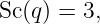
Solution 1: identify quaternion partsFor  we have  Therefore
and
The component column is
A pure quaternion has zero scalar part, so q is not pure. A real quaternion has zero vector part, so q is not real either.
Solution 2: quaternion equalityEquality requires corresponding coefficients to agree. Thus  Hence
A quaternion has four independent real coefficients, so one quaternion equality is shorthand for four real equations.
Solution 3: addition and scalar multiplicationComponentwise addition gives
Subtraction gives
Also,
and
Finally,  and direct addition of 2p and 2q gives the same result.
Solution 4: Hamilton basis multiplicationUsing the Hamilton table, 
 Also,  while  Since i2 = −1,  and 
Solution 5: derive a cyclic productStarting with  right multiply by −k:  Associativity gives ![ij[k(− k)] = k.](https://images.physicslibrary.org/cache/objects/1114/make4ht/ExampleOfQuaternionDefinitionAndBasicAlgebra45x.png) Because k(−k) = 1,
Similarly, left multiply the fundamental relation by −i:  Since (−i)i = 1,
Solution 6: direct general product expansionDistribute without changing factor order:  Use  Collecting coefficients gives
Solution 7: order mattersReversing the factors gives
Therefore ![[p,q] = pq − qp
= (− 7 + i + 3j + 9k ) − (− 7 + 9i + j − 3k ),](https://images.physicslibrary.org/cache/objects/1114/make4ht/ExampleOfQuaternionDefinitionAndBasicAlgebra53x.png) so
The commutator is nonzero, so p and q do not commute.
Solution 8: a cancellation identityExpand in factor order:  Thus  Therefore
If the basis elements were incorrectly assumed to commute, the middle terms would be combined as 2ij = 2k, which is wrong because ij≠ji.
Solution 9: associativity versus commutativityFirst,  Also,  Hence associativity holds in this example. But  so commutativity fails. Quaternion factors may be regrouped but not generally reordered.
Solution 10: distributivityFor the first identity, 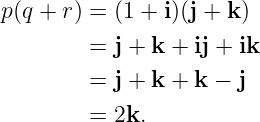 Separately,  so pq + pr = 2k. For the second identity, 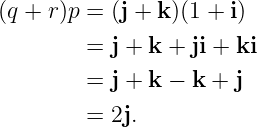 Also,  so qp + rp = 2j.
Solution 11: complex subalgebraMultiply directly: 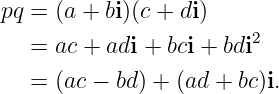 Thus
Reversing the factors yields the same expression because the real coefficients commute and only one imaginary basis direction is present. This restricted set is a copy of the complex numbers inside the quaternions. It does not imply that general quaternions commute because different imaginary basis directions do not commute.
Solution 12: arbitrary unit pure quaternionExpand 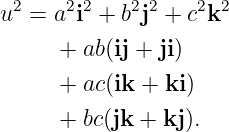 Each mixed pair cancels because reversing distinct Hamilton basis factors changes the sign. Hence  Using a2 + b2 + c2 = 1 gives
Thus every unit pure quaternion behaves algebraically like an imaginary unit. Later, this allows an arbitrary spatial unit axis to appear naturally inside quaternion axis angle formulas.
Solution 13: pure quaternion product and vector analysisExpanding uv gives the scalar terms  so
The vector terms are  which is exactly u × v. Therefore
For u = i and v = j, the dot product is zero and the cross product is k, so the formula gives ij = k as required.
Solution 14: storage order diagnosticThe claim is incorrect. Storage order changes only the order of the four real coefficients in memory or display; it does not change Hamilton multiplication. For Package A,
For Package B,
The semantic quaternion is identical in both cases.
Solution 15: multiplication convention versus attitude conventionThe colleague’s claim is incorrect. The basis equation  identifies a multiplication law whose cross-like basis products are flipped relative to the PhysicsLibrary Hamilton rule ij = +k. It does not by itself identify active or passive attitude semantics. Likewise, scalar first notation only specifies coefficient ordering. To determine attitude semantics, one needs the declared physical map, for example an active vector rule such as  or a frame labeled passive coordinate rule such as  Multiplication law, storage order, and attitude interpretation are separate convention choices.
4 Compact reviewThe central facts tested here are
and, for pure quaternions,
The last identity is the bridge to the next PhysicsLibrary quaternion entry, which develops the scalar vector Hamilton product in compact form.
5 Sources and exercise provenanceThe exercises and solutions in this companion are newly written or expanded for PhysicsLibrary. Hamilton is the foundational historical source; Joly, Kelland and Tait, and Hathaway provide later systematic and pedagogical treatments. The present article uses modern scalar first engineering notation rather than reproducing historical notation.
References
[1] W. R. Hamilton, Elements of Quaternions, 2nd ed., edited by C. J. Joly, Longmans, Green, and Co., 1899. Internet Archive scan [2] C. J. Joly, A Manual of Quaternions, Macmillan and Co., London, 1905. Internet Archive search [3] P. Kelland and P. G. Tait, Introduction to Quaternions, with Numerous Examples, 2nd ed., Macmillan and Co., London, 1882. Internet Archive search [4] A. S. Hathaway, A Primer of Quaternions, 1896. Project Gutenberg edition
LicenseUnless otherwise noted, this PhysicsLibrary entry is intended for release under the Creative Commons Attribution ShareAlike 4.0 International license. "example of quaternion definition and basic algebra" is owned by bloftin.
This object's parent. Cross-references: cross product, dot product, relation, formulas, unit, commutativity, identity, commute, commutator, quaternion multiplication, vector, scalar, kinematics, quaternion, quaternion definition and basic algebra There is 1 reference to this object. This is version 3 of example of quaternion definition and basic algebra, born on 2026-08-28, modified 2026-08-28. Object id is 1114, canonical name is ExampleOfQuaternionDefinitionAndBasicAlgebra. Accessed 276 times total. Classification:
|
|
|
|
Pending Errata and AddendaNone.
|
DiscussionNo messages.
|
Interact |
![[parent]](https://images.physicslibrary.org/images/uparrow.png)

![⌊ ⌋
qw
| qx|
[q]PL = |⌈ q |⌉ .
y
qz](https://images.physicslibrary.org/cache/objects/1114/make4ht/ExampleOfQuaternionDefinitionAndBasicAlgebra1x.png)










![[p,q] = pq − qp.](https://images.physicslibrary.org/cache/objects/1114/make4ht/ExampleOfQuaternionDefinitionAndBasicAlgebra12x.png)













![⌊ ⌋
3
|− 2|
[q]PL = |⌈ 5 |⌉ .
− 7](https://images.physicslibrary.org/cache/objects/1114/make4ht/ExampleOfQuaternionDefinitionAndBasicAlgebra29x.png)









![[p,q] = − 8i + 2j + 12k.](https://images.physicslibrary.org/cache/objects/1114/make4ht/ExampleOfQuaternionDefinitionAndBasicAlgebra54x.png)





![[0.8, − 0.1,0.2,− 0.55].](https://images.physicslibrary.org/cache/objects/1114/make4ht/ExampleOfQuaternionDefinitionAndBasicAlgebra74x.png)
![[− 0.1,0.2,− 0.55,0.8].](https://images.physicslibrary.org/cache/objects/1114/make4ht/ExampleOfQuaternionDefinitionAndBasicAlgebra75x.png)




