|
|
|
|||||||
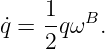
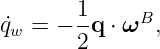
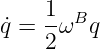
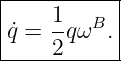
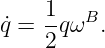
for body resolved angular velocity, while
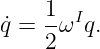
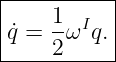
for inertial resolved angular velocity.
2 Exercises
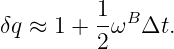
Exercise 1Starting from a short time body frame rotation increment, derive
Exercise 2Starting from an inertial frame rotation increment, derive
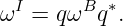
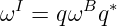
Exercise 3Show that the body resolved and inertial resolved equations are equivalent if
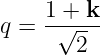
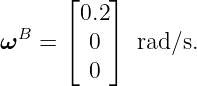
Exercise 4Let
and let the body resolved angular velocity be
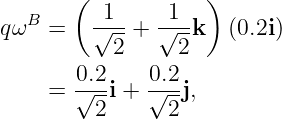
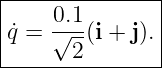
Compute q.
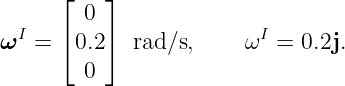
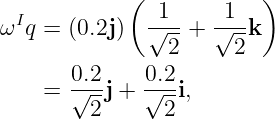
Exercise 5For the same attitude in Exercise 4, find the inertial resolved angular velocity ωI and verify that the inertial rate equation gives the same q.
Exercise 6Derive the scalar and vector equations
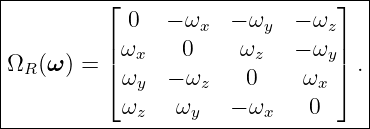
Exercise 7Derive the 4 × 4 right multiplication rate matrix ΩR(ω) for scalar-first ordering.
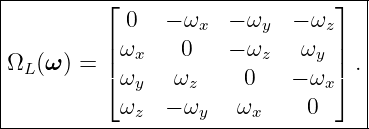
Exercise 8Derive the 4 × 4 left multiplication rate matrix ΩL(ω) for scalar-first ordering.
Exercise 9Prove that the continuous quaternion kinematic equation preserves the norm of a unit quaternion.
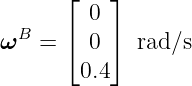
Exercise 10Starting from q(0) = 1, let
be constant. Find q(t) exactly.
Exercise 11For the angular rate in Exercise 10, compute the exact quaternion after Δt = 0.5 s.
Exercise 12Use one forward Euler step with Δt = 0.5 s for Exercise 10. Compute the norm of the unnormalized result and compare it with the exact quaternion.
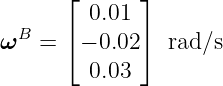
Exercise 13A body mounted gyro reports
for Δt = 0.01 s. Form the first order incremental quaternion.
Exercise 14Explain why replacing an attitude trajectory q(t) by −q(t) requires replacing q(t) by −q(t) but does not change the physical motion.
Exercise 15A program stores quaternions scalar last and uses the body rate matrix written for scalar-first ordering without permuting the state. Explain the resulting bug and how to correct it.
Exercise 16A programmer uses
for a quaternion q = Iq B driven by body resolved gyro measurements. What is wrong, and what symptom would you expect for rotations not aligned with a principal coordinate axis?
3 Solutions
Solution 1Over dt, the body frame incremental rotation is
Since it is resolved about the current body axes, it composes on the right:
Thus
and taking dt → 0 gives
Solution 2For an inertial resolved increment,
and the increment composes on the left:
Therefore
Solution 3Using
and q∗q = 1,
Multiplying by 1∕2 proves that the two kinematic equations are identical.
Solution 4Write
Then
because ki = j. Hence
Solution 5The attitude is a +90∘ rotation about z, so a body frame +x vector is mapped into inertial +y. Therefore
Then
which gives exactly the same q as Exercise 4.
Solution 6Using the scalar vector Hamilton product,
Multiplying by 1∕2 gives the required scalar and vector equations.
Solution 7Expanding qωB in scalar-first ordering gives
Thus q4 = (1∕2)ΩRq4.
Solution 8Expanding ωIq gives
Thus q4 = (1∕2)ΩLq4.
Solution 9Both ΩR and ΩL are skew symmetric. Therefore
Hence the exact continuous equation preserves ∥q∥.
Solution 10The angular speed magnitude is 0.4 rad∕s and the axis is k. Therefore
The physical rotation angle is 0.4t radians.
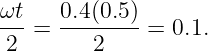
Solution 11At t = 0.5 s,
Thus
or numerically
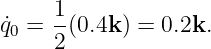
Solution 12At q0 = 1,
A forward Euler step gives
Its norm is
The exact quaternion from Exercise 11 has norm exactly one.
Solution 13The first order increment is
Therefore
Solution 14If q(t) satisfies the kinematic equation, multiplying the entire trajectory by −1 gives the same physical orientation because q and −q represent the same rotation. Differentiating −q(t) gives −q(t). The kinematic equation is linear in q, so the sign reversed pair remains a valid solution describing the same physical motion.
Solution 15The matrix sign pattern assumes the state order [qw,qx,qy,qz]T . A scalar-last array uses a different ordering, so direct multiplication associates the wrong coefficients with the wrong state components. The state and matrix must be permuted consistently, or the quaternion must be converted to scalar-first ordering before applying the formula.
Solution 16For q = Iq B and body resolved gyro measurements, the correct equation is
Using ωBq treats the numerical components as though they were resolved in the inertial frame. For single axis rotations aligned with an axis that commutes with the current quaternion, the error can be hidden. For general three-dimensional motion, the attitude will propagate with incorrect coupling and sign behavior because quaternion multiplication is not commutative.
LicenseThis article is an original synthesis prepared for PhysicsLibrary and intended for release under CC BY-SA 4.0. "example of quaternion kinematics and angular velocity" is owned by bloftin.
This object's parent. Cross-references: quaternion multiplication, commutes, formula, magnitude, speed, program, unit, norm, kinematic, matrix, vector, scalar, angular velocity, quaternion, section, quaternion kinematics and angular velocity There is 1 reference to this object. This is version 2 of example of quaternion kinematics and angular velocity, born on 2026-08-24, modified 2026-08-27. Object id is 1106, canonical name is ExampleOfQuaternionKinematicsAndAngularVelocity. Accessed 275 times total. Classification:
|
|
|
|
Pending Errata and AddendaNone.
|
DiscussionNo messages.
|
Interact |
![[parent]](https://images.physicslibrary.org/images/uparrow.png)