Since Newton’s time, when the sizes of the mirrors in telescopes were measured in inches, reflecting
telescopes have grown ever larger. In 1948, US astronomers built a telescope with a 5-meter
(200-inch) diameter mirror on Palomar Mountain in Southern California. It remained the largest
visible-light telescope in the world for several decades. The giants of today, however, have primary
mirrors (the largest mirrors in the telescope) that are 8- to 10-meters in diameter, and larger ones
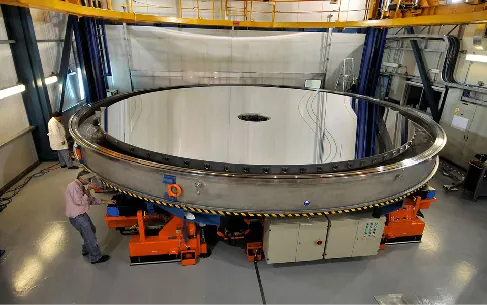
are being built (Figure 6.7).
Figure 6.7 Large Telescope Mirror. This image shows one of the primary mirrors of the
European Southern Observatory’s Very Large Telescope, named Yepun, just after it was
recoated with aluminum. The mirror is a little over 8 meters in diameter. (credit: ESO/G.
Huedepohl)
Modern Visible-Light and Infrared Telescopes
The decades starting in 1990 saw telescope building around the globe grow at an unprecedented
rate. (See Table 6.1, which also includes websites for each telescope in case you want to visit or
learn more about them.) Technological advancements had finally made it possible to build
telescopes significantly larger than the 5-meter telescope at Palomar at a reasonable cost. New
technologies have also been designed to work well in the infrared, and not just visible,
wavelengths.
Table 6.1: Large Single-Dish Visible-Light and Infrared Telescopes
| Aperture (m) | Telescope Name | Location | Status | Website |
| 39 | European Extremely Large Telescope (E-ELT) | Cerro Armazonas, Chile | First light 2025 (estimated) | www.eso.org/sci/facilities/eelt |
| 30 | Thirty-Meter Telescope (TMT) | Maunakea, HI | First light 2025 (estimated) | www.tmt.org |
| 24.5 | Giant Magellan Telescope (GMT) | Las Campanas Observatory, Chile | First light 2025 (estimated) | www.gmto.org |
| 11.1 × 9.9 | Southern African Large Telescope (SALT) | Sutherland, South Africa | 2005 | www.salt.ac.za |
| 10.4 | Gran Telescopio Canarias (GTC) | La Palma, Canary Islands | First light 2007 | www.gtc.iac.es |
| 10.0 | Keck I and II (two telescopes) | Maunakea, HI | Completed 1993–96 | www.keckobservatory.org |
| 9.1 | Hobby–Eberly Telescope (HET) | Mount Locke, TX | Completed 1997 | www.as.utexas.edu/mcdonald/het |
| 8.4 | Large Binocular Telescope (LBT) (two telescopes) | Mount Graham, AZ | First light 2004 | www.lbto.org |
| 8.4 | Large Synoptic Survey Telescope (Rubin Obs.) | The Cerro Pachón, Chile | First light 2021 | www.lsst.org |
| 8.3 | Subaru Telescope | Maunakea, HI | First light 1998 | www.naoj.org |
| 8.2 | Very Large Telescope (VLT) | Cerro Paranal, Chile | All four telescopes completed 2000 | www.eso.org/public/teles-instr/paranal |
| 8.1 | Gemini North and Gemini South | Maunakea, HI (North) and Cerro Pachón, Chile (South) | First light 1999 (North), First light 2000 (South) | www.gemini.edu |
| 6.5 | Magellan Telescopes (two telescopes: Baade and Landon Clay) | Las Campanas, Chile | First light 2000 and 2002 | obs.carnegiescience.edu/Magellan |
| 6.5 | Multi-Mirror Telescope (MMT) | Mount Hopkins, AZ | Completed 1979 | www.mmto.org |
| 6.0 | Big Telescope Altazimuth (BTA-6) | Mount Pastukhov, Russia | Completed 1976 | w0.sao.ru/Doc-en/Telescopes/bta/descrip.html |
| 5.1 | Hale Telescope | Mount Palomar, CA | Completed 1948 | www.astro.caltech.edu/palomar/about/telescopes/hale.html |
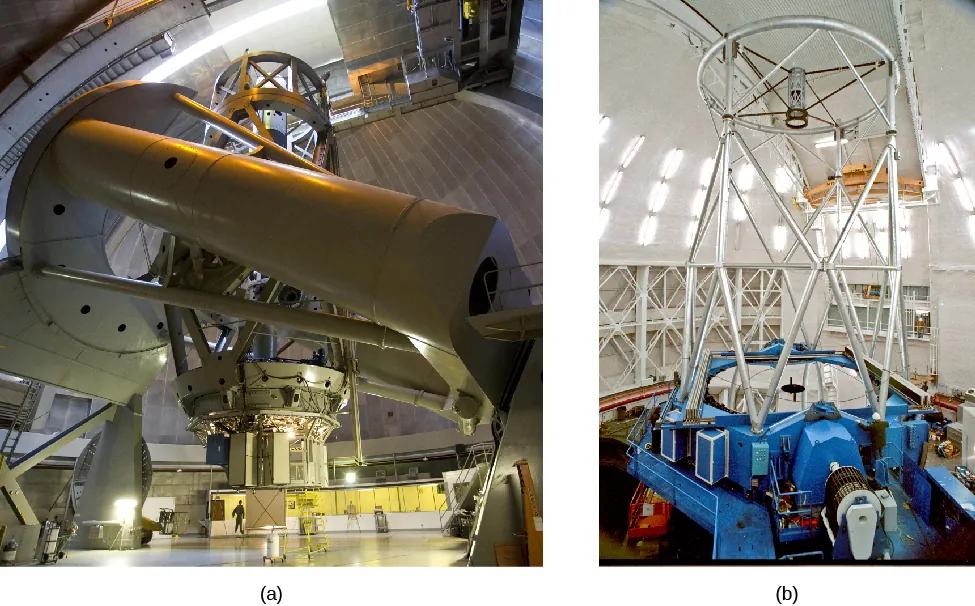
The differences between the Palomar telescope and the modern Gemini North telescope (to take
an example) are easily seen in Figure 6.8. The Palomar telescope is a massive steel
structure designed to hold the 14.5-ton primary mirror with a 5-meter diameter. Glass
tends to sag under its own weight; hence, a huge steel structure is needed to hold the
mirror.
A mirror 8 meters in diameter, the size of the Gemini North telescope, if it were built using the
same technology as the Palomar telescope, would have to weigh at least eight times as much and
would require an enormous steel structure to support it.
Figure 6.8 Modern Reflecting Telescopes. (a) The Palomar 5-meter reflector: The Hale telescope on
Palomar Mountain has a complex mounting structure that enables the telescope (in the open
“tube” pointing upward in this photo) to swing easily into any position. (b) The Gemini North
8-meter telescope: The Gemini North mirror has a larger area than the Palomar mirror,
but note how much less massive the whole instrument seems. (credit a: modification
of work by Caltech/Palomar Observatory; credit b: modification of work by Gemini
Observatory/AURA)
The 8-meter Gemini North telescope looks like a featherweight by contrast, and indeed it is. The
mirror is only about 8 inches thick and weighs 24.5 tons, less than twice as much as the Palomar
mirror. The Gemini North telescope was completed about 50 years after the Palomar telescope.
Engineers took advantage of new technologies to build a telescope that is much lighter in weight
relative to the size of the primary mirror.
The Gemini mirror does sag, but with modern computers, it is possible to measure that sag many
times each second and apply forces at 120 different locations to the back of the mirror to correct
the sag, a process called active control. Seventeen telescopes with mirrors 6.5 meters in diameter
and larger have been constructed since 1990.
The twin 10-meter Keck telescopes on Maunakea, which were the first of these new-technology
instruments, use precision control in an entirely novel way. Instead of a single primary mirror 10
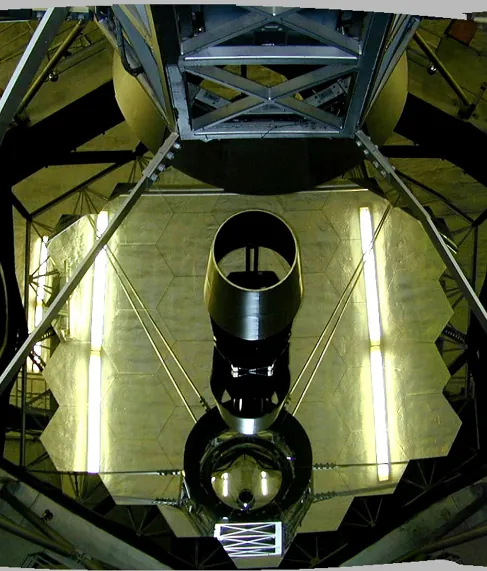
meters in diameter, each Keck telescope achieves its larger aperture by combining the light from 36
separate hexagonal mirrors, each 1.8 meters wide (Figure 6.9). Computer-controlled actuators
(motors) constantly adjust these 36 mirrors so that the overall reflecting surface acts
like a single mirror with just the right shape to collect and focus the light into a sharp
image.
Figure 6.9 Thirty-Six Eyes Are Better Than One. The mirror of the 10-meter Keck telescope is
composed of 36 hexagonal sections. (credit: NASA)
Link to Learning
Learn more about the Keck Observatory on Maunakea through the History Channel clip on the
telescopes and the work that they do.
In addition to holding the mirror, the steel structure of a telescope is designed so that the entire
telescope can be pointed quickly toward any object in the sky. Since Earth is rotating, the
telescope must have a motorized drive system that moves it very smoothly from east to west at
exactly the same rate that Earth is rotating from west to east, so it can continue to point at the
object being observed. All this machinery must be housed in a dome to protect the telescope from
the elements. The dome has an opening in it that can be positioned in front of the
telescope and moved along with it, so that the light from the objects being observed is not
blocked.
Voyagers in Astronomy
George Ellery Hale: Master Telescope Builder
George Ellery Hale (Figure 6.10) was a giant among early telescope builders. Not once, but four
times, he initiated projects that led to the construction of what was the world’s largest telescope at
the time. And he was a master at winning over wealthy benefactors to underwrite the construction
of these new instruments.
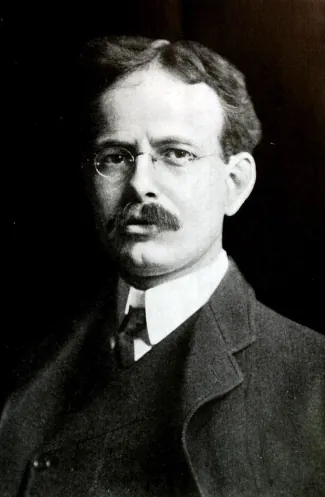
Figure 6.10 George Ellery Hale (1868–1938). Hale’s work led to the construction of several major
telescopes, including the 40-inch refracting telescope at Yerkes Observatory, and three reflecting
telescopes: the 60-inch Hale and 100-inch Hooker telescopes at Mount Wilson Observatory, and the
200-inch Hale Telescope at Palomar Observatory.
Hale’s training and early research were in solar physics. In 1892, at age 24, he was named associate
professor of astral physics and director of the astronomical observatory at the University of
Chicago. At the time, the largest telescope in the world was the 36-inch refractor at the Lick
Observatory near San Jose, California. Taking advantage of an existing glass blank for a 40-inch
telescope, Hale set out to raise money for a larger telescope than the one at Lick. One
prospective donor was Charles T. Yerkes, who, among other things, ran the trolley system in
Chicago.
Hale wrote to Yerkes, encouraging him to support the construction of the giant telescope by saying
that “the donor could have no more enduring monument. It is certain that Mr. Lick’s
name would not have been nearly so widely known today were it not for the famous
observatory established as a result of his munificence.” Yerkes agreed, and the new
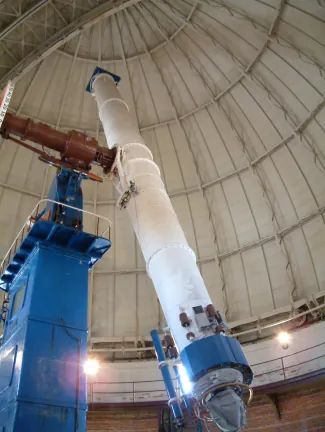
telescope was completed in May 1897; it remains the largest refractor in the world (Figure
6.11).
Figure 6.11 World’s Largest Refractor. The Yerkes 40-inch (1-meter) telescope.
Even before the completion of the Yerkes refractor, Hale was not only dreaming of building a still
larger telescope but was also taking concrete steps to achieve that goal. In the 1890s, there was a
major controversy about the relative quality of refracting and reflecting telescopes. Hale realized
that 40 inches was close to the maximum feasible aperture for refracting telescopes. If telescopes
with significantly larger apertures were to be built, they would have to be reflecting
telescopes.
Using funds borrowed from his own family, Hale set out to construct a 60-inch reflector. For a site,
he left the Midwest for the much better conditions on Mount Wilson—at the time, a wilderness
peak above the small city of Los Angeles. In 1904, at the age of 36, Hale received funds from the
Carnegie Foundation to establish the Mount Wilson Observatory. The 60-inch mirror was placed in
its mount in December 1908.
Two years earlier, in 1906, Hale had already approached John D. Hooker, who had made his
fortune in hardware and steel pipe, with a proposal to build a 100-inch telescope. The technological
risks were substantial. The 60-inch telescope was not yet complete, and the usefulness of large
reflectors for astronomy had yet to be demonstrated.
George Ellery Hale’s brother called him “the greatest gambler in the world.” Once again, Hale
successfully obtained funds, and the 100-inch telescope was completed in November 1917.
(It was with this telescope that Edwin Hubble was able to establish that the spiral
nebulae were separate islands of stars—or galaxies—quite removed from our own Milky
Way.)
Hale was not through dreaming. In 1926, he wrote an article in Harper’s Magazine about the
scientific value of a still larger telescope. This article came to the attention of the Rockefeller
Foundation, which granted $6 million for the construction of a 200-inch telescope. Hale died in
1938, but the 200-inch (5-meter) telescope on Palomar Mountain was dedicated 10 years later and
is now named in Hale’s honor.
Picking the Best Observing Sites
A telescope like the Gemini or Keck telescope costs about $100 million to build. That kind of
investment demands that the telescope be placed in the best possible site. Since the end of the
nineteenth century, astronomers have realized that the best observatory sites are on mountains, far
from the lights and pollution of cities. Although a number of urban observatories remain,
especially in the large cities of Europe, they have become administrative centers or
museums.
The real action takes place far away, often on desert mountains or isolated peaks in the Atlantic
and Pacific Oceans, where we find the staff’s living quarters, computers, electronic and machine
shops, and of course the telescopes themselves. A large observatory today requires a supporting
staff of 20 to 100 people in addition to the astronomers.
The performance of a telescope is determined not only by the size of its mirror but also by its
location. Earth’s atmosphere, so vital to life, presents challenges for the observational astronomer.
In at least four ways, our air imposes limitations on the usefulness of telescopes:
- The most obvious limitation is weather conditions such as clouds, wind, and rain. At
the best sites, the weather is clear as much as 75% of the time.
- Even on a clear night, the atmosphere filters out a certain amount of starlight, especially
in the infrared, where the absorption is due primarily to water vapor. Astronomers
therefore prefer dry sites, generally found at high altitudes.
- The sky above the telescope should be dark. Near cities, the air scatters the glare from
lights, producing an illumination that hides the faintest stars and limits the distances
that can be probed by telescopes. (Astronomers call this effect light pollution.)
Observatories are best located at least 100 miles from the nearest large city.
- Finally, the air is often unsteady; light passing through this turbulent air is disturbed,
resulting in blurred star images. Astronomers call these effects “bad seeing.” When
seeing is bad, images of celestial objects are distorted by the constant twisting and
bending of light rays by turbulent air.
The best observatory sites are therefore high, dark, and dry. The world’s largest telescopes are
found in such remote mountain locations as the Andes Mountains of Chile (Figure 6.12), the desert
peaks of Arizona, the Canary Islands in the Atlantic Ocean, and Maunakea in Hawaii, a dormant
volcano with an altitude of 13,700 feet (4200 meters).
Link to Learning
Light pollution is a problem not just for professional astronomers but for everyone who wants to
enjoy the beauty of the night sky. In addition research is now showing that it can disrupt the life
cycle of animals with whom we share the urban and suburban landscape. And the light wasted
shining into the sky leads to unnecessary municipal expenses and use of fossil fuels. Concerned
people have formed an organization, the International Dark-Sky Association, whose website is full
of good information.
A citizen science project called Globe at Night allows you to measure the light levels in your
community by counting stars and to compare it to others around the world. Recently, a new threat
to dark skies has emerged. A number of commercial companies are planning and launching
large swarms of satellites into low-Earth orbit to provide internet access around the
world. Unfortunately, these satellites reflect sunlight and have already begun to ruin
astronomical photographs the world over. See the Further Exploration section at the
end of this chapter for more resources on this topic. If you get interested in this topic
and want to do a paper for your astronomy course or another course while you are
in college, the Dark Night Skies guide can point you to a variety of resources on the
topic.
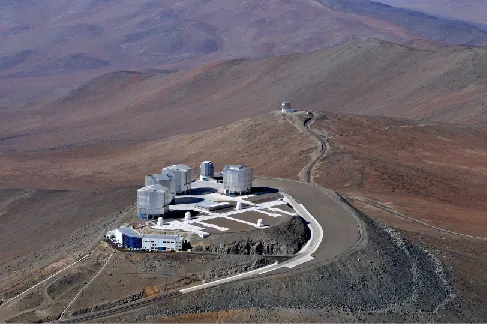
Figure 6.12 High and Dry Site. Cerro Paranal, a mountain summit 2.7 kilometers above sea level in
Chile’s Atacama Desert, is the site of the European Southern Observatory’s Very Large Telescope.
This photograph shows the four 8-meter telescope buildings on the site and vividly illustrates that
astronomers prefer high, dry sites for their instruments. The 4.1-meter Visible and Infrared Survey
Telescope for Astronomy (VISTA) can be seen in the distance on the next mountain peak. (credit:
ESO)
The Resolution of a Telescope
In addition to gathering as much light as they can, astronomers also want to have the sharpest
images possible. Resolution refers to the precision of detail present in an image: that is, the
smallest features that can be distinguished. Astronomers are always eager to make out more detail
in the images they study, whether they are following the weather on Jupiter or trying to
peer into the violent heart of a “cannibal galaxy” that recently ate its neighbor for
lunch.
One factor that determines how good the resolution will be is the size of the telescope. Larger
apertures produce sharper images. Until very recently, however, visible-light and infrared telescopes
on Earth’s surface could not produce images as sharp as the theory of light said they
should.
The problem—as we saw earlier in this chapter—is our planet’s atmosphere, which is
turbulent. It contains many small-scale blobs or cells of gas that range in size from inches to
several feet. Each cell has a slightly different temperature from its neighbor, and each
cell acts like a lens, bending (refracting) the path of the light by a small amount. This
bending slightly changes the position where each light ray finally reaches the detector in a
telescope.
The cells of air are in motion, constantly being blown through the light path of the telescope by
winds, often in different directions at different altitudes. As a result, the path followed by the light
is constantly changing.
For an analogy, think about watching a parade from a window high up in a skyscraper. You decide
to throw some confetti down toward the marchers. Even if you drop a handful all at the same time
and in the same direction, air currents will toss the pieces around, and they will reach the ground
at different places. As we described earlier, we can think of the light from the stars as a series of
parallel beams, each making its way through the atmosphere. Each path will be slightly different,
and each will reach the detector of the telescope at a slightly different place. The result
is a blurred image, and because the cells are being blown by the wind, the nature of
the blur will change many times each second. You have probably noticed this effect
as the “twinkling” of stars seen from Earth. The light beams are bent enough that
part of the time they reach your eye, and part of the time some of them miss, thereby
making the star seem to vary in brightness. In space, however, the light of the stars is
steady.
Astronomers search the world for locations where the amount of atmospheric blurring, or
turbulence, is as small as possible. It turns out that the best sites are in coastal mountain ranges
and on isolated volcanic peaks in the middle of an ocean. Air that has flowed long distances over
water before it encounters land is especially stable.
The resolution of an image is measured in units of angle on the sky, typically in units of
arcseconds. One arcsecond is 1/3600 degree, and there are 360 degrees in a full circle. So we are
talking about tiny angles on the sky. To give you a sense of just how tiny, we might note that 1
arcsecond is how big a quarter would look when seen from a distance of 5 kilometers. The best
images obtained from the ground with traditional techniques reveal details as small as several
tenths of an arcsecond across. This image size is remarkably good. One of the main reasons for
launching the Hubble space telescope was to escape Earth’s atmosphere and obtain even sharper
images.
But since we can’t put every telescope into space, astronomers have devised a technique called
adaptive optics that can beat Earth’s atmosphere at its own game of blurring. This technique
(which is most effective in the infrared region of the spectrum with our current technology) makes
use of a small flexible mirror placed in the beam of a telescope. A sensor measures how much the
atmosphere has distorted the image, and as often as 500 times per second, it sends
instructions to the flexible mirror on how to change shape in order to compensate for
distortions produced by the atmosphere. The light is thus brought back to an almost
perfectly sharp focus at the detector. Figure 6.13 shows just how effective this technique
is.
With adaptive optics, ground-based telescopes can achieve resolutions of 0.1 arcsecond or a little
better in the infrared region of the spectrum. This impressive figure is the equivalent of the
resolution that the Hubble Space Telescope achieves in the visible-light region of the
spectrum.
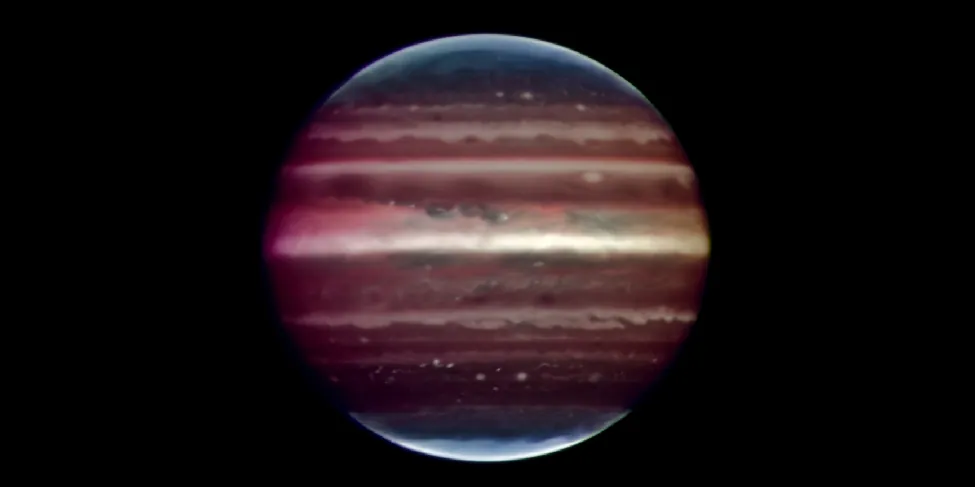
Figure 6.13 power of Adaptive Optics. One of the clearest pictures of Jupiter ever taken from
the ground, this image was produced with adaptive optics using an 8-meter-diameter
telescope at the Very Large Telescope in Chile. Adaptive optics uses infrared wavelengths to
remove atmospheric blurring, resulting in a much clearer image. (credit: modification of
work by ESO, F. Marchis, M. Wong (UC Berkeley); E. Marchetti, P. Amico, S. Tordo
(ESO))
Astronomy Basics
How Astronomers Really Use Telescopes
In the popular view (and some bad movies), an astronomer spends most nights in a cold
observatory peering through a telescope, but this is not very accurate today. Most astronomers do
not live at observatories, but near the universities or laboratories where they work.
An astronomer might spend only a week or so each year observing at the telescope
and the rest of the time measuring or analyzing the data acquired from large project
collaborations and dedicated surveys. Many astronomers use radio telescopes for space
experiments, which work just as well during the daylight hours. Still others work at
purely theoretical problems using supercomputers and never observe at a telescope of any
kind.
Even when astronomers are observing with large telescopes, they seldom peer through them.
Electronic detectors permanently record the data for detailed analysis later. At some observatories,
observations may be made remotely, with the astronomer sitting at a computer thousands of miles
away from the telescope.
Time on major telescopes is at a premium, and an observatory director will typically receive many
more requests for telescope time than can be accommodated during the year. Astronomers must
therefore write a convincing proposal explaining how they would like to use the telescope and why
their observations will be important to the progress of astronomy. A committee of astronomers is
then asked to judge and rank the proposals, and time is assigned only to those with the greatest
merit.
Even if your proposal is among the high-rated ones, you may have to wait many months for your
turn. If the skies are cloudy on the nights you have been assigned, it may be more than a year
before you get another chance.
Some older astronomers still remember long, cold nights spent alone in an observatory dome, with
only music from a tape recorder or an all-night radio station for company. The sight of the stars
shining brilliantly hour after hour through the open slit in the observatory dome was unforgettable.
So, too, was the relief as the first pale light of dawn announced the end of a 12-hour observation
session.
Astronomy is much easier today, with teams of observers working together, often at their
computers, in a warm room. Those who are more nostalgic, however, might argue that some of the
romance has gone from the field, too.
Attribution
Access for free at openstax.org.
Bibliography
This entry is a derivative work of the original March 9, 2022 release identified in [1].
[1] Andrew Fraknoi, David Morrison, and Sidney C. Wolff, Astronomy 2e. Houston, Texas:
OpenStax, March 9, 2022. Digital ISBN 978-1-951693-50-3. Textbook content produced by
OpenStax in this edition is licensed under the Creative Commons Attribution 4.0 International
License (CC BY 4.0), except where otherwise noted. Changes: converted to LaTeX for
PhysicsLibrary. Access for free at openstax.org.