A simple harmonic oscillator is a mechanical system which consists of a particle under the
influence of a Hooke’s law force. The equation of motion of such a system is
It is typical to define the quantity ω =  and write this equation as
Note that this equation is linear. Among other consequences, this means that the period of
oscilltions does not depend on amplitude. It is rather simple to solve this equation in TEMs of
trigonometric functions to obtain a general solution. This solution is typically written in one of two
forms.
Either of these solutions shows that the frequency of oscillation is ω (independent of the
amplitude). The relation between the two solutions is provided by the angle addition law for the
sine. One finds that the constants appearing in the two solutions are related in the following
way:
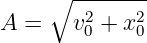
These constants have the following interpretation: A is the amplitude of the oscillation. ϕ is
the phase of the oscillation. v0 is the velocity at time t = 0. x0 is the position at time
t = 0.
![[parent]](https://images.physicslibrary.org/images/uparrow.png)