Definition 0.1: In order to define a weak Hopf algebra, one ‘weakens’ or relaxes certain axioms of
a Hopf algebra as follows :
- The comultiplication is not necessarily unit–preserving.
- The counit 𝜀 is not necessarily a homomorphism of algebras.
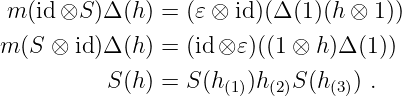
- The axioms for the antipode map S : A→A with respect to the counit are as follows. For all
h ∈ H,
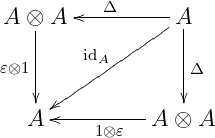
These axioms may be appended by the following commutative diagrams
along with the counit axiom:
Some authors substitute the term quantum ‘groupoid’ for a weak Hopf algebra.
0.1 Examples of weak Hopf algebras.
- We refer here to Bais et al. (2002). Let G be a non-Abelian group and H ⊂ G a discrete
subgroup. Let F(H) denote the space of functions on H and ℂH the group algebra
(which consists of the linear span of group elements with the group structure).
The quantum double D(H) (Drinfeld, 1987) is defined by
where, for x ∈ H, the ‘twisted tensor product’ is specified by
The physical interpretation is often to take H as the ‘electric gauge group’ and F(H) as the
‘magnetic symmetry’ generated by {f ⊗e} . In terms of the counit 𝜀, the double D(H) has a
trivial representation given by 𝜀(f ⊗ h) = f(e) . We next look at certain features of this
construction.
For the purpose of braiding relations there is an R matrix, R ∈ D(H) ⊗D(H), leading to the
operator
in terms of the Clebsch–Gordan series ΠαA ⊗ Π
βB N
αβCABγ Π
γC, and where σ denotes a
flip operator. The operator ℛ2 is sometimes called the monodromy or Aharanov–Bohm phase
factor. In the case of a condensate in a state |v⟩ in the carrier space of some representation
ΠαA . One considers the maximal Hopf subalgebra T of a Hopf algebra A for which |v⟩ is
T–invariant; specifically :
N
αβCABγ Π
γC, and where σ denotes a
flip operator. The operator ℛ2 is sometimes called the monodromy or Aharanov–Bohm phase
factor. In the case of a condensate in a state |v⟩ in the carrier space of some representation
ΠαA . One considers the maximal Hopf subalgebra T of a Hopf algebra A for which |v⟩ is
T–invariant; specifically :
- For the second example, consider A = F(H) . The algebra of functions on H can be broken
to the algebra of functions on H∕K, that is, to F(H∕K), where K is normal in H,
that is, HKH−1 = K . Next, consider A = D(H) . On breaking a purely electric
condensate |v⟩, the magnetic symmetry remains unbroken, but the electric symmetry
ℂH is broken to ℂNv, with Nv ⊂ H, the stabilizer of |v⟩ . From this we obtain
T = F(H)⊗ℂNv .
- In Nikshych and Vainerman (2000) quantum groupoids (as weak C*–Hopf algebras, see
below) were studied in relationship to the noncommutative symmetries of depth 2 von
Neumann subfactors. If
is the Jones extension induced by a finite index depth 2 inclusion A ⊂ B of II1 factors, then
Q = A′∩ B2 admits a quantum groupoid structure and acts on B1, so that B = B1Q and
B2 = B1 ⋊ Q . Similarly, in Rehren (1997) ‘paragroups’ (derived from weak C*–Hopf
algebras) comprise (quantum) groupoids of equivalence classes such as associated with
6j–symmetry groups (relative to a fusion rules algebra). They correspond to type II von
Neumann algebras in quantum mechanics, and arise as symmetries where the local subfactors
(in the sense of containment of observables within fields) have depth 2 in the Jones extension.
Related is how a von Neumann algebra N, such as of finite index depth 2, sits
inside a weak Hopf algebra formed as the crossed product N ⋊ A (Böhm et al.
1999).
- In Mack and Schomerus (1992) using a more general notion of the Drinfeld construction,
develop the notion of a quasi triangular quasi–Hopf algebra (QTQHA) is developed with the
aim of studying a range of essential symmetries with special properties, such the quantum
group algebra Uq(sl2) with |q| = 1 . If qp = 1, then it is shown that a QTQHA is canonically
associated with Uq(sl2). Such QTQHAs are claimed as the true symmetries of minimal
conformal field theories.
1 Definitions of Related Concepts
Let us recall two basic concepts of quantum operator algebra that are essential to algebraic
quantum theories.
1.1 Definition of a Von Neumann Algebra.
Let ℋ denote a complex (separable) Hilbert space. A von Neumann algebra 𝒜 acting on ℋ is a
subset of the algebra of all bounded operators ℒ(ℋ) such that:
- 𝒜 is closed under the adjoint operation (with the adjoint of an element T denoted by
T∗).
- 𝒜 equals its bicommutant, namely:
If one calls a commutant of a set 𝒜 the special set of bounded operators on ℒ(ℋ) which commute
with all elements in 𝒜, then this second condition implies that the commutant of the commutant of
𝒜 is again the set 𝒜.
On the other hand, a von Neumann algebra 𝒜 inherits a unital subalgebra from ℒ(ℋ), and
according to the first condition in its definition 𝒜 does indeed inherit a *-subalgebra structure, as
further explained in the next section on C*-algebras. Furthermore, the Bicommutant theorem
states that 𝒜 is a von Neumann algebra if and only if 𝒜 is a ∗-subalgebra of ℒ(ℋ), closed in the
smallest topology for which the maps
are continuous for all ξ,η ∈ℋ, where ⟨⋅,⋅⟩ denotes the inner product on ℋ. For further
instruction on this subject, see, for example, Aflsen and Schultz (2003) and Connes
(1994).
1.2 Definition of a Hopf algebra
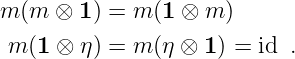
Firstly, a unital associative algebra consists of a linear space A together with two linear
maps
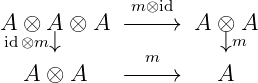
satisfying the conditions
This first condition can be seen in terms of a commuting diagram :
Next suppose we consider ‘reversing the arrows’, and take an algebra A equipped with a linear
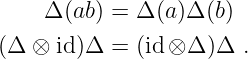
homorphisms Δ : A→A ⊗ A, satisfying, for a,b ∈ A :
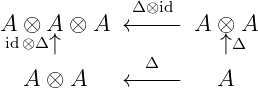
We call Δ a comultiplication, which is said to be coasociative in so far that the following diagram
commutes
There is also a counterpart to η, the counity map 𝜀 : A→ℂ satisfying
A bialgebra (A,m, Δ,η,𝜀) is a linear space A with maps m, Δ,η,𝜀 satisfying the above
properties.
Now to recover anything resembling a group structure, we must append such a bialgebra with an
antihomomorphism S : A→A, satisfying S(ab) = S(b)S(a), for a,b ∈ A . This map is defined
implicitly via the property :
We call S the antipode map. A Hopf algebra is then a bialgebra (A,m,η, Δ,𝜀) equipped with an
antipode map S .
Commutative and noncommutative Hopf algebras form the backbone of quantum ‘groups’ and are
essential to the generalizations of symmetry. Indeed, in most respects a quantum ‘group’ is
identifiable with a Hopf algebra. When such algebras are actually associated with proper groups of
matrices there is considerable scope for their representations on both finite and infinite dimensional
Hilbert spaces.
References
[1] E. M. Alfsen and F. W. Schultz: Geometry of State Spaces of Operator Algebras,
Birkhäuser, Boston–Basel–Berlin (2003).
[2] I. Baianu : Categories, Functors and Automata Theory: A Novel Approach to
Quantum Automata through Algebraic–Topological Quantum Computations., Proceed.
4th Intl. Congress LMPS, (August-Sept. 1971).
[3] I. C. Baianu, J. F. Glazebrook and R. Brown.: A Non–Abelian, Categorical Ontology
of Spacetimes and Quantum Gravity., Axiomathes 17,(3-4): 353-408(2007).
[4] I.C.Baianu, R. Brown J.F. Glazebrook, and G. Georgescu, Towards Quantum
Non–Abelian Algebraic Topology. in preparation, (2008).
[5] F.A. Bais, B. J. Schroers and J. K. Slingerland: Broken quantum symmetry and
confinement phases in planar physics, Phys. Rev. Lett. 89 No. 18 (1–4): 181–201 (2002).
[6] J.W. Barrett.: Geometrical measurements in three-dimensional quantum gravity.
Proceedings of the Tenth Oporto Meeting on Geometry, Topology and Physics (2001).
Intl. J. Modern Phys. A 18 , October, suppl., 97–113 (2003).
[7] M. R. Buneci.: Groupoid Representations, (orig. title “Reprezentari de Grupoizi”),
Ed. Mirton: Timishoara (2003).
[8] M. Chaician and A. Demichev: Introduction to Quantum Groups, World Scientific
(1996).
[9] Coleman and De Luccia: Gravitational effects on and of vacuum decay., Phys. Rev.
D 21: 3305 (1980).
[10] L. Crane and I.B. Frenkel. Four-dimensional topological quantum field theory, Hopf
categories, and the canonical bases. Topology and physics. J. Math. Phys. 35 (no. 10):
5136–5154 (1994).
[11] W. Drechsler and P. A. Tuckey: On quantum and parallel transport in a
Hilbert bundle over spacetime., Classical and Quantum Gravity, 13:611-632 (1996). doi:
10.1088/0264–9381/13/4/004
[12] V. G. Drinfel’d: Quantum groups, In Proc. Intl. Congress of Mathematicians,
Berkeley 1986, (ed. A. Gleason), Berkeley, 798-820 (1987).
[13] G. J. Ellis: Higher dimensional crossed modules of algebras, J. of Pure Appl. Algebra
52 (1988), 277-282.
[14] P.. I. Etingof and A. N. Varchenko, Solutions of the Quantum Dynamical
Yang-Baxter Equation and Dynamical Quantum Groups, Comm.Math.Phys., 196:
591-640 (1998).
[15] P. I. Etingof and A. N. Varchenko: Exchange dynamical quantum groups, Commun.
Math. Phys. 205 (1): 19-52 (1999)
[16] P. I. Etingof and O. Schiffmann: Lectures on the dynamical Yang–Baxter equations,
in Quantum Groups and Lie Theory (Durham, 1999), pp. 89-129, Cambridge University
Press, Cambridge, 2001.
[17] B. Fauser: A treatise on quantum Clifford Algebras. Konstanz, Habilitationsschrift.
arXiv:math.QA/0202059 (2002).
[18] B. Fauser: Grade Free product Formulae from Grassman–Hopf Gebras. Ch. 18
in R. Ablamowicz, Ed., Clifford Algebras: Applications to Mathematics, Physics and
Engineering, Birkhäuser: Boston, Basel and Berlin, (2004).
[19] J. M. G. Fell.: The Dual Spaces of C*–Algebras., Transactions of the American
Mathematical Society, 94: 365–403 (1960).
[20] F.M. Fernandez and E. A. Castro.: (Lie) Algebraic Methods in Quantum Chemistry
and Physics., Boca Raton: CRC Press, Inc (1996).
[21] R. P. Feynman: Space–Time Approach to Non–Relativistic Quantum Mechanics,
Reviews of Modern Physics, 20: 367–387 (1948). [It is also reprinted in (Schwinger 1958).]
[22] A. Fröhlich: Non–Abelian Homological Algebra. I. Derived functors and satellites.,
Proc. London Math. Soc., 11(3): 239–252 (1961).
[23] R. Gilmore: Lie Groups, Lie Algebras and Some of Their Applications., Dover Publs.,
Inc.: Mineola and New York, 2005.
[24] P. Hahn: Haar measure for measure groupoids., Trans. Amer. Math. Soc. 242:
1–33(1978).
[25] P. Hahn: The regular representations of measure groupoids., Trans. Amer. Math.
Soc. 242:34–72(1978).
[26] R. Heynman and S. Lifschitz. 1958. Lie Groups and Lie Algebras., New York and
London: Nelson Press.
[27] C. Heunen, N. P. Landsman, B. Spitters.: A topos for algebraic quantum theory,
(2008). arXiv:0709.4364v2 [quant–ph]