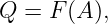
The main representation result underlying Morita theory is the Eilenberg–Watts theorem.
Theorem 1 (Eilenberg–Watts). Let A and B be rings, and let
be an additive, right-exact functor that preserves arbitrary direct sums. Then there exists a
(B,A)-bimodule Q, unique up to isomorphism, such that F is naturally isomorphic to the
tensor-product functor
One may take
with its right A-module structure induced by the endomorphisms of the left regular A-module.
This theorem yields the standard bimodule characterization of Morita equivalence.
Corollary 1. Two rings A and B are Morita equivalent if and only if there exist an
(A,B)-bimodule P and a (B,A)-bimodule Q such that
as (A,A)-bimodules and
as (B,B)-bimodules.
In this situation the functors
and
are quasi-inverse equivalences.
Moreover,
and P and Q are finitely generated projective generators on the appropriate sides.
Proof sketch. If the module categories are equivalent, choose quasi-inverse equivalences F and G.
By the Eilenberg–Watts theorem,
for suitable bimodules Q and P. Since
evaluating at the regular modules gives
Conversely, these bimodule isomorphisms immediately show that the two tensor functors above are
quasi-inverse equivalences.
Corollary 2. If A and B are Morita equivalent, then:
- the categories of right modules
are equivalent;
- the categories of bimodules
are equivalent.
With bimodules P and Q as above, an equivalence on bimodules is given by
It sends the regular (A,A)-bimodule A to the regular (B,B)-bimodule B, since
A quasi-inverse is