0.1 Introduction and basic concepts
Compact quantum groupoids were introduced in Landsman (1998) as a simultaneous
generalization of a compact groupoid and a quantum group. Since this construction is relevant to
the definition of locally compact quantum groupoids and their representations investigated here, its
exposition is required before we can step up to the next level of generality. Firstly, let 𝔄 and 𝔅
denote C*–algebras equipped with a *–homomorphism ηs : 𝔅→𝔄, and a *–antihomomorphism
ηt : 𝔅→𝔄 whose images in 𝔄 commute. A non–commutative Haar measure is defined as a
completely positive map P : 𝔄→𝔅 which satisfies P(Aηs(B)) = P(A)B . Alternatively, the
composition ℰ = ηs ∘ P : 𝔄→ηs(B) ⊂ 𝔄 is a faithful conditional expectation.
0.2 Groupoids and quantum compact groupoids
Let us consider G to be a (topological) groupoid.
We denote by Cc(G) the space of smooth complex–valued functions with compact support on G .
In particular, for all f,g ∈ Cc(G), the function defined via convolution
is again an element of Cc(G), where the convolution product defines the composition law on
Cc(G) . We can turn Cc(G) into a *–algebra once we have defined the involution ∗, and this is
done by specifying f∗(γ) = f(γ−1) .
0.2.1 Groupoid representations
We recall that following Landsman (1998) a representation of a groupoid G, consists of a family (or
field) of Hilbert spaces {ℋx}x∈X indexed by X = Ob G, along with a collection of maps
{U(γ)}γ∈G, satisfying:
- U(γ) : ℋs(γ)→ℋr(γ), is unitary.
- U(γ1γ2) = U(γ1)U(γ2), whenever (γ1,γ2) ∈ G(2) (the set of arrows).
- U(γ−1) = U(γ)∗, for all γ ∈ G .
0.2.2 Lie groupoids, their dual algebroids and representations on Hilbert space bundles
Suppose now Glc is a Lie groupoid. Then the isotropy group Gx is a Lie group, and for a (left or
right) Haar measure μx on Gx, we can consider the Hilbert spaces ℋx = L2(G
x,μx) as exemplifying
the above sense of a representation. Putting aside some technical details which can be found in
Connes (1994) and Landsman (2006), the overall idea is to define an operator of Hilbert
spaces
given by
for all γ ∈ Gx, and ξ ∈ℋx . For each x ∈ X = Ob G, πx defines an involutive representation
πx : Cc(G)→ℋx . We can define a norm on Cc(G) given by
whereby the completion of Cc(G) in this norm, defines the reduced C*–algebra Cr∗(G) of G
lc. It is
perhaps the most commonly used C*–algebra for Lie groupoids (groups) in noncommutative
geometry.
0.2.3 Hilbert bimodules and tensor products
The next step requires a little familiarity with the theory of Hilbert modules (see e.g. Lance, 1995).
We define a left 𝔅–action λ and a right 𝔅–action ρ on 𝔄 by λ(B)A = Aηt(B) and
ρ(B)A = Aηs(B) . For the sake of localization of the intended Hilbert module, we implant a
𝔅–valued inner product on 𝔄 given by ⟨A,C⟩𝔅 = P(A∗C) . Let us recall that P is defined as a
completely positive map. Since P is faithful, we fit a new norm on 𝔄 given by ∥A∥2 = ∥P(A∗A)∥𝔅 .
The completion of 𝔄 in this new norm is denoted by 𝔄− leading then to a Hilbert module over
𝔅 .
The tensor product 𝔄−⊗𝔅𝔄− can be shown to be a Hilbert bimodule over 𝔅, which for i = 1, 2,
leads to *–homorphisms φi : 𝔄→ℒ𝔅(𝔄−⊗ 𝔄−) . Next is to define the (unital) C*–algebra
𝔄 ⊗𝔅𝔄 as the C*–algebra contained in ℒ𝔅(𝔄−⊗ 𝔄−) that is generated by φ1(𝔄) and
φ2(𝔄) .
0.3 Definition of compact quantum groupoids: axioms, coproducts, and bimodule
antihomomorphism
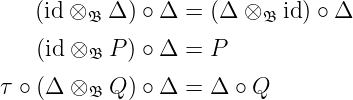
The last stage of the recipe for defining a compact quantum groupoid entails considering a certain
coproduct operation Δ : 𝔄→𝔄 ⊗𝔅𝔄, together with a coinverse Q : 𝔄→𝔄 that it is both an algebra
and bimodule antihomomorphism. Finally, the following axiomatic relationships are
observed :
where τ is a flip map : τ(a ⊗ b) = (b ⊗ a) .
0.3.1 Locally compact quantum groupoids (LCQG)
There is a natural extension of the above definition of quantum compact groupoids to locally
compact quantum groupoids by taking Glc to be a locally compact groupoid (instead of a compact
groupoid), and then following the steps in the above construction with the topological
groupoid G being replaced by Glc. Additional integrability and Haar measure system
conditions need however be also satisfied as in the general case of locally compact groupoid
representations.
References
[1] E. M. Alfsen and F. W. Schultz: Geometry of State Spaces of Operator Algebras,
Birkhäuser, Boston–Basel–Berlin (2003).
[2] M. R. Buneci.: Groupoid Representations, Ed. Mirton: Timishoara (2003).
[3] J. M. G. Fell.: The Dual Spaces of C*–Algebras., Transactions of the American
Mathematical Society, 94: 365–403 (1960).
[4] R. Gilmore: Lie Groups, Lie Algebras and Some of Their Applications., Dover Publs.,
Inc.: Mineola and New York, 2005.
[5] P. Hahn: Haar measure for measure groupoids, Trans. Amer. Math. Soc. 242:
1–33(1978).
[6] P. Hahn: The regular representations of measure groupoids., Trans. Amer. Math.
Soc. 242:34–72(1978).