0.1 Dynamic Adjointness, Similarity and Analogous Systems.
-
1.
- Comparing systems: Similarity relations;
-
2.
- Analogous and Adjoint Systems;
-
3.
- Classification as a Dynamic Analogy;
-
4.
- Categorical adjointness and Functional Homology;
-
5.
- topological Dynamics: Topological conjugation/ and Dynamic Equivalence;
-
6.
- Applications of Adjointness in quantum field theories (QFT);
-
7.
- Applications of Categorical Adjointness in Mathematical Biology;
Categorical comparisons of different types of systems in diagrams provide useful means for their
classification and understanding the relations between them. Thus, two dynamic systems whose state
spaces are isomorphic such that their dynamics commute with the isomorphism of their state spaces are
defined to be analogous systems. A related, dynamic similarity between systems is recalled in the next
section.
From a global viewpoint, comparing categories of such different systems does reveal useful analogies, or
similarities, between systems and also their universal properties. According to Rashevsky (1969),
general relations between sets of biological organisms can be compared with those between
societies, thus leading to more general principles pertaining to both. This can be considered as a
further, practically useful elaboration of Spencer’s philosophical principle ideas in biology and
sociology.
0.1.1 Topological Dynamics: Topological Conjugation/Conjugacy and Dynamic Equivalence.
When two dynamic systems have state spaces with defined topologies one can naturally define their
dynamic equivalence in terms of topological conjugation as a form of dynamic, topological equivalence.
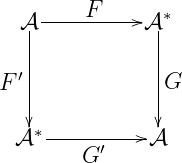
Thus, topological conjugation can be considered as a particular case of the commutative square diagram
(0.1) in the next subsection where the four corners of diagram (0.1) are replaced sequentially by
topological spaces X,Y,X and Y , respectively, and the two pairs of adjoint functors (F,G) and (G′,F′)
are then naturally replaced by two corresponding pairs of homeomorphisms between X and
Y .
Remark: One notes that topological equivalence is considered to be a weaker equivalence by comparison
with topological conjugacy or conjugation because–unlike topological conjugacy–a topological equivalence
of dynamical systems does not map the time variable along with the orbits and their orientation. An often
cited example of topologically equivalent, but not topologically conjugate systems, is that of the
non-hyperbolic class of two-dimensional (2D) solutions of systems of differential equations which have
closed orbits.
0.1.2 Diagrams Linking Super– and Ultra– Complex/Meta–Levels.
When viewed from a formal perspective of Poli’s theory of levels (Baianu and Poli, 2008), the two levels of
super– and ultra– complex systems are quite distinct in many of their defining properties, and therefore,
categorical diagrams that ‘mix’ such distinct levels do not commute. Considering dynamic
similarity, Rosen (1968) introduced the concept of ‘analogous’ (classical) dynamical systems
in terms of categorical, dynamic isomorphisms between their isomorphic state-spaces that
commute with their transition (state) function, or dynamic laws. However, the extension of this
concept to either complex or super-complex systems has not yet been investigated, and may be
similar in importance to the introduction of the Lorentz-Poincaré group of transformations for
reference frames in Relativity theory. On the other hand, one is often looking for relational
invariance or similarity in functionality between different organisms or between different stages of
development during ontogeny–the development of an organism from a fertilized egg. In this context,
the categorical concept of ‘dynamically adjoint systems’ was introduced in relation to the
data obtained through nuclear transplant experiments (Baianu and Scripcariu, 1974). Thus,
extending the latter concept to super– and ultra– complex systems , one has in general, that two
complex or supercomplex systems with ‘state spaces’ being defined respectively as 𝒜 and
𝒜∗ , are dynamically adjoint if they can be represented naturally by the following (functorial)
diagram:
with F ≈ F′ and G ≈ G′ being isomorphic (that is, ≈ representing natural equivalences between adjoint
functors of the same kind, either left or right), and as above in diagram (0.1), the two diagonals are,
respectively, the state-space transition functions Δ : 𝒜→𝒜 and Δ∗ : 𝒜∗ →𝒜∗ of the two
adjoint dynamical systems. (It would also be interesting to investigate dynamic adjointness in
the context of quantum dynamical systems and quantum automata, as defined in Baianu,
1971a).
A left-adjoint functor, such as the functor F in the above commutative diagram between categories
representing state spaces of equivalent cell nuclei preserves limits (or ‘commutes with the
inductive limit in 𝒜 of any functor’), whereas the right-adjoint (or coadjoint) functor, such as G
above, preserves colimits (or commutes with the projective limit in 𝒜∗ of any functor). (For
precise definitions of adjoint functors the reader is referred to Brown, Galzebrook and Baianu,
2007, as well as to Popescu, 1973, Baianu and Scripcariu, 1974, and the initial paper by Kan,
1958).
0.1.3 Nuclear Transplant Experiments, Cloning, Embryogenesis, Development and Other Biological
applications
Consider dynamic attractors and genericity of states as in the above diagram that are preserved in
differentiating cells up to the blastula stage of organismic development. Subsequent stages of ontogenetic
development can be considered only ‘weekly adjoint’ or partially analogous. Similar dynamic controls may
operate for controlling division cycles in the cells of different organisms; therefore, such instances are also
good example of the dynamic adjointness relation between cells of different organisms that may be very far
apart phylogenetically, even on different ‘branches of the tree of life.’ A more elaborate dynamic concept of
‘homology’ between the genomes of different species during evolution was also proposed (Baianu, 1971a),
suggesting that an entire phylogenetic series can be characterized by a topologically–rather
than biologically–homologous sequence of genomes which preserves certain genes encoding
the essential biological functions. A striking example was recently suggested involving the
differentiation of the nervous system in the fruit fly and mice (and perhaps also man) which leads to
the formation of the back, middle and front parts of the neural tube. A related, topological
generalization of such a dynamic similarity between systems was previously introduced as topological
conjugacy(Baianu, 1986-1987a; Baianu and Lin, 2004), which replaces recursive, digital simulation with
symbolic, topological modelling for both super– and ultra– complex systems (Baianu and
Lin., 2004; Baianu, 2004c; Baianu et al., 2004, 2006b). This approach stems logically from the
introduction of topological/ computation and topological computers Baianu, 1971b), as well as
their natural extensions to quantum nano-automata (Baianu, 2004a), quantum automata and
quantum computers (Baianu, 1971a, and 1971b, respectively); the latter may allow us to make a
‘quantum leap’ in our understanding Life and the higher complexity levels in general. Such
is also the relevance of quantum logics and LM-logic algebra to understand the immanent
operational logics of the human brain and the associated mind meta–level. Quantum Logics
concepts are introduced next that are also relevant to the fundamental, or ‘ultimate’, concept of
spacetime, well-beyond our phenomenal reach, and thus in this specific sense,transcedental to our
physical experience (perhaps vindicating the need for a Kantian–like transcedental logic, but
from a quite different standpoint than that originally advanced by Kant in his critique of
‘pure’ reason; instead of being ‘mystical’- as Husserl might have said–the transcedental logic
of quantized spacetime is very different from the Boolean logic of digital computers, as it is
quantum, and thus non–commutative). A Transcedental Ontology, whereas with a definite
Kantian ‘flavor’, would not be as unacceptable as it was to Husserl, but would rely on ‘verifiable’
many–valued, non–commutative logics, and thus contrary to Kant’s original presupposition, as
well as untouchable by Husserl’s critique. The fundamental nature of spacetime would be
‘provable’ and ‘verifiable’, but only to the extent allowed by Quantum Logics, not by an arbitrary
Kantian–‘transcedental’ logic or by impossible, direct phenomenal observations at the Planck
scale.