|
|
|
|||||||
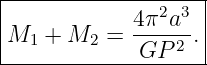
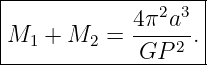
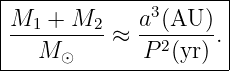
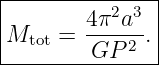
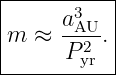
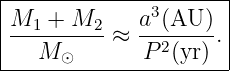
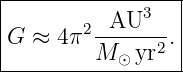
In SI units this equation explicitly contains the Newtonian gravitational constant G. Yet introductory astronomy often writes the same binary star relation in the remarkably simple form
Where did G go? It did not disappear from the physics. The combination involving G has been absorbed into the chosen units of
The underlying quantity is the solar gravitational parameter
This derivation shows exactly how Equation (1) becomes Equation (2), why the Earth-Sun system provides the natural normalization, and why the familiar iastronomical unit form is properly written with an approximate equality sign in modern usage.
Figure 1. The simple iastronomical unit form is obtained by expressing orbital size, period, and total mass in units chosen from the Sun-Earth system.
1 Begin with the SI equationFor an isolated binary star,
The Newtonian dynamical-mass relation is
In SI units,
The formula is exact within the Newtonian two-body model.
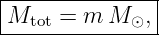
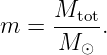
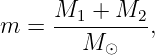
2 Introduce dimensionless astronomical quantitiesWrite the total mass as a number of solar masses:
where
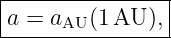
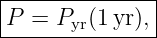
Write the orbital semimajor axis as
where aAU is the numerical semimajor axis in astronomical units. Write the orbital period as
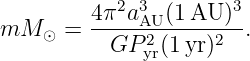
where Pyr is the numerical period in years. Substitute Equations (5)–(7) into Equation (4):
Expand:
Now divide by M⊙:
This equation exposes the entire issue. The familiar simplified formula follows if the quantity in square brackets is approximately one.
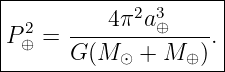
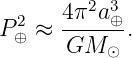
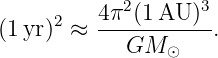
3 The Earth-Sun normalizationConsider the Newtonian orbit of Earth around the Sun. The two-body relation is
Because
we can write
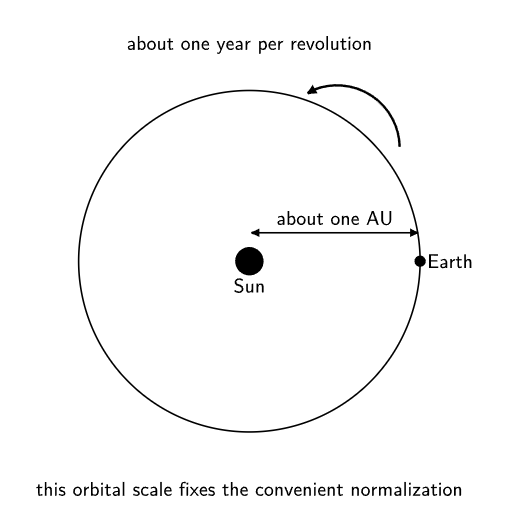
The astronomical unit and year are natural length and time scales for Solar-system orbital motion. Thus, schematically,
Therefore
Rearrange:
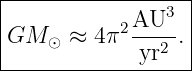
This is the key conversion.
Figure 2. The Sun-Earth orbital scale provides the natural normalization that makes the numerical coefficient in Kepler’s third law nearly unity in astronomical units.
4 Substitute the normalizationReturn to Equation (8):
Using Equation (10),
Therefore
Since
we obtain
This is the standard iastronomical unit form.
5 So where did
|
 | (13) |
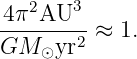
The unit system is arranged so that
 | (14) |
is numerically close to
 | (15) |
when expressed in
 | (16) |
That is why the explicit 4π2∕G factor disappears from the familiar classroom formula.
 is more direct observationally than
  alone
aloneOrbital dynamics directly measures gravitational parameters such as
 | (17) |
For the Sun, planetary motion constrains
 | (18) |
much more directly than it constrains M⊙ in kilograms.
To obtain a solar mass in kilograms, one must divide by the laboratory-measured Newtonian constant:
| (13) |
The uncertainty in G is much larger than the relative uncertainty with which Solar-system dynamics can determine a solar gravitational parameter.
For this reason precision astronomy often treats gravitational parameters as primary dynamical quantities.
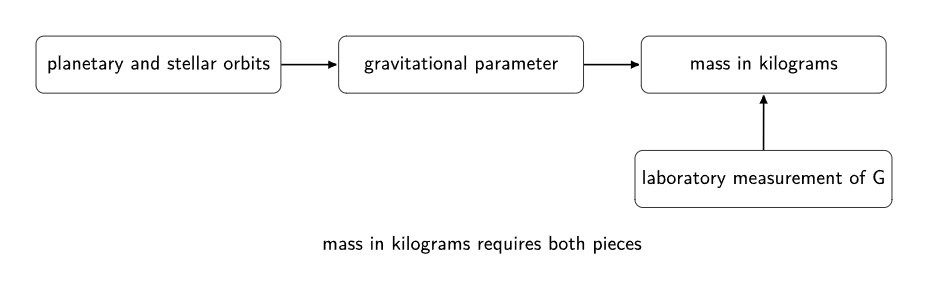
Figure 3. Orbital dynamics measures a gravitational parameter directly. Converting that parameter into kilograms requires a separate laboratory value of the Newtonian gravitational constant.
 in astronomical units
One can formally express the Newtonian gravitational constant in the unit system
 | (19) |
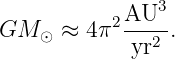
From Equation (10),
 | (20) |
Divide by one solar mass:
| (14) |
If this numerical form of G is substituted into Equation (4), the factors of 4π2 cancel directly.
This notation is useful pedagogically, but Equation (14) should be understood as a numerical expression for G in a particular system of units, not as a new physical law.
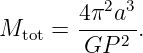
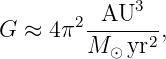
Start again from
 | (21) |
Using
 | (22) |
we have
![--------4π2a3---------
Mtot ≈ [4π2AU3 ∕(M ⊙yr2)]P 2.](https://images.physicslibrary.org/cache/objects/1414/make4ht/WhyTheAstronomicalUnitFormOfKeplersThirdLawHasNoExplicitG39x.png) | (23) |
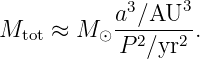
Cancel 4π2:
 | (24) |
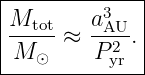
Therefore
 | (25) |
The simplicity is entirely a consequence of unit normalization.
Historically, the astronomical unit was not always defined as an exact number of meters.
Classical Solar-system astronomy used the Gaussian gravitational constant, conventionally written k, as part of the astronomical system of units.
The historical system connected
That convention made Keplerian orbital relations especially convenient for planetary calculations.
Modern metrology changed this arrangement.
The astronomical unit is now an exact SI length, and the Gaussian gravitational constant is no longer a defining astronomical constant.
The International Astronomical union redefined the astronomical unit in 2012 as exactly
| (15) |
This is now a conventional unit of length.
It is no longer defined dynamically through Earth’s orbit or through the Gaussian gravitational constant.
The modern AU is therefore an exact conversion to SI length.
For stellar and exoplanetary astronomy, the International Astronomical Union adopted a nominal solar mass parameter:
| (16) |
The superscript N indicates that this is a nominal conversion constant.
It is exact by definition and is useful for expressing stellar and planetary quantities consistently.
It should not be confused with a claim that the physical Sun’s actual gravitational parameter is known with zero uncertainty.
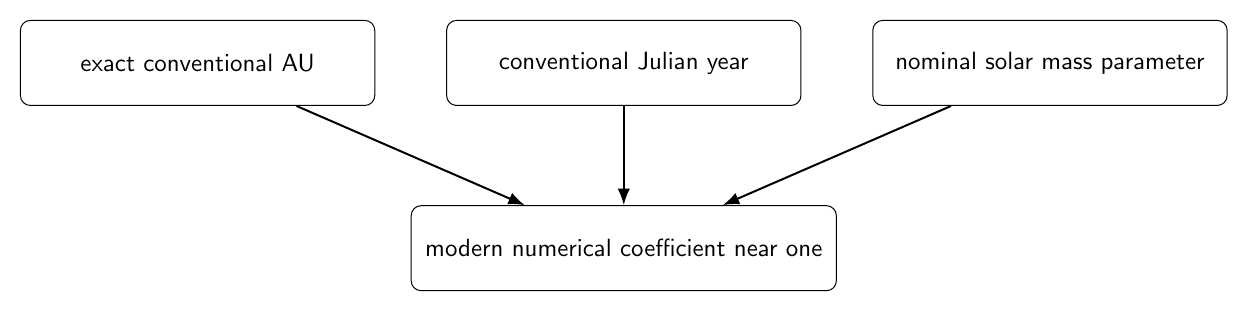
Figure 4. Modern astronomy separates exact conventional unit definitions from measured physical quantities.
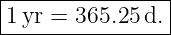
A common astronomical year used for unit conversion is the Julian year:
| (17) |
With
 | (26) |
the Julian year is
| (18) |
This provides a precise conventional time conversion for evaluating the coefficient in Equation (8).
Using
| 1 au | = 149 597 870 700 m, | (27) |
| 1 yr | = 31 557 600 s, | (28) |
| (GM)⊙N | = 1.3271244 × 10²⁰ m3 s−2, | (29) |
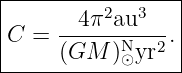
define
| (19) |
Numerically,
| (20) |
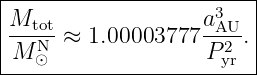
Therefore the modern nominal-unit relation is
| (21) |
For most introductory binary star calculations,
 | (30) |
to far better precision than typical observational uncertainties.
Thus Equation (12) remains entirely appropriate for introductory work.
The fractional difference between the modern coefficient and unity is
| (22) |
As a percentage,
| (23) |
A binary whose simplified formula gives
 | (31) |
would differ by only about
 | (32) |
if this nominal modern coefficient alone were applied.
That difference is negligible in many introductory problems, though precision stellar-mass work should use a clearly specified system of constants.
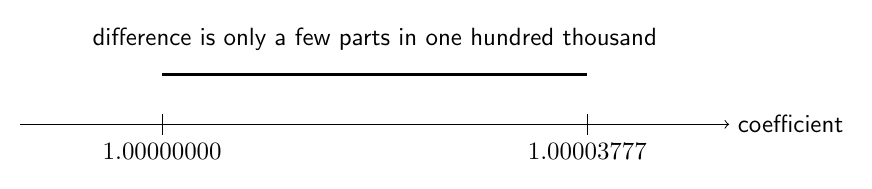
Figure 5. The familiar coefficient of one is an excellent approximation. Modern exact unit conventions shift the nominal coefficient only by a few parts in one hundred thousand.
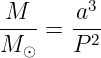
There are several reasons not to treat
 | (33) |
as a timeless exact identity.
First, the modern astronomical unit is an exact SI length rather than a dynamically defined orbital scale.
Second, the Julian year is a conventional time unit.
Third, the physical solar gravitational parameter is observational, while the nominal solar mass parameter is a defined conversion constant.
Fourth, the Earth-Sun system is a two-body approximation only at the simplest level.
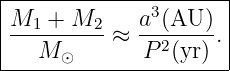
Therefore the careful introductory statement is
 | (34) |
For precision work, one should retain the chosen gravitational parameter and exact unit conversions explicitly.
The dimensions of the Newtonian gravitational constant are
| (24) |
Therefore
 | (35) |
has dimensions of mass.
Now choose units
| L0 | = AU, | (36) |
| T0 | = yr, | (37) |
| M0 | = M⊙. | (38) |
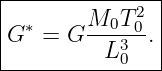
The dimensionless numerical value of G in this system is
| (25) |
With the traditional Sun-Earth normalization,
 | (39) |
Thus the simplified Kepler relation is a classic example of how a clever unit choice can absorb physical constants into dimensionless numerical coefficients.
The same phenomenon appears throughout physics.
For example, one can choose units in which
 | (40) |
in relativity.
That does not mean the speed of light ceases to exist.
It means time and length units have been chosen so that the numerical conversion factor between them is one.
Likewise, choosing AU, years, and solar masses makes the gravitational normalization in Kepler’s third law extremely simple.
The physics remains unchanged.
Suppose a binary has
| a | = 10 AU, | (41) |
| P | = 20 yr. | (42) |
The simplified iastronomical unit form gives
 | ≈ | (43) |
=  | (44) | |
| = 2.5 . | (45) |
Using the modern nominal coefficient,
 | ≈ 1.00003777 | (46) |
| ≈ 2.50009 . | (47) |
The difference is insignificant for most introductory applications.
 in SI looks inconvenient
Using the 2022 CODATA recommended value,
 | (48) |
an SI calculation requires:
The iastronomical unit form performs those conversions once through the unit normalization instead of repeating them in every orbital calculation.
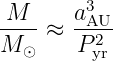
For introductory problems,
 | (49) |
is usually ideal.
For high-precision work, the calculation should state:
Precision orbital work often uses GM directly because that is the quantity constrained by the dynamics.
The SI form of Kepler’s third law for a binary star is
 | (50) |
Expressing mass, orbital size, and period in solar masses, AU, and years gives
![|------------[---------]-----|
|M1 + M2 4 π2AU3 a3AU |
|---------= -------2- --2-.|
---M-⊙--------GM--⊙yr----Pyr--](https://images.physicslibrary.org/cache/objects/1414/make4ht/WhyTheAstronomicalUnitFormOfKeplersThirdLawHasNoExplicitG71x.png) | (51) |
The Sun-Earth normalization makes the quantity in brackets extremely close to unity.
Therefore
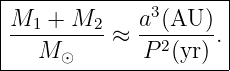 | (52) |
The constant G has not disappeared physically.
Its numerical effect has been absorbed into the unit system through the solar gravitational parameter and the chosen length, time, and mass scales.
Modern IAU conventions separate the exact astronomical unit from measured and nominal gravitational parameters, which is why the approximate equality sign is the careful choice.
[1] B. W. Carroll and D. A. Ostlie, An Introduction to Modern Astrophysics, 2nd ed., Cambridge University Press, 2017.
[2] International Astronomical Union, Resolution B2 on the re-definition of the astronomical unit of length, XXVIII General Assembly, 2012.
[3] International Astronomical Union, Resolution B3 on recommended nominal conversion constants for selected solar and planetary properties, XXIX General Assembly, 2015.
[4] P. J. Mohr, D. B. Newell, B. N. Taylor, and E. Tiesinga, CODATA Recommended Values of the Fundamental Physical Constants: 2022, National Institute of Standards and Technology, 2024–2025.
[5] R. W. Hilditch, An Introduction to Close Binary Stars, Cambridge University Press, 2001.
| Other names: | BIN01D2 |
| Also defines: | astronomical unit form of Kepler's third law, solar gravitational parameter, nominal solar mass parameter, astronomical unit normalization |
| Keywords: | binary stars, Kepler's third law, astronomical unit, solar mass, solar gravitational parameter, gravitational constant, dynamical mass, Julian year, Gaussian gravitational constant, orbital units |
| Physics Classification: | 97.80.-d (Binary and multiple stars) |
None.
No messages.
![[parent]](https://images.physicslibrary.org/images/uparrow.png)




![4 π2[aAU (1 AU )]3
mM ⊙ = --------------2--.
G [Pyr(1yr)]](https://images.physicslibrary.org/cache/objects/1414/make4ht/WhyTheAstronomicalUnitFormOfKeplersThirdLawHasNoExplicitG10x.png)
![|----[-------------]-----|
| 4π2-(1-AU-)3- a3AU |
m = GM (1yr )2 P2 .|
-----------⊙----------yr--](https://images.physicslibrary.org/cache/objects/1414/make4ht/WhyTheAstronomicalUnitFormOfKeplersThirdLawHasNoExplicitG12x.png)

![[ ]
-4π2AU3-- a3AU-
m = GM ⊙yr2 P 2 .
yr](https://images.physicslibrary.org/cache/objects/1414/make4ht/WhyTheAstronomicalUnitFormOfKeplersThirdLawHasNoExplicitG18x.png)
 go?
go?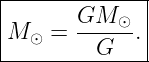






![|------------|
| L3 |
|[G ] = ----2.|
-------M-T----](https://images.physicslibrary.org/cache/objects/1414/make4ht/WhyTheAstronomicalUnitFormOfKeplersThirdLawHasNoExplicitG57x.png)