Vectors in a Plane
Let a and b be nonparallel vectors in a plane. Every vector u in that plane can be written uniquely
as
Thus {a,b} is a basis for the plane.
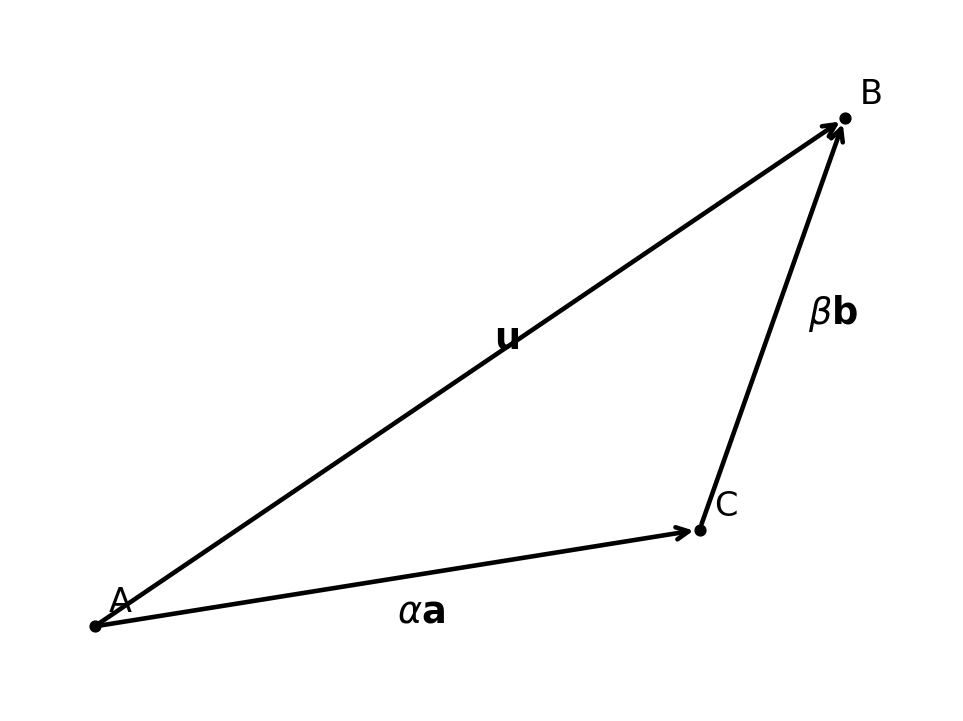
Figure 8, modernized: decomposition of a planar vector in a two-vector basis.
Uniqueness follows from linear independence: if
then α = β = 0.
For noncollinear points A,B,C, every point P in their plane has a unique affine representation
These are affine, or barycentric, coordinates relative to the triangle.
Modern notation references
The notation and terminology in this modernized article follow standard present-day mechanics
and vector-analysis usage, particularly:
- J. R. Taylor, Classical Mechanics, University Science Books, 2005.
- D. Kleppner and R. Kolenkow, An Introduction to Mechanics, 2nd ed., Cambridge
University Press, 2014.
- H. Goldstein, C. Poole, and J. Safko, Classical Mechanics, 3rd ed., Addison–Wesley,
2002.
Source
This article is a modernized restatement of the corresponding Public Domain article in Louis
Brand, Vectorial Mechanics, John Wiley & Sons, New York, 1930, Chapter I, “Vector Algebra.”
The original 1930 edition is the source basis.



