|
|
|
|||||||
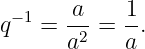
Solving
|
 | (21) |
In general,
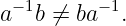
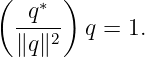
Therefore one must never cancel a quaternion factor without preserving the side on which the inverse acts.
Let

Its conjugate is

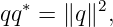
Its squared norm is

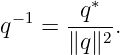
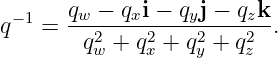
Therefore
 | (22) |
A direct multiplication gives

Let

First compute

and

Thus
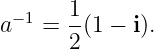
Consider first

The solution is

Hence
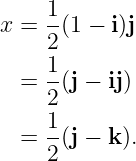
Now consider instead

The solution is

Thus
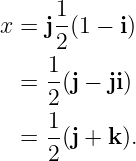
Therefore
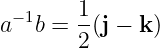 | (23) |
while
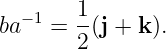 | (24) |
The two division problems have different answers because the inverse acts on different sides.
Let

Their inverses are
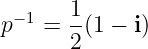
and
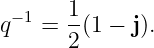
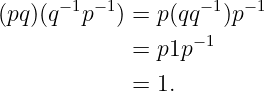
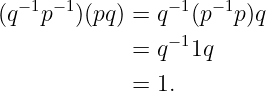
The inverse of the product is

Therefore
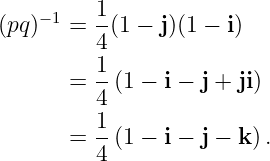
Since

its conjugate is

and its squared norm is
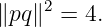
The direct inverse formula gives the same result.
The algebraic inverse formula is independent of active or passive interpretation. Its frame meaning depends on the convention used for orientation.
PhysicsLibrary uses a unit quaternion

to map coordinates from frame A into frame B:
 | (25) |
Since a frame quaternion is unit,

The inverse quaternion therefore represents the reverse coordinate map:
 | (26) |
Consequently,
 | (27) |
The frame labels make the direction of the inverse explicit. Inverting a frame quaternion does not merely change a sign; it reverses which coordinate system is mapped into which.
Suppose

maps coordinates from A into B, and

maps coordinates from B into C.
The direct passive chain is
 | (28) |
Invert both sides:

Using the reversed frame labels gives
 | (29) |
The order reversal in the algebra is exactly what is needed to traverse the frame chain in the opposite direction.
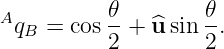
For a positive frame rotation through angle 𝜃 about unit axis u, PhysicsLibrary uses
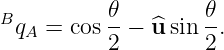 | (30) |
Because this quaternion is unit,

Therefore
 | (31) |
The inverse corresponds to traversing the same frame relation in the opposite direction.
Let

be the passive direction cosine matrix associated with a unit frame quaternion.
The inverse coordinate transformation is

Because the matrix is orthogonal,

The quaternion inverse produces the same map:
 | (32) |
Thus quaternion inversion corresponds to matrix transposition for unit orientation transformations.
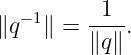
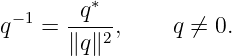
The inverse formula
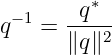
is mathematically valid for every nonzero quaternion, but numerical implementations should consider several practical issues.
In general,
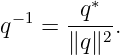
Only a unit quaternion satisfies q−1 = q∗.
The zero quaternion has no multiplicative inverse.
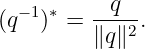
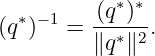
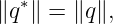
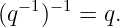
The correct identity is

The expressions a−1b and ba−1 solve different equations and are generally unequal.
For ax = b, multiply by a−1 on the left. For xa = b, multiply by a−1 on the right.
The inverse formula is algebraic and does not change when passive frame maps are adopted.
Under the PhysicsLibrary convention,

It follows from noncommutative multiplication and is required for both algebraic cancellation and correct reversal of frame chains.
The exercises are stated first so the article can be used for self study. Complete solutions follow afterward.
Find the inverse of

For the quaternion in Exercise 1, verify explicitly that

and

Let
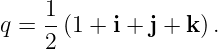
Show that q is unit and find q−1.
Find the inverse of

Let

Compute p−1 and q−1, then verify

For

solve

Using the same a and b, solve

Compare your answer with Exercise 6.
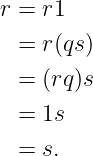
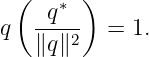
Prove that
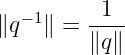
for every nonzero quaternion.
If Bq A maps coordinates from A into B, write the quaternion that maps coordinates from B into A.
Starting from

derive the inverse chain from frame C back to frame A.
Let

The conjugate is

The squared norm is

Therefore
 | (33) |
By construction,

Therefore
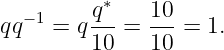
Similarly,
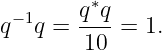
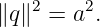
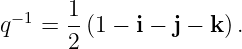
For
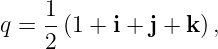
the squared norm is
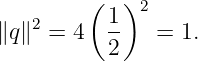
Thus q is unit and

Therefore
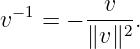
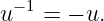
For

the squared norm is

Since v∗ = −v,
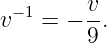
Hence
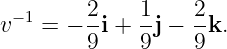
For

we have
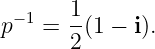
For
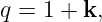
we have
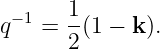
Therefore
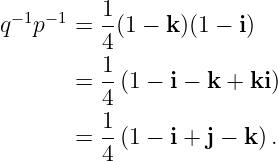
Now

Its conjugate is

and
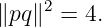
Hence

Given

we have
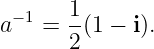
For

the solution is

Thus
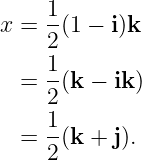
Therefore
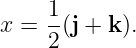
For

the solution is

Hence
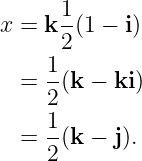
Therefore
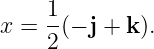
The solutions to Exercises 6 and 7 differ because quaternion multiplication is not commutative.
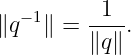
Because

norm multiplicativity gives

Since q≠0,

Therefore
The reverse coordinate map is

Since frame quaternions are unit,

Start from

Invert:

Relabeling the reverse maps gives

The reversed multiplication order agrees with the reversed sequence of frames.
The first five algebra articles have now supplied the main operations needed for quaternion orientation:

For a unit quaternion these collapse to the particularly simple relation

The next PhysicsLibrary article develops the axis angle representation and shows how a physical frame rotation through angle 𝜃 about a unit axis u produces the passive quaternion
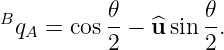
From Q06 onward, the quaternion series can build rotation geometry directly on the algebra developed in Q01 through Q05.
Hamilton’s quaternions form a division algebra: every nonzero quaternion has a two sided multiplicative inverse. Classical quaternion texts often express division through reciprocal quaternions, conjugation, and the historical tensor or norm notation.
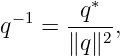
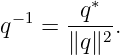
Modern notation makes the inverse especially compact:
The distinction between left and right division is a direct consequence of noncommutative multiplication and should be preserved explicitly in engineering applications.
[1] W. R. Hamilton, Elements of Quaternions, 2nd ed., edited by C. J. Joly, Longmans, Green, and Co., 1899. Public domain historical source. Internet Archive scan
[2] C. J. Joly, A Manual of Quaternions, Macmillan and Co., London, 1905. Public domain historical source. Internet Archive scan
[3] A. S. Hathaway, A Primer of Quaternions, 1896. Public domain historical source. Project Gutenberg edition
[4] Wikibooks contributors, “Abstract Algebra/Quaternions.” Openly licensed instructional source. Wikibooks quaternion article
Unless otherwise noted, this PhysicsLibrary entry is intended for release under the Creative Commons Attribution ShareAlike 4.0 International license.
| Keywords: | quaternion, inverse, reciprocal, division, unit quaternion, conjugate, norm, Hamilton product, noncommutative algebra |
|
| Physics Classification: | 02.10.Hh (Rings and algebras) |
| 02.10.Ud (Linear algebra) |
None.
No messages.













![⌊ qw ⌋
1 | |
[q−1]PL = -----------------| − qx|.
q2w + q2x + q2y + q2z⌈ − qy⌉
− qz](https://images.physicslibrary.org/cache/objects/1094/make4ht/QuaternionInverse24x.png)