Consider the function  , the derivative of Ψ with respect to time; one can say that
the operator
, the derivative of Ψ with respect to time; one can say that
the operator  acting on the function Ψ yields the function
  . More generally, if a
certain operation allows us to bring into correspondence with each function Ψ of a certain
function space, one and only one well-defined function Ψ′ of that same space, one says the
Ψ′ is obtained through the action of a given operator A on the function Ψ, and one
writes
. More generally, if a
certain operation allows us to bring into correspondence with each function Ψ of a certain
function space, one and only one well-defined function Ψ′ of that same space, one says the
Ψ′ is obtained through the action of a given operator A on the function Ψ, and one
writes
By definition A is a linear operator if its action on the function λ1Ψ1 + λ2Ψ2, a linear combination
with constant (complex) coefficients, of two functions of this function space, is given
by
Among the linear operators acting on the wave functions
associated with a particle, let us mention:
- the differential operators ∂∕∂x,∂∕∂y,∂∕∂z,∂∕∂t, such as the one which was considered
above;
- the operators of the form f(r,t) whose action consists in multiplying the function Ψ
by the function f(r,t)
Starting from certain linear operators, one can form new linear operators by the following algebraic
operations:
- multiplication of an operator A by a constant c:
- the sum S = A + B of two operators A and B:
- the product P = AB of an operator B by the operator A:
Note that in contrast to the sum, the product of two operators is not commutative. Therein
lies a very important difference between the algebra of linear operators and ordinary
algebra.
The product AB is not necessarily identical to the product BA; in the first case, B first
acts on the function Ψ, then A acts upon the function (BΨ) to give the final result; in
the second case, the roles of A and B are inverted. The difference AB − BA of these
two quantities is called the commutator of A and B; it is represented by the symbol
[A,B]:
If this difference vanishes, one says that the two operators commute:
As an example of operators which do not commute, we mention the operator f(x),
multiplication by function f(x), and the differential operator ∂∕∂x. Indeed we have, for any
Ψ,
In other words
and, in particular
However, any pair of derivative operators such as ∂∕∂x,∂∕∂y,∂∕∂z,∂∕∂t, commute.
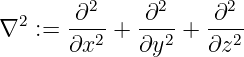
A typical example of a linear operator formed by sum and product of linear operators is the
Laplacian operator
which one may consider as the scalar product of the vector operator gradient ∇ := 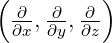 , by
itself.
, by
itself.
0.1 References
[1] Messiah, Albert. ”Quantum mechanics: volume I.” Amsterdam, North-Holland Pub. Co.; New
York, Interscience Publishers, 1961-62.
This entry is a derivative of the Public domain work [1].

![[parent]](https://images.physicslibrary.org/images/uparrow.png)





![[A,B ] := AB − BA](https://images.physicslibrary.org/cache/objects/588/make4ht/QuantumOperatorConcept8x.png)


![[ ]
∂-,f (x) = ∂f-
∂x ∂x](https://images.physicslibrary.org/cache/objects/588/make4ht/QuantumOperatorConcept11x.png)
![[ ∂ ]
---,x = 1
∂x](https://images.physicslibrary.org/cache/objects/588/make4ht/QuantumOperatorConcept12x.png)