The Laplacian operator in spherical coordinates is
The derivation is fairly straight forward and begins with locating a vector r in spherical
coordinates as shown in the figure.

Figure 1. Spherical Coordinates
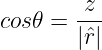
The z component of the unit vector in direction of r is given from the simple right
triangle
Since a unit vector has a length of 1, the z component is
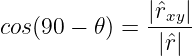
To get the x component, we need to get the r projected onto the xy-plane
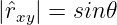
using the trig identity
the projected unit vector is
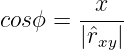
Finally, the x component is reached through the right triangle
giving
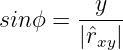
the y component follows the x component through
which yields
The vector in spherical coordinates is then
Now describing the unit vectors of a moving particle r,𝜃,ϕ shown in the spherical coordinates
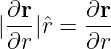
figure is a little more tricky. If a particle moves in the r direction, it only moves in or out along r
so
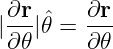
For 𝜃 and ϕ, think of uniform circular motion like a record, so they can be calculated
from
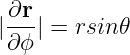
Next, take the partial derivatives of (2) and then calculate their magnitudes to get the above unit
vectors.
Using the basic trig identity
Then plug in these values to get
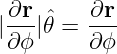
and from before we had
The generalized differential for curvilinear coordinates is
For spherical coordinates we have
and from earlier we learned
Plugging these values into the generalized differential yields
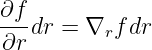
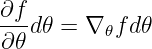
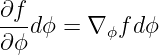
The next major step is to see how the gradient fits into the definition of the differential for a
function f
So we see that the following must be equal and we need to solve for the gradient’s components.
Therfore our scale factors are
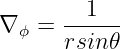
which finally gives us the gradient in spherical coordinates
The last tedious calculation is then the Laplacian, which is our goal
Let us break it up by components to make it easy to view, so carrying out only part of the dot
product our 1st term is
While this looks a little scary, all but the 2nd term is zero. The first term is zero because there is
no r in r
so taking the derivative with respect to r yeilds zero. Similarly, the 3rd and 6th term are zero when
taking the partial derivatives. The 4th,5th,7th and 8th terms are zero because the dot product of
two orthogonal vectors (90o) is zero so
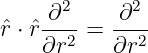
This leaves only the second term
Now onto the 𝜃 term
The dot product gets rid of the 2nd, 3rd, 7th and 8th terms, while the 4th and 6th terms are zero
when taking the derivatives
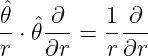
Two terms remain, for the first term we need to calculate
This yields
The 5th term is just the dot product
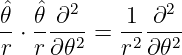
Finally, the ϕ part of the dot product is
Once again the dot product makes the 2nd, 4th and 5th terms zero. The first term
derivative
this leads to
The 3rd term derivative is
this leads to
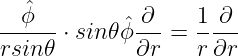
The 6th term can be seen to be zero because the derivative of ϕ with respect to ϕ is a vector
perpendicular to ϕ (feel free to carry out this calculation), so the dot product will be
zero.
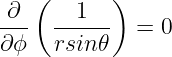
The 7th term derivative is zero
Then we keep the 8th term
Putting the results from (3),(4),(5),(6),(7) and (8) we get
Certainly, we could finish here, but let us combine some terms and notice the following
relationships (check these for yourself)
This gives us the equation given in (1), the Laplacian in spherical coordinates
References
[1] Marsden, J., Tromba, A. ”Vector Calculus” Fourth Edition. W.H. Freeman Company,
1996.
[2] Ellis, R., Gulick, D. ”Calculus” Harcourt Brace Jovanovich, Inc., Orlando, FL, 1991.
[3] Benbrook, J. ”Intermediate Electromagnetic Theory”, lecture notes, University of Houston, Fall
2002.






![r = rˆr = r[sin𝜃cosϕ ˆi + sin 𝜃sinϕ ˆj + cos𝜃 ˆk]](https://images.physicslibrary.org/cache/objects/100/make4ht/LaplacianInSphericalCoordinates10x.png)


![∂r
--- = r[cos𝜃cosϕˆi + cos𝜃 sinϕˆj − sin𝜃ˆk ]
∂ 𝜃](https://images.physicslibrary.org/cache/objects/100/make4ht/LaplacianInSphericalCoordinates14x.png)
![∂r
--- = r[− sin𝜃sin ϕˆi + sin 𝜃cosϕˆj]
∂ ϕ](https://images.physicslibrary.org/cache/objects/100/make4ht/LaplacianInSphericalCoordinates15x.png)
![∂r √ ----- ∘ ------------------------------------
|---| = x ⋅ x = r2[cos2𝜃cos2ϕ + cos2𝜃 sin2ϕ + sin2𝜃]
∂ 𝜃](https://images.physicslibrary.org/cache/objects/100/make4ht/LaplacianInSphericalCoordinates16x.png)
![∂r- ∘ ----2-----2-------2--------2-
|∂𝜃| = r cos 𝜃 (cos ϕ + sin ϕ) + sin 𝜃]](https://images.physicslibrary.org/cache/objects/100/make4ht/LaplacianInSphericalCoordinates17x.png)

![∂r- ∘ ----2-----2-------2--
|∂ϕ| = r sin 𝜃(sin ϕ + cos ϕ)]](https://images.physicslibrary.org/cache/objects/100/make4ht/LaplacianInSphericalCoordinates19x.png)



























![[ ] ( )
∂2 2 ∂ 1 ∂ 2 ∂
∂r2-+ r-∂r- = r2 ∂r- r ∂r-](https://images.physicslibrary.org/cache/objects/100/make4ht/LaplacianInSphericalCoordinates61x.png)
![[ ] ( )
1 ∂2 cos𝜃 ∂ 1 ∂ ∂
r2∂-𝜃2 + r2sin𝜃-∂𝜃- = r2sin-𝜃∂-𝜃 sin𝜃∂-𝜃](https://images.physicslibrary.org/cache/objects/100/make4ht/LaplacianInSphericalCoordinates62x.png)
