1 Laplace Equation in Cylindrical Coordinates
Solutions to the Laplace equation in cylindrical coordinates have wide applicability from fluid
mechanics to electrostatics. Applying the method of separation of variables to Laplace’s partial
differential equation and then enumerating the various forms of solutions will lay down a
foundation for solving problems in this coordinate system. Finally, the use of Bessel
functions in the solution reminds us why they are synonymous with the cylindrical
domain.
1.1 Separation of Variables
Beginning with the Laplacian in Cylindrical Coordinates, apply the operator to a potential
function and set it equal to zero to get the Laplace equation
First expand out the terms
Then apply the method of separation of variables by assuming the solution is in the
form
Plug this into (2) and note how we can bring out the functions that are not affected by the
derivatives
Divide by R(r)P(ϕ)Z(z) and use short hand notation to get
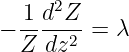
“Separating” the z term to the other side gives
This equation can only be satisfied for all values if both sides are equal to a constant, λ, such
that
Before we can focus on solutions, we need to further separate (4), so multiply (4) by
r2
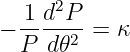
Separate the terms
As before, set both sides to a constant, κ
Now there are three differential equations and we know the form of these solutions. The differential
equations of (3) and (5) are ordinary differential equations, while (6) is a little more complicated
and we must turn to Bessel functions.
1.2 Axial Solutions (z)
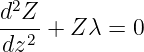
Following the guidelines setup in [Etgen] for linear homogeneous differential equations, the first
step in solving
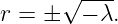
is to find the roots of the characteristic polynomial
Although, one can go forward using the square root, here we will introduce another constant, γ to
imply the following cases. So if we want real roots, then we want to ensure a negative
constant
and if we want complex roots, then we want to ensure a positive constant
Case 1: λ ≤ 0 and real roots (λ = −γ2).
For every real root, there will be an exponential in the general solution. The real roots
are
Therefore, the solutions for these roots are
Combining these using the principle of superposition, gives the general solution,
Case 2: λ > 0 and complex roots (λ = γ2).
The roots are
and the corresponding solutions
Combining these into a general solution yields
1.3 Azimuthal Solutions (𝜃)
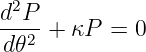
Azimuthal solutions for
are in the most general sense obtained similarly to the axial solutions with the characteristic
polynomial
Using another constant, ν to ensure positive or negative constants, we get two cases.
Case 1: κ ≤ 0 and real roots (κ = −ν2).
The solutions for these roots are then
Combining these for the general solution,
Case 2: κ > 0 and complex roots (κ = ν2).
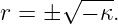
The roots are
and the corresponding solutions
Combining these into a general solution
For the first glimpse at simplification, we will note a restriction on κ that is used when it is
required that the solution be periodic to ensure P is single valued
Then we are left with either the periodic solutions that occur with complex roots or the zero case.
So not only
but also ν must be an integer, i.e.
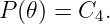
Note, that ν = 0, is still a solution, but to be periodic we can only have a constant
1.4 Radial Solutions (r)
The radial solutions are the more difficult ones to understand for this problem and are solved using
a power series. The two types of solutions generated based on the choices of constants from the 𝜃
and z solutions (excluding non-periodic solutions for P) leads to the Bessel functions and the
modified Bessel functions. The first step for both these cases is to transform (6) into the Bessel
differential equation.
Case 1: λ < 0 (λ = −γ2), κ > 0 (κ = ν2).
Substitute γ and ν into the radial equation (6) to get
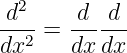
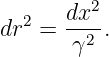
Next, use the substitution
Therefore, the derivatives are
and make a special note that
so
Substituting these relationships into (10) gives us
Finally, multiply by R∕x2 to get the Bessel differential equation
Delving into all the nuances of solving Bessel’s differential equation is beyond the scope of this
article, however, the curious are directed to Watson’s in depth treatise [Watson]. Here, we will
just present the results as we did for the previous differential equations. The general
solution is a linear combination of the Bessel function of the first kind Jν(r) and the
Bessel function of the second kind Y ν(r). Remebering that ν is a positive integer or
zero.
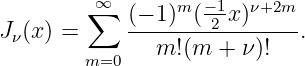
Bessel function of the first kind:
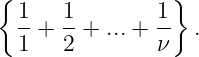
Bessel function of the second kind (using Hankel’s formula):
For the unfortunate person who has to evaluate this function, note that when m = 0, the
singularity is taken care of by replacing the series in brackets by
Some solace can be found since most physical problems need to be analytic at x = 0 and
therefore Y ν(x) breaks down at ln(0). This leads to the choice of constant C2 to be
zero.
Case 2: λ > 0 (λ = γ2), κ > 0 (κ = ν2).
Using the previous method of substitution, we just get the change of sign
This leads to the modified Bessel functions as a solution, which are also known as the pure
imaginary Bessel functions. The general solution is denoted
where Iν is the modified Bessel function of the first kind and Kν is the modified Bessel function of
the second kind
1.5 Combined Solution
Keeping track of all the different cases and choosing the right terms for boundary conditions is a
daunting task when one attempts to solve Laplace’s equation. The short hand notation used in
[Kusse] and [Arfken] will be presented here to help organize the choices as a reference. It is
important to remember that these solutions are only for the single valued azimuth cases
(κ = ν2).
Once the separate solutions are obtained, the rest is simple since our solution is separable
so we just combine the individual solutions to get the general solutions to the Laplace equation in
cylindrical coordinates.
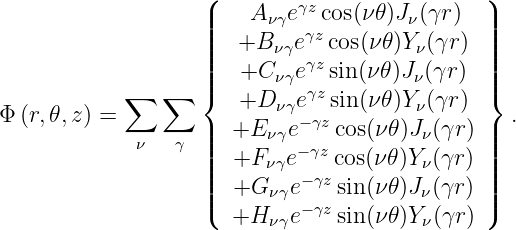
Case 1: λ < 0 (λ = −γ2), κ > 0 (κ = ν2).
Case 2: λ > 0 (λ = γ2), κ > 0 (κ = ν2).
Interpreting the short hand notation is as simple as expanding terms and not forgetting the linear
solutions, i.e. (γ = 0) . As an example, case 1, expanded out while ignoring the linear terms would
give
References
[1] Arfken, George, Weber, Hans, Mathematical Physics. Academic Press, San Diego,
2001.
[2] Etgen, G., Calculus. John Wiley & Sons, New York, 1999.
[3] Guterman, M., Nitecki, Z., Differential Equations, 3rd Edition. Saunders College
Publishing, Fort Worth, 1992.
[4] Jackson, J.D., Classical Electrodynamics, 2nd Edition. John Wiley & Sons, New York,
1975.
[5] Kusse, Bruce, Westwig, Erik, Mathematical Physics. John Wiley & Sons, New York,
1998.
[6] Lebedev, N., Special Functions & Their Applications. Dover Publications, New York,
1995.
[7] Watson, G.N., A Treatise on the Theory of Bessel Functions. Cambridge University
Press, New York, 1995.