Physics Library
 An open source physics library
Encyclopedia | Forums | Docs | Random |  
Login
create new user
Username:
Password:
forget your password?
Main Menu
Sections

Meta

Talkback

Downloads

Information
Heaviside formula (Definition)

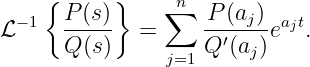
Let P(s) and Q(s) be polynomials with the degree of the former less than the degree of the latter.

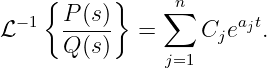
  • If all complex zeroes a1, a2, …, an of Q(s) are simple, then
        {      }    n
 − 1  P-(s)-    ∑   -P(aj)- ajt
ℒ     Q (s )  =     Q ′(aj) e  .
                j=1
    (1)

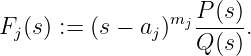
  • If the different zeroes a1, a2, …, an of Q(s) have multiplicities m1, m2, …, mn, respectively, define
                     mjP-(s)
Fj (s) := (s − aj) Q (s).

    Then

        {      }    n      mj−1  (k)    mj− 1− k
 − 1  P-(s-)    ∑    ajt∑    Fj--(aj)t--------
ℒ     Q (s )  =     e        k!(mj  − 1 − k)!.
                j=1     k=0
    (2)

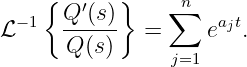
A special case of the Heaviside formula (1) is

    {   ′  }    ∑n
ℒ− 1  Q-(s)- =      eajt.
      Q (s)     j=1
(3)

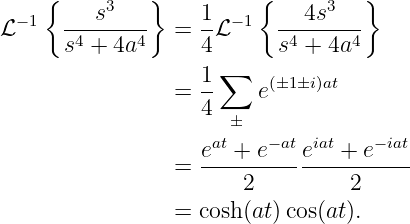
Example. Since the zeroes of the binomial s4 + 4a4 are s = (±1 ± i)a, we obtain

    {         }          {         }
  −1  ---s3---     1- −1   --4s3---
ℒ     s4 + 4a4   = 4ℒ      s4 + 4a4
                     ∑
                 = 1-    e(±1±i)at
                   4  ±
                    at   − at iat    −iat
                 = e--+-e----e--+--e----
                       2         2
                 = cosh(at)cos(at).
(4)

Proof of (1). Without loss of generality, suppose that Q(s) is monic. Therefore

Q (s) = (s − a1)(s − a2) ⋅⋅⋅(s − an ).
(5)

For j = 1, 2, …, n, write

Q (s) = (s − aj)Qj (s),
(6)

so that Qj(aj)0.

We have a partial fraction expansion of the form

P-(s)   --C1--    -C2---        --Cn---
Q (s) = s − a1 +  s − a2 + ⋅⋅ ⋅ + s − an,
(7)

with constants Cj. By linearity of the inverse Laplace transform,

    {      }     n
 − 1  P-(s-)    ∑       ajt
ℒ     Q (s )  =     Cje   .
                j=1
(8)

To determine the constants Cj, multiply the partial fraction expansion by s aj. This gives

-P-(s-)                ∑   --Cν---
Qj (s) = Cj + (s − aj)    s − aν.
                      ν⁄=j
(9)

Setting s = aj gives

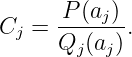
Cj =  P-(aj).
      Qj(aj)
(10)

Since

         d
Q ′(s) =  --((s − aj)Qj (s)) = Qj (s) + (s − aj)Q ′j(s),
         ds
(11)

we have Q(aj) = Qj(aj). Hence

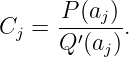
Cj =  P-(aj).
      Q ′(aj)
(12)

Substituting these values into the inverse Laplace expansion yields formula (1).

References

[1]   K. Väisälä, Laplace-muunnos. Handout Nr. 163. Teknillisen korkeakoulun ylioppilaskunta, Otaniemi, Finland (1968).


"Heaviside formula" is owned by pahio.
(view preamble)
View style:

Cross-references: formula, Laplace transform

This is version 2 of Heaviside formula, born on 2009-04-17, modified 2026-09-05.
Object id is 644, canonical name is HeavisideFormula.
Accessed 1426 times total.

Classification:
Physics Classification02.30.Uu (Integral transforms)
Pending Errata and Addenda
None.
Discussion
Style: Expand: Order:

No messages.

Interact
rate | post | correct | update request | add derivation | add example | add (any)