Two harmonic functions u and v from an open subset A of ℝ × ℝ to ℝ, which satisfy the
Cauchy-Riemann equations
are the harmonic conjugate functions of each other.
- The relationship between u and v has a simple geometric meaning: Let’s determine the
slopes of the constant-value curves u(x, y) = a and v(x, y) = b in any point (x, y)
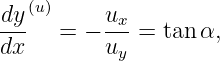
by differentiating these equations. The first gives uxdx + uydy = 0, or
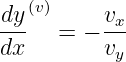
and the second similarly
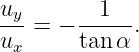
but this is, by virtue of (1), equal to
Thus, by the condition of orthogonality, the curves intersect at right angles in every
point.
- If one of u and v is known, then the other may be determined with (1): When e.g. the
function u is known, we need only to calculate the line integral
along any path connecting (x0, y0) and (x, y) in A. The result is the harmonic
conjugate v of u, unique up to a real addend if A is simply connected.
- It follows from the preceding, that every harmonic function has a harmonic conjugate
function.
- The real part and the imaginary part of a holomorphic function are always the harmonic
conjugate functions of each other.
Example. sin x cosh y and cos x sinh y are harmonic conjugates of each other.