Geiger’s method [1] is an iterative procedure using Gauss-Newton optimization to determine the
location of an earthquake, or seismic event. Originally his method was developed to obtain the
origin time and Epicentre but it is easily extended to include the Focal Depth for Hypocentre
determination.
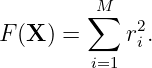
Given a set of M arrival times ti find the origin time t0 and the hypocentre in cartesian
coordinatios (x0,y0,z0) which minimize the objective function
Here, ri is the difference between observed and calculated arrival times
and the unknown parameter vector is
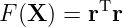
In matrix form (1) becomes
The Gauss–Newton procedure requires an initial guess of the sought parameters, denoted here
as
which are then used to calculate the adjustment vector
in
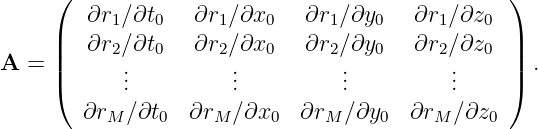
The Jacobian matrix A is defined as
The partial derivatives are evaluated at the initial guess, or trial vector, X∗. Equation (7) can be
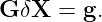
rewritten as
Using (9) and an initial guess X∗ an adjustment vector can be calculated. The initial
guess can then be updated X∗ + δX and used as the inital guess in the next run of
the algorithm. In this manner the sought parameters X can be determined to some
tolerance.
References
[1] Geiger, L., “Probability method for the determination of earthquake epicenters from
the arrival time only.” Bull. St. Louis Univ. vol. 8, pp. 60-71.
[2] Lee, W. H. K. and Stewart, S. W. Principles and Applications of Microearthquake
Networks, Academic Press, New York. 1981
[3] Gibowicz, S. J. and Kijko, A. An Introduction to Mining Seismology, Academic
Press, New York. 1994.