|
|
|
|||||||
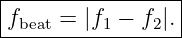
For nearby frequencies,
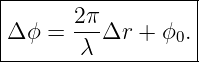
For path difference,
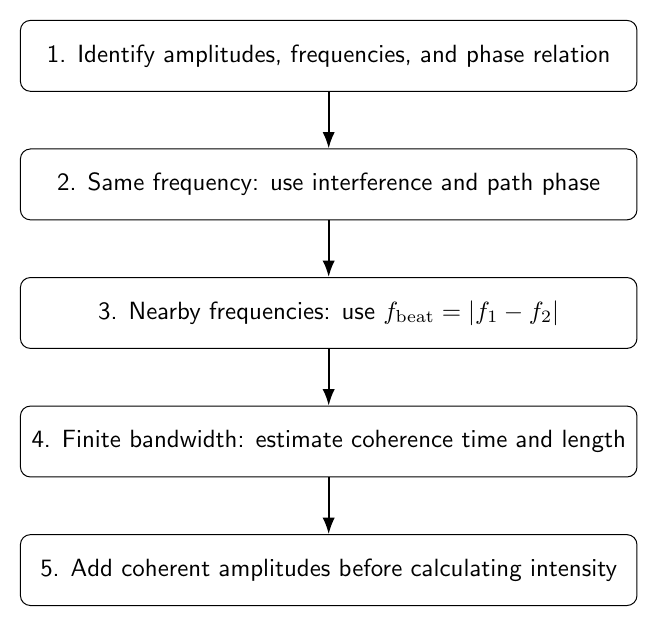
Figure 1. A compact strategy: decide whether the problem concerns fixed-phase interference, nearby-frequency beats, or finite coherence; then work with amplitudes first and intensities second.
1 High-value GRE facts
Part I: Original GRE-style problems
Problem 1: equal-amplitude constructive interferenceTwo coherent waves each have amplitude
and zero phase difference. The resultant amplitude is
Problem 2: destructive interferenceTwo equal-amplitude coherent waves cancel completely when their phase difference is
Problem 3: equal-source intensity maximumEach of two equal coherent sources individually produces intensity
At complete constructive interference, the total intensity is
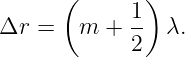
Problem 4: path differenceTwo in-phase sources have wavelength
Complete destructive interference occurs at path difference
Problem 5: beat frequencyTwo tones have frequencies
and
The beat frequency is
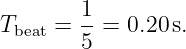
Problem 6: beat periodIf the beat frequency is
the beat period is
Problem 7: unequal beat amplitudesTwo nearby-frequency waves have amplitudes
and
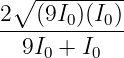
The minimum beat-envelope amplitude is
Problem 8: coherent visibilityPerfectly coherent sources have intensities
The fringe visibility is
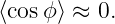
Problem 9: incoherent averagingIf the relative phase of two sources varies randomly and rapidly compared with the averaging time, the average interference term is approximately
Problem 10: coherence-time estimateA source has bandwidth
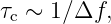
Using
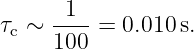
the coherence time is approximately
Problem 11: coherence lengthFor the source in Problem 10, take wave speed
The coherence length is approximately
Problem 12: partial coherenceTwo equal-intensity fields have
Their maximum possible fringe visibility is
Part II: Complete worked solutions
Solution 1In phase, the amplitudes add:
Answer: (D).
Solution 2For equal amplitudes, complete destructive interference occurs at
The simplest choice is
Answer: (C).
Solution 3Constructive interference doubles the amplitude. Since intensity is proportional to amplitude squared,
Answer: (D).
Solution 4For in-phase sources, destructive interference occurs at
The smallest positive value is
Answer: (C).
Solution 5
Answer: (B).
Solution 6
Answer: (C).
Solution 7For unequal amplitudes,
Answer: (C).
Solution 8
Answer: (C).
Solution 9Rapid random phase variation gives
Thus the stable interference term averages away. Answer: (C).
Solution 10
Answer: (B).
Solution 11
Answer: (C).
Solution 12For equal intensities,
Therefore
Answer: (C).
2 GRE checklist
References
References
[1] PhysicsLibrary, M06-12, Acoustic Resonance in Pipes and Helmholtz Resonators. [2] PhysicsLibrary, M06-10, Fourier Analysis, Wave Packets, and Dispersion. [3] A. P. French, Vibrations and Waves, W. W. Norton, 1971. [4] L. E. Kinsler, A. R. Frey, A. B. Coppens, and J. V. Sanders, Fundamentals of Acoustics, 4th ed., Wiley, 2000. "GRE Physics Companion: Beats, Interference, and Coherence" is owned by bloftin.
This object's parent. Cross-references: coherence length, speed, phase, fringe visibility, period, beat frequency, destructive interference, constructive interference, coherence time, phase difference, amplitudes, work, frequencies This is version 1 of GRE Physics Companion: Beats, Interference, and Coherence, born on 2026-10-24. Object id is 1528, canonical name is GREPhysicsCompanionBeatsInterferenceAndCoherence. Accessed 9 times total. Classification:
|
|
|
|
Pending Errata and AddendaNone.
|
DiscussionNo messages.
|
Interact |