Some examples of applying the Einstein summation notation.
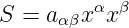
Example 1. Let us consider the quantity
for a three dimensional space. Since the index α occurs as both a subscript and a superscript, we
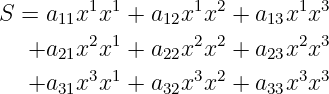
sum on α from 1 to 3. This yields
Now each term of S is such that β is both a subscript and superscript. Summing on β from 1 to 3
as prescribed by our summation convention yields the quadratic form
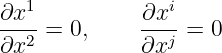
Example 2. If x1,x2,x3,…,xn is a set of independent variables, then
and if i≠j
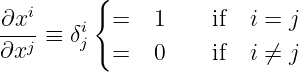
We may write
The symbol δji is called the Kronecker delta. We have
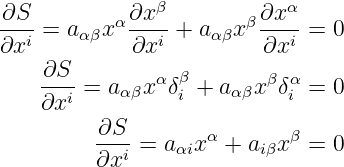
Let us now assume that the quadratic form at the end of example 1 vanishes identically for all
values of the independent variables x1,x2, x3, and a
ij to be constant. Differentiating
S = aαβxαxβ = 0 with respect to a given variable, say xi, yields
Now differentiating with respect to xi yields
so that aji + aij = 0 or aij = −aji for i,j = 1, 2, 3.
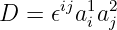
Example 3. We define 𝜖ij,i,j = 1, 2, to have the following numerical values: Let
𝜖11 = 𝜖22 = 0,𝜖12 = 1,𝜖21 = −1. We now consider the expression
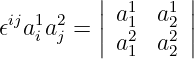
Expanding (2) by use of our summation convention yields
The reader who is familiar with second-order determinants quickly recognizes that
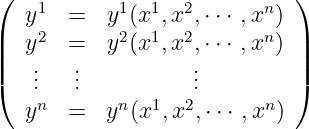
Example 4. The system of equations
represents a coordinate transformation from an (x1,x2, ,xn) coordinate system to a
(y1,y2,
,xn) coordinate system to a
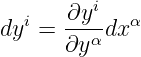
(y1,y2, ,yn) coordinate system. From the calculus we have
The α in the term  is to be considered as a subscript. If, furthermore, the xi, i = 1, 2,
 ,n,
can be solved for the y1,y2,
,n,
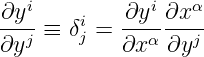
can be solved for the y1,y2, ,yn, and assuming differentiability of the xi with respect to each yi,
one obtains
,yn, and assuming differentiability of the xi with respect to each yi,
one obtains
Differentiating this expression with respect to yk yields
Multiplying both sides of this equation by  amd summing on the inex i yields
or
which yields
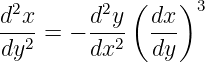
In particular, if y = f(x), then
0.1 References
[1] Lass, Harry. ”Elements of pure and applied mathematics” New York: McGraw-Hill Companies,
1957.
This entry is a derivative of the Public domain work [1].

![[parent]](https://images.physicslibrary.org/images/uparrow.png)