
|
|
|
|||||||
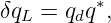
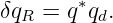
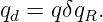
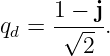
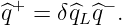
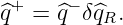
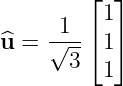
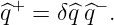
They reconstruct the desired attitude as
or
For a passive positive small frame error vector δ𝜃,
so
1 Exercises
2 Solutions
Solution 1: identity errorIf
 then
 and
 Therefore
The physical attitude error is zero.
Solution 2: opposite stored quaternion signIf
 then
 and
 Thus the raw errors are
The quaternions +1 and −1 represent the same identity orientation. Therefore the physical attitude error is zero. For a local principal representation, flip the sign:
Solution 3: same axis desired versus actual yawThe conjugate of the current attitude is
 Therefore
 Because both quaternions use the same axis, they commute, so
The quaternion half angle is 7.5∘, so the physical frame error is
The negative k vector part is exactly the passive sign expected for a positive frame rotation about +z.
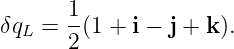
Solution 4: noncommuting left and right errorsThe current conjugate is
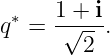 The left error is
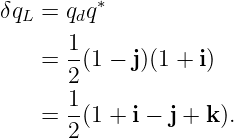 Hence
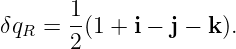
The right error is
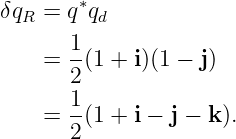 Hence
For both errors,
 Therefore
 and
For the left error,
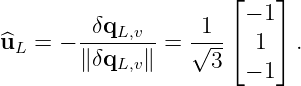
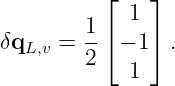 Passive axis extraction gives
For the right error,
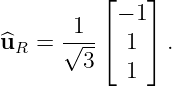
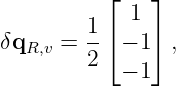 so
The angle is the same, but the coordinates of the error axis differ.
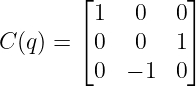
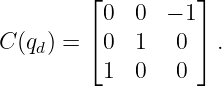
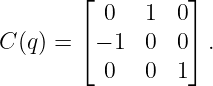
Solution 5: direction cosine matrix error checkThe current DCM is
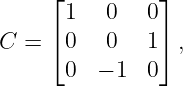 and the desired DCM is
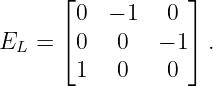
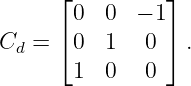 The left error matrix is
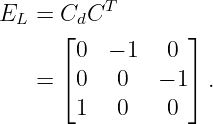 Thus
Converting
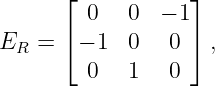
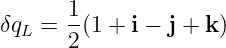 with the Q09 quaternion to DCM formula gives exactly this matrix. Similarly,
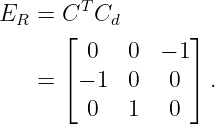 Therefore
which agrees with
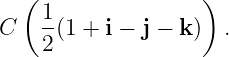
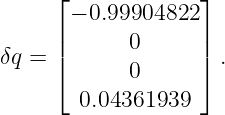
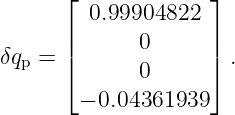
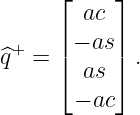
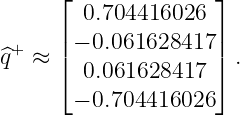
Solution 6: principal quaternion signThe raw error has
 Multiply all four components by −1:
The scalar is approximately
 and the vector magnitude is approximately
 Therefore
 The vector part points in the −k quaternion direction. Under the passive convention the physical positive frame axis is the opposite vector direction:
Thus the error is a positive 5∘ frame rotation about +z.
Solution 7: exact passive axis angle extractionThe squared norm is
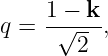
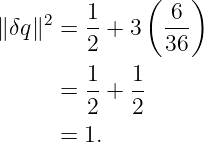 Thus the quaternion is unit. Its scalar component is
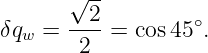 Therefore
The vector part is
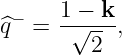
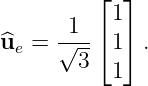
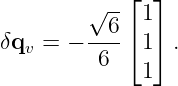 Its direction is opposite the physical passive frame axis, so
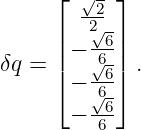
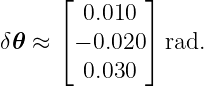
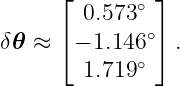
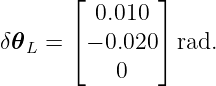
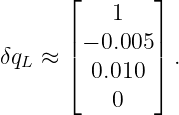
Solution 8: small error vector from a quaternionFor a passive small error,
 Thus
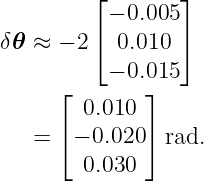 Therefore
Using
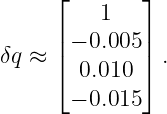
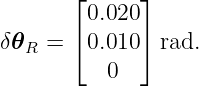
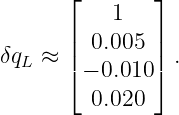
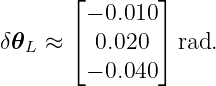
 the components are approximately
Solution 9: transport a right small error to the leftThe relation is
 Therefore
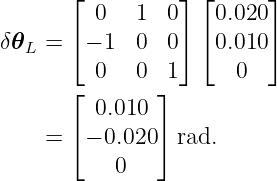 Thus
The first order right error quaternion is
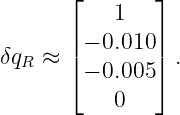 The first order left error quaternion is
The two vector parts differ because the same geometric error is resolved on different sides of the current attitude map.
Solution 10: left error estimation injectionA positive 2∘ passive frame yaw correction has quaternion
The left injection is
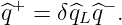 Both rotations are about +z, so they commute and their frame angles add:
 Thus
The corrected attitude is a positive passive frame yaw of
Solution 11: right error injection with noncommuting axesLet
 Then
 Expanding with Hamilton multiplication,
 Therefore
Numerically,

 Hence
Because the correction axis is not the same as the nominal yaw axis, the product cannot be reduced by simply adding scalar angles.
Solution 12: physical control correction from a passive error quaternionThe vector part is
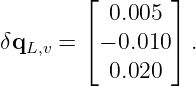 For the PhysicsLibrary passive convention,
 Therefore
Using
 would produce the opposite physical frame correction because the passive quaternion vector part has the negative half angle sign.
Solution 13: relative attitude between two bodiesThe direct relative attitude is
 The conjugate of the first attitude is
 Therefore
 Hence
Because quaternion arguments use half angles, this represents a positive relative frame rotation of
about +z.
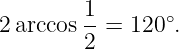
Solution 14: why Euler angle subtraction is not the exact errorExercise 4 compares a positive 90∘ x frame rotation with a positive 90∘ y frame rotation. The exact multiplicative quaternion error has scalar part
 Therefore the exact principal error angle is
 If one incorrectly treated the two 90∘ angle changes as orthogonal components of an ordinary Euclidean vector, one might form
 That number is not the actual finite relative rotation. The discrepancy occurs because finite rotations compose on a noncommutative group. Euler angle coordinates are sequence dependent nonlinear coordinates, not Cartesian components of a global attitude vector.
Solution 15: near
|
 | (39) |
Its scalar component is small but positive.
If the physical error passes beyond 180∘, the raw continuation of the same quaternion branch gives a negative scalar component. A policy that requires

will then multiply the quaternion by −1.
Consequently the stored quaternion components can switch sign even though the physical attitude changes continuously.
The physical orientation does not become discontinuous. The discontinuity belongs to the chosen principal quaternion representative.
A right multiplicative error is defined by
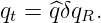
Therefore a correction estimated in the right error coordinates must be injected on the right:
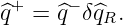 | (40) |
Using
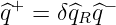
would reinterpret the same quaternion components as a left side correction, which is generally a different physical coordinate resolution.
One correct alternative is therefore to retain the right error definition and right inject it.
A second correct alternative is to transport the correction to the left side:
 | (41) |
and then inject
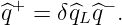 | (42) |
For a small error vector, the equivalent coordinate transport is
 | (43) |
The covariance definition, Jacobians, correction coordinates, and injection side must all use one consistent convention.
| Quantity | PhysicsLibrary passive result |
| Left error | δqL = qdq∗ |
| Right error | δqR = q∗q d |
| Left reconstruction | qd = δqLq |
| Right reconstruction | qd = qδqR |
| Small frame error | δq ≈ [1,−δ𝜃∕2]T |
| Recover small frame error | δ𝜃 ≈−2δqv |
| Left/right relation | δqL = qδqRq∗ |
| Small vector transport | δ𝜃L = C(q)δ𝜃R |
The exercises and solutions in this companion are newly written or rewritten for PhysicsLibrary under the passive frame convention.
Sommer and coauthors provide a modern convention analysis that helps separate Hamilton quaternion algebra from active and passive frame semantics. Markley and Crassidis provide a broad spacecraft attitude treatment including multiplicative attitude errors. Solà provides a detailed engineering discussion of quaternion perturbations and error state filtering; formulas must be translated carefully when its quaternion map differs from the PhysicsLibrary convention.
[1] H. Sommer, I. Gilitschenski, M. Bloesch, S. Weiss, R. Siegwart, and J. Nieto, “Why and How to Avoid the Flipped Quaternion Multiplication,” Aerospace, vol. 5, no. 3, article 72, 2018. Published under CC BY 4.0. Publisher article
[2] F. L. Markley and J. L. Crassidis, Fundamentals of Spacecraft Attitude Determination and Control, Springer, 2014. Engineering reference. Publisher book page
[3] J. Solà, “Quaternion Kinematics for the Error State Kalman Filter,” technical report, 2017. arXiv preprint
[4] M. D. Shuster, “The Nature of the Quaternion,” The Journal of the Astronautical Sciences, vol. 56, no. 3, pp. 359–373, 2008. Reference source. DOI record
Unless otherwise noted, this PhysicsLibrary entry is intended for release under the Creative Commons Attribution ShareAlike 4.0 International license.
| Keywords: | quaternion, relative attitude, error quaternion, attitude error, multiplicative error, small angle approximation, exercises, worked solutions |
| Physics Classification: | 02.40.Yy (Geometric mechanics ) |
| 02.10.Hh (Rings and algebras) | |
| 45.40.-f (Dynamics and kinematics of rigid bodies) |
None.
No messages.
![[parent]](https://images.physicslibrary.org/images/uparrow.png)



![[ ]
1
δq ≈ − 1δ𝜃 ,
2](https://images.physicslibrary.org/cache/objects/1108/make4ht/ExampleOfRelativeAttitudeAndErrorQuaternions6x.png)



























 principal sign behavior