
|
|
|
|||||||
Equivalently,
For pure quaternions,
Reversing the factors gives
Therefore the commutator is
The symmetric combination is
2 Exercises
3 Solutions
Solution 1: derive the pure quaternion productExpand without changing factor order:
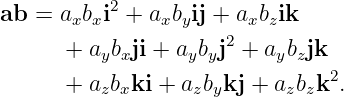 Use

 and the reversed negative products. The scalar terms are
 The i coefficient is
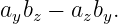 The j coefficient is
 The k coefficient is
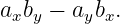 These are exactly the components of a × b. Therefore
The scalar part is −a ⋅ b and the vector part is a × b.
Solution 2: product from scalar and vector partsWrite
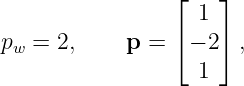 and
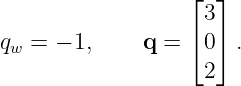 The dot product is
 The cross product is
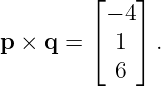 The scalar part is
 The vector part is
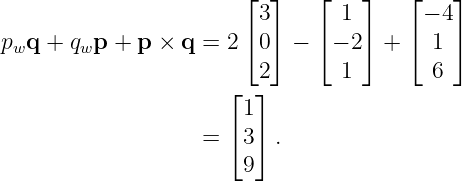 Hence
Solution 3: reverse the product efficientlyThe scalar part remains unchanged because
 The scalar multiplication terms in the vector part are also unchanged:
 Only the cross product changes sign:
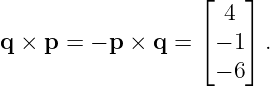 Thus the vector part of qp is
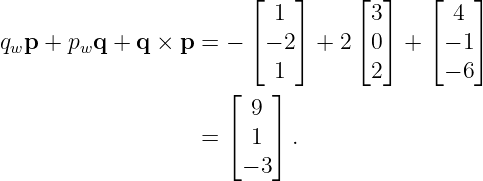 Therefore
Solution 4: commutatorFrom Solutions 2 and 3,
![[p,q] = pq − qp
= (− 7 + i + 3j + 9k ) − (− 7 + 9i + j − 3k ).](https://images.physicslibrary.org/cache/objects/1115/make4ht/ExampleOfQuaternionProduct59x.png) Thus
Directly,
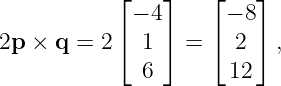 which gives the same pure quaternion.
Solution 5: anticommutatorAdd the general products:
 and
 The cross products cancel. Therefore
For Exercise 2,
 and
 Thus
The oriented cross product term disappears from the symmetric combination.
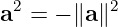
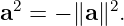
Solution 6: pure quaternion squareSet b = a in
 Then
 Since
 and
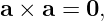 we obtain
If ∥a∥ = 1, then
Solution 7: perpendicular pure quaternionsIf
 then
 Reversing the order gives
 For
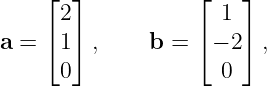 the dot product is
 The cross product is
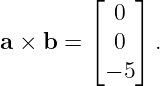 Therefore
Solution 8: parallel pure quaternionsIf
 then
 Thus
 which is purely real. For
 and
 we have
 Therefore
Solution 9: geometric angle encoded in a pure productFor unit vectors,
 Also,
 If n is the unit vector in the direction of the cross product,
 Therefore
For
 we get
Solution 10: when do two quaternions commute?The commutator is
![[p,q] = 2p × q.](https://images.physicslibrary.org/cache/objects/1115/make4ht/ExampleOfQuaternionProduct94x.png) Therefore
 if and only if
 In three dimensional Euclidean space, a cross product is zero exactly when the vectors are linearly dependent or one is zero. Thus the vector parts must be parallel, antiparallel, or one vector part must vanish. Hence
Solution 11: a complex subalgebraLet
 with
 Multiply:
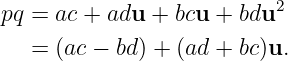 Therefore
Reversing the factors gives
 Real coefficients commute, so
 The map
 preserves addition and multiplication because both imaginary units square to −1. Thus this two dimensional quaternion subalgebra is isomorphic to the complex numbers.
Solution 12: component formula recoveryThe scalar part is
 so the first component is
 For the vector part,
 the cross product is
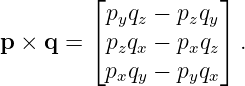 Add the scalar multiple terms componentwise. The i component becomes
 The j component becomes
 The k component becomes
 Therefore
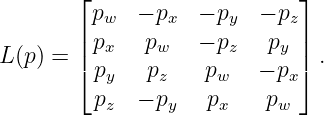
Solution 13: left multiplication matrixStart from the component formula for pq and collect coefficients multiplying
 The scalar component is
 The i component is
 The j component is
 The k component is
 Hence
Thus
Solution 14: right multiplication matrixNow collect the component formula for pq by coefficients of the components of p. The result is
so that
Compare R(q) with
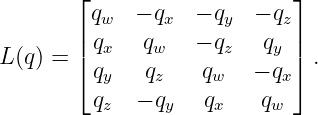 The scalar row is identical, but the signs associated with the cross product structure differ. This is the matrix manifestation of left versus right Hamilton multiplication.
Solution 15: associativity as a matrix identityFor any quaternion r,
![L(pq)[r] = [(pq)r] .
PL PL](https://images.physicslibrary.org/cache/objects/1115/make4ht/ExampleOfQuaternionProduct123x.png) Associativity gives
 Therefore
![[(pq )r] = L (p)L(q)[r] .
PL PL](https://images.physicslibrary.org/cache/objects/1115/make4ht/ExampleOfQuaternionProduct125x.png) Since this holds for every r,
For
 the Hamilton product is
 Thus
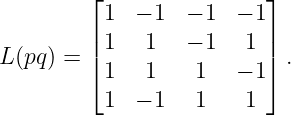 Also,
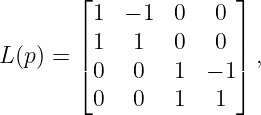 and
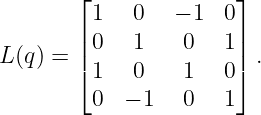 Direct matrix multiplication gives
Solution 16: Hamilton versus flipped multiplication diagnosticPhysicsLibrary Hamilton multiplication uses
 in the vector part. The proposed operation ⋆ uses
 Therefore it does not agree with PhysicsLibrary Hamilton multiplication. Under Hamilton multiplication,
 Use
 and
 Then
 Hence
The proposed operation is the reversed Hamilton product.
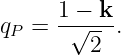
Solution 17: passive attitude does not change Hamilton multiplicationThe passive attitude convention specifies how a quaternion is interpreted as a frame transformation. Hamilton multiplication specifies the algebra used to multiply quaternion elements. These are separate choices. PhysicsLibrary retains
 whether the quaternion is being used as a passive attitude map, an algebraic quantity, or a pure quaternion encoding a vector. If the cross product sign were changed merely because an attitude convention was passive, then the pure product rule would become
 That would contradict the declared Hamilton basis relation  Thus the later passive attitude quaternion
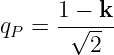 changes the interpretation of the quaternion’s vector sign for a positive frame rotation. It does not change the multiplication law.
4 Compact reviewThe multiplication companion can be summarized by four identities:
and
The cross product sign is a direct multiplication convention diagnostic: PhysicsLibrary Hamilton multiplication uses the positive sign.
5 Sources and exercise provenanceThe exercises and solutions in this companion are newly written or expanded for PhysicsLibrary from the algebra developed in Quaternion Product in Scalar Vector Form. Hamilton is the foundational source for the quaternion product. Joly and Kelland–Tait provide classical systematic treatments and examples. Sommer and coauthors provide a modern discussion of Hamilton versus reversed quaternion multiplication in engineering applications.
References
[1] W. R. Hamilton, Elements of Quaternions, 2nd ed., edited by C. J. Joly, Longmans, Green, and Co., 1899. Public domain historical source. Internet Archive scan [2] C. J. Joly, A Manual of Quaternions, Macmillan and Co., London, 1905. Public domain historical source. Internet Archive search [3] P. Kelland and P. G. Tait, Introduction to Quaternions, with Numerous Examples, 2nd ed., Macmillan and Co., London, 1882. Public domain historical source. Internet Archive search [4] H. Sommer, I. Gilitschenski, M. Bloesch, S. Weiss, R. Siegwart, and J. Nieto, “Why and How to Avoid the Flipped Quaternion Multiplication,” Aerospace, vol. 5, no. 3, article 72, 2018. Published under CC BY 4.0. Publisher article
LicenseUnless otherwise noted, this PhysicsLibrary entry is intended for release under the Creative Commons Attribution ShareAlike 4.0 International license. "example of quaternion product" is owned by bloftin.
This object's parent. Cross-references: relation, algebraic, operation, matrix multiplication, unit vectors, identity, matrix, commute, unit, square, dot product, formula, commutator, vectors, quaternions, cross product, vector, scalar, quaternion product There is 1 reference to this object. This is version 2 of example of quaternion product, born on 2026-08-28, modified 2026-08-28. Object id is 1115, canonical name is ExampleOfQuaternionProduct. Accessed 262 times total. Classification:
|
|
|
|
Pending Errata and AddendaNone.
|
DiscussionNo messages.
|
Interact |
![[parent]](https://images.physicslibrary.org/images/uparrow.png)





![[p,q] = pq − qp = 2p × q.](https://images.physicslibrary.org/cache/objects/1115/make4ht/ExampleOfQuaternionProduct5x.png)






![[p,q] = pq − qp](https://images.physicslibrary.org/cache/objects/1115/make4ht/ExampleOfQuaternionProduct12x.png)
![[p,q] = 2p × q.](https://images.physicslibrary.org/cache/objects/1115/make4ht/ExampleOfQuaternionProduct13x.png)








![[p,q] = 2p × q,](https://images.physicslibrary.org/cache/objects/1115/make4ht/ExampleOfQuaternionProduct23x.png)




![⌊ p q − p q − p q − p q ⌋
| w w x x y y z z|
[pq]PL = | pwqx + pxqw + pyqz − pzqy| .
⌈ pwqy − pxqz + pyqw + pzqx⌉
pwqz + pxqy − pyqx + pzqw](https://images.physicslibrary.org/cache/objects/1115/make4ht/ExampleOfQuaternionProduct28x.png)

![[pq]PL = L (p)[q]PL,](https://images.physicslibrary.org/cache/objects/1115/make4ht/ExampleOfQuaternionProduct30x.png)
![[pq]PL = R (q)[p]PL.](https://images.physicslibrary.org/cache/objects/1115/make4ht/ExampleOfQuaternionProduct32x.png)








![[p,q] = − 8i + 2j + 12k.](https://images.physicslibrary.org/cache/objects/1115/make4ht/ExampleOfQuaternionProduct60x.png)






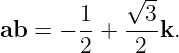


![⌊ p q − p q − p q − p q ⌋
| w w x x y y z z|
[pq]PL = | pwqx + pxqw + pyqz − pzqy| .
⌈ pwqy − pxqz + pyqw + pzqx⌉
pwqz + pxqy − pyqx + pzqw](https://images.physicslibrary.org/cache/objects/1115/make4ht/ExampleOfQuaternionProduct112x.png)
![⌊ ⌋
pw − px − py − pz
||px pw − pz py ||
[pq]PL = ⌈py pz pw − px⌉ [q]PL.
p − p p p
z y x w](https://images.physicslibrary.org/cache/objects/1115/make4ht/ExampleOfQuaternionProduct118x.png)
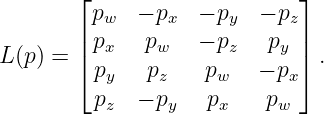
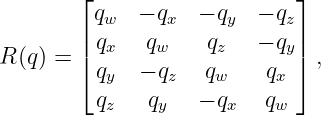
![[pq]PL = R (q)[p]PL.](https://images.physicslibrary.org/cache/objects/1115/make4ht/ExampleOfQuaternionProduct121x.png)

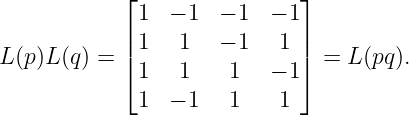



![[p,q] = 2p × q,](https://images.physicslibrary.org/cache/objects/1115/make4ht/ExampleOfQuaternionProduct146x.png)
