Physics Library
 An open source physics library
Encyclopedia | Forums | Docs | Random | Template Test |  
Login
create new user
Username:
Password:
forget your password?
Main Menu
Sections

Meta

Talkback

Downloads

Information
[parent] example of Euler angles: sequence composition and the twelve standard sequences (Example)

Euler Angles: Sequence Composition and the Twelve Standard Sequences Examples, Exercises, and Solutions

This entry is the self study companion to Euler Angles: sequence composition and the twelve standard sequences.

The goal is to make sequence classification and composition routine enough that later Euler formulas can be derived rather than memorized.

All exercises are stated first. Complete worked solutions follow afterward.

Convention summary

PhysicsLibrary uses passive coordinate maps:

$\displaystyle {}^B\mathbf v = {}^BC_A\,{}^A\mathbf v.$ (1)

For intrinsic $i$-$j$-$k$,

$\displaystyle {}^BC_A = C_k(\gamma)C_j(\beta)C_i(\alpha).$ (2)

For extrinsic $i$-$j$-$k$,

$\displaystyle {}^BC_A = C_i(\alpha)C_j(\beta)C_k(\gamma).$ (3)

The reverse-order equivalence is

intrinsic $\displaystyle i$-$\displaystyle j$-$\displaystyle k (\alpha,\beta,\gamma) \equiv$   extrinsic $\displaystyle k$-$\displaystyle j$-$\displaystyle i (\gamma,\beta,\alpha).$ (4)

The six Tait Bryan sequences are

$\displaystyle 123,\quad132,\quad213,\quad231,\quad312,\quad321.$ (5)

The six proper Euler sequences are

$\displaystyle 121,\quad131,\quad212,\quad232,\quad313,\quad323.$ (6)

Visual reference

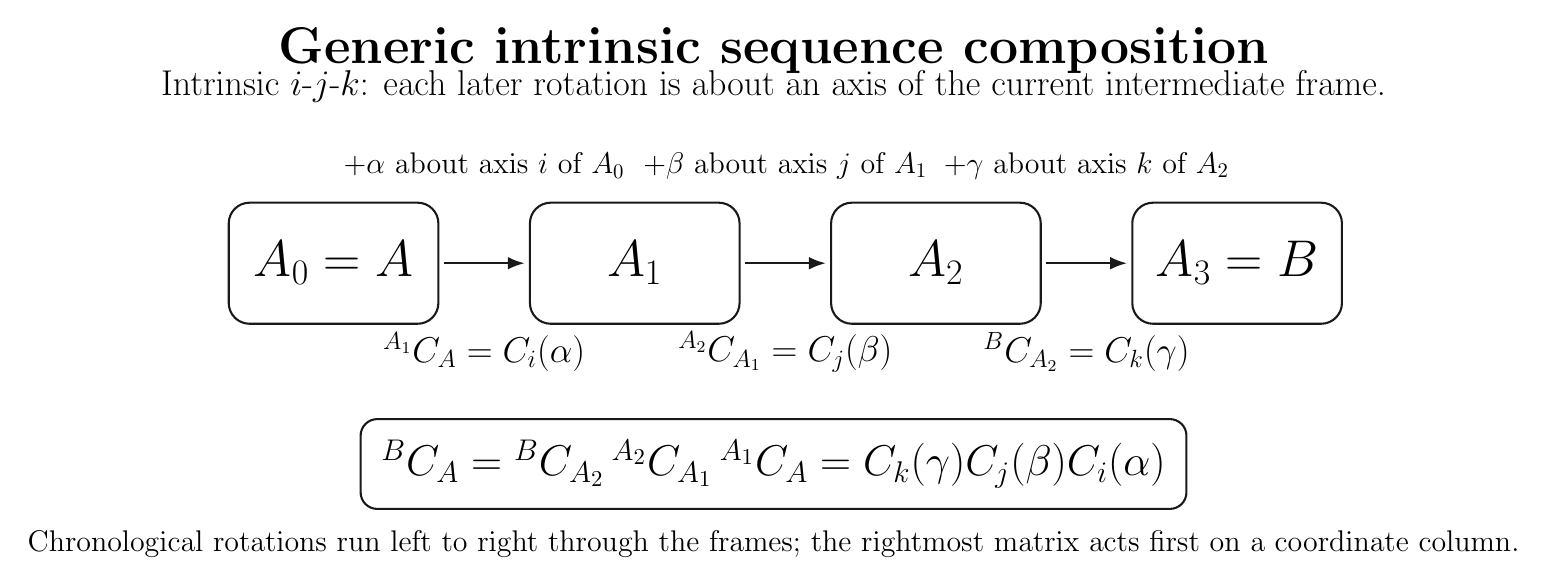
Image EA04_intrinsic_sequence_composition

Figure. Generic intrinsic frame-chain composition.
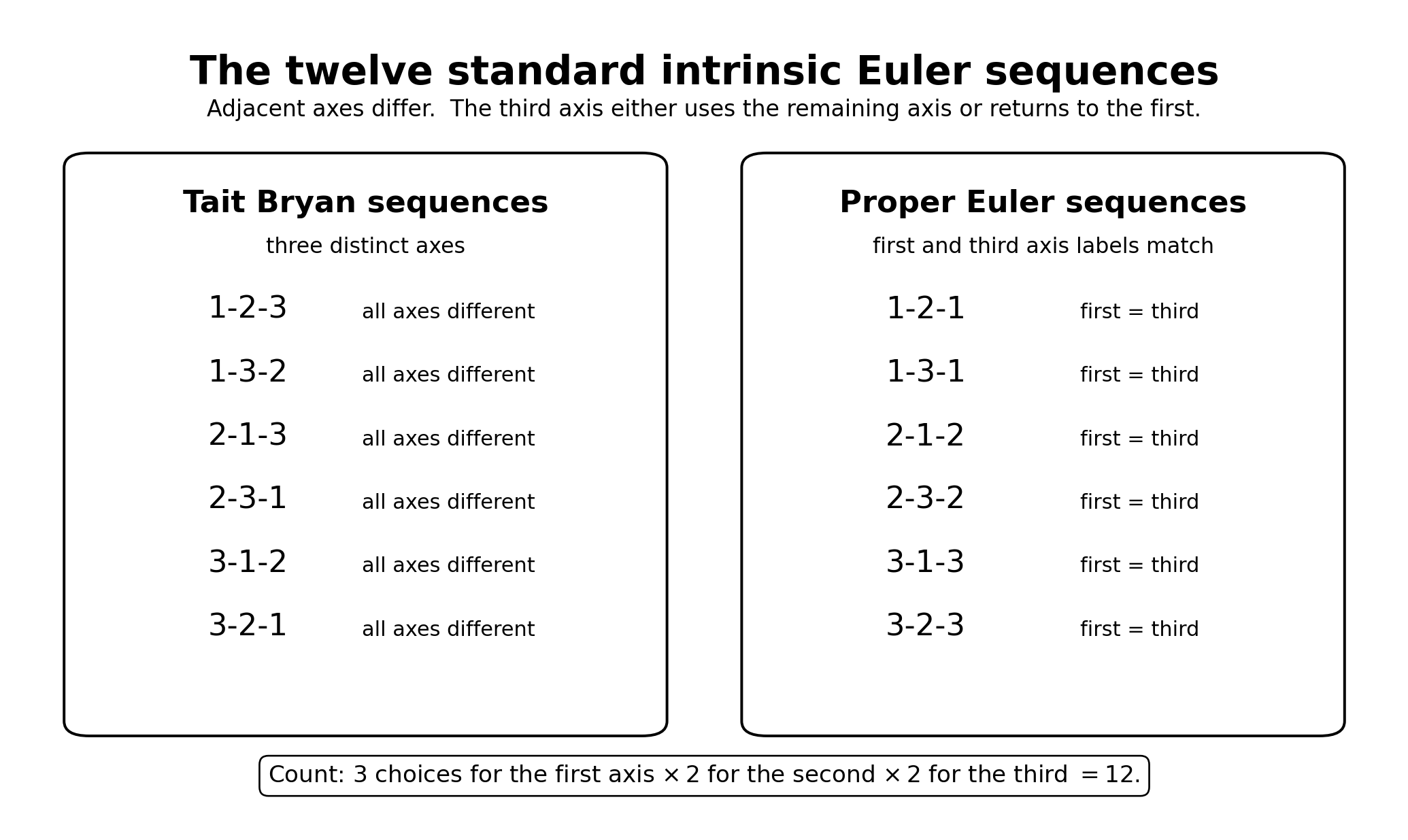
Image EA04_twelve_standard_sequences

Figure. The twelve standard intrinsic Euler sequences separated into Tait Bryan and proper Euler families.

Exercises

  1. Derive the count of twelve.

    Explain why the number of standard three-angle Euler sequences is

    $\displaystyle 3\times2\times2=12. $

    State what each factor counts.

  2. Classify the sequence family.

    Classify each sequence as Tait Bryan or proper Euler:

    $\displaystyle 123,\quad121,\quad312,\quad313,\quad231,\quad232. $

    State the family criterion.

  3. List all six Tait Bryan sequences.

    Construct all six standard sequences with three distinct axis labels.

  4. List all six proper Euler sequences.

    Construct all six standard sequences in which the first and third axis labels match.

  5. Write an intrinsic product.

    Write the passive intrinsic product for sequence $1$-$3$-$2$ with angles $(\alpha,\beta,\gamma)$.

  6. Write a proper Euler product.

    Write the passive intrinsic product for $3$-$1$-$3$.

    Why can the first and third rotations not generally be combined?

  7. Frame-chain derivation.

    For intrinsic $2$-$3$-$1$, introduce intermediate frames $A_0,A_1,A_2,A_3$ and derive the complete passive map ${}^BC_A$.

  8. Rightmost factor diagnostic.

    Explain why

    $\displaystyle {}^BC_A=C_1(\gamma)C_3(\beta)C_2(\alpha) $

    still describes chronological intrinsic axis order $2$-$3$-$1$.

  9. Single-angle reductions.

    For intrinsic $3$-$1$-$2$,

    $\displaystyle {}^BC_A=C_2(\gamma)C_1(\beta)C_3(\alpha). $

    Find the remaining elementary matrix when:

    1. $\beta=\gamma=0$;
    2. $\alpha=\gamma=0$;
    3. $\alpha=\beta=0$.
  10. Intrinsic/extrinsic conversion.

    Find the extrinsic sequence and chronological angle order equivalent to

       intrinsic $\displaystyle 2$-$\displaystyle 3$-$\displaystyle 1(\alpha,\beta,\gamma). $
  11. Palindrome sequence subtlety.

    Find the extrinsic description equivalent to intrinsic

    $\displaystyle 3$-$\displaystyle 2$-$\displaystyle 3(\alpha,\beta,\gamma). $

    Why is this conversion easy to misread?

  12. Tait Bryan singularity.

    State the generic middle-angle singularity condition for every Tait Bryan sequence and its values on the common principal branch.

  13. Proper Euler singularity.

    State the generic middle-angle singularity condition for every proper Euler sequence and its values on the common principal branch.

  14. Aerospace 3-2-1 specialization.

    Identify $(\alpha,\beta,\gamma)$ with $(\psi,\theta,\phi)$ and write the PhysicsLibrary passive yaw pitch roll product.

  15. Numerical 3-2-1 composition.

    Using

    $\displaystyle \psi=30^\circ,\qquad \theta=20^\circ,\qquad \phi=10^\circ, $

    compute

    $\displaystyle {}^BC_A=C_1(\phi)C_2(\theta)C_3(\psi). $
  16. Compare two sequence orders.

    Using

    $\displaystyle \alpha=30^\circ,\qquad \beta=20^\circ,\qquad \gamma=10^\circ, $

    compare intrinsic $3$-$2$-$1$ with intrinsic $1$-$2$-$3$.

  17. Recognize the family from the singularity.

    A source states that its chart is singular when $\sin\beta=0$. Which sequence family is it using?

    A second source gives $\cos\beta=0$. Which family is that?

  18. quaternion counterpart.

    Write the passive quaternion product for intrinsic $2$-$1$-$3$ and state the DCM consistency relation.

  19. Debug a wrong product.

    A student claims intrinsic $1$-$2$-$3$ is

    $\displaystyle {}^BC_A=C_1(\alpha)C_2(\beta)C_3(\gamma). $

    Identify the mistake and write the correct product.

  20. Recover a sequence from a product.

    A passive intrinsic DCM is

    $\displaystyle {}^BC_A=C_2(\gamma)C_3(\beta)C_1(\alpha). $

    Identify the chronological sequence and its family.

  21. Recover a proper Euler sequence from a product.

    A passive intrinsic DCM is

    $\displaystyle {}^BC_A=C_3(\gamma)C_1(\beta)C_3(\alpha). $

    Identify the sequence and family.

  22. Verification battery.

    List at least five checks that should be applied to a derived Euler sequence matrix before using it in software.

Solutions

Solution 1: derive the count of twelve

There are three choices for the first axis.

The second axis must differ from the first, leaving two choices.

The third axis has two standard choices: the remaining unused axis, producing a Tait Bryan sequence, or the first axis again, producing a proper Euler sequence.

Therefore

$\displaystyle 3\times2\times2=12.$ (7)

Solution 2: classify the sequence family

Tait Bryan means all three axis labels are different. Proper Euler means the first and third labels match.

Thus

$\displaystyle 123,\quad312,\quad231 $

are Tait Bryan, while

$\displaystyle 121,\quad313,\quad232 $

are proper Euler.

Solution 3: list all six Tait Bryan sequences

The six are

$\displaystyle 123,\quad132,\quad213,\quad231,\quad312,\quad321.$ (8)

Solution 4: list all six proper Euler sequences

The six are

$\displaystyle 121,\quad131,\quad212,\quad232,\quad313,\quad323.$ (9)

Solution 5: write an intrinsic product

For $1$-$3$-$2$,

$\displaystyle i=1,\qquad j=3,\qquad k=2. $

Therefore

$\displaystyle {}^BC_A=C_2(\gamma)C_3(\beta)C_1(\alpha).$ (10)

Solution 6: write a proper Euler product

For intrinsic $3$-$1$-$3$,

$\displaystyle {}^BC_A=C_3(\gamma)C_1(\beta)C_3(\alpha).$ (11)

The first rotation is about axis $3$ of the initial frame. After the middle rotation, the third rotation is about axis $3$ of a different intermediate frame. The two axis labels match, but the physical axes generally do not.

Solution 7: frame-chain derivation

For intrinsic $2$-$3$-$1$,

$\displaystyle {}^{A_1}C_A=C_2(\alpha),$ (12)
$\displaystyle {}^{A_2}C_{A_1}=C_3(\beta),$ (13)

and

$\displaystyle {}^BC_{A_2}=C_1(\gamma).$ (14)

Therefore

$\displaystyle {}^BC_A = {}^BC_{A_2}\,{}^{A_2}C_{A_1}\,{}^{A_1}C_A = C_1(\gamma)C_3(\beta)C_2(\alpha).$ (15)

Solution 8: rightmost factor diagnostic

Coordinate columns are multiplied from the left. Hence $C_2(\alpha)$ acts on ${}^A\mathbf v$ first, followed by $C_3(\beta)$ and then $C_1(\gamma)$.

The chronological intrinsic order is therefore

$\displaystyle 2\longrightarrow3\longrightarrow1. $

Solution 9: single-angle reductions

From

$\displaystyle {}^BC_A=C_2(\gamma)C_1(\beta)C_3(\alpha), $

we obtain

$\displaystyle \beta=\gamma=0 \quad\Longrightarrow\quad {}^BC_A=C_3(\alpha),$ (16)

$\displaystyle \alpha=\gamma=0 \quad\Longrightarrow\quad {}^BC_A=C_1(\beta),$ (17)

and

$\displaystyle \alpha=\beta=0 \quad\Longrightarrow\quad {}^BC_A=C_2(\gamma).$ (18)

Solution 10: intrinsic/extrinsic conversion

Reverse both axis order and associated angle order:

intrinsic $\displaystyle 2$-$\displaystyle 3$-$\displaystyle 1 (\alpha,\beta,\gamma) \equiv$   extrinsic $\displaystyle 1$-$\displaystyle 3$-$\displaystyle 2 (\gamma,\beta,\alpha).$ (19)

Solution 11: palindrome sequence subtlety

Reversing $3$-$2$-$3$ leaves the same digit string, so

intrinsic $\displaystyle 3$-$\displaystyle 2$-$\displaystyle 3 (\alpha,\beta,\gamma) \equiv$   extrinsic $\displaystyle 3$-$\displaystyle 2$-$\displaystyle 3 (\gamma,\beta,\alpha).$ (20)

The axis labels look unchanged, but the angle association still reverses.

Solution 12: Tait Bryan singularity

The generic singularity is

$\displaystyle \cos\beta=0.$ (21)

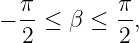
On

$\displaystyle -\frac{\pi}{2}\leq\beta\leq\frac{\pi}{2}, $

the singular values are

$\displaystyle \beta=\pm\frac{\pi}{2}.$ (22)

Solution 13: proper Euler singularity

The generic singularity is

$\displaystyle \sin\beta=0.$ (23)

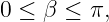
On

$\displaystyle 0\leq\beta\leq\pi, $

the singular values are

$\displaystyle \beta=0 \qquad\hbox{or}\qquad \beta=\pi.$ (24)

Solution 14: aerospace 3-2-1 specialization

PhysicsLibrary uses

$\displaystyle \alpha=\psi,\qquad \beta=\theta,\qquad \gamma=\phi. $

Thus

$\displaystyle {}^BC_A=C_1(\phi)C_2(\theta)C_3(\psi).$ (25)

Solution 15: numerical 3-2-1 composition

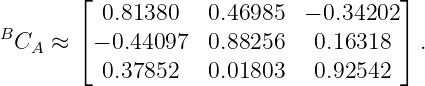
Using the elementary passive matrices gives

$\displaystyle {}^BC_A \approx \begin{bmatrix} 0.81380&0.46985&-0.34202\ -0.44097&0.88256&0.16318\ 0.37852&0.01803&0.92542 \end{bmatrix}.$ (26)

This matrix is orthogonal and has determinant $+1$ to numerical precision.

Solution 16: compare two sequence orders

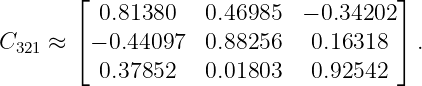
For intrinsic $3$-$2$-$1$,

$\displaystyle C_{321} \approx \begin{bmatrix} 0.81380&0.46985&-0.34202\ -0.44097&0.88256&0.16318\ 0.37852&0.01803&0.92542 \end{bmatrix}.$ (27)

For intrinsic $1$-$2$-$3$,

$\displaystyle C_{123} \approx \begin{bmatrix} 0.92542&0.31880&-0.20487\ -0.16318&0.82317&0.54384\ 0.34202&-0.46985&0.81380 \end{bmatrix}.$ (28)

They are different, demonstrating sequence dependence and noncommutativity.

Solution 17: recognize the family from the singularity

If

$\displaystyle \sin\beta=0, $

the sequence is proper Euler.

If

$\displaystyle \cos\beta=0, $

the sequence is Tait Bryan.

Solution 18: quaternion counterpart

For intrinsic $2$-$1$-$3$,

$\displaystyle {}^Bq_A=q_3^P(\gamma)q_1^P(\beta)q_2^P(\alpha).$ (29)

The passive quaternion and DCM must satisfy

$\displaystyle {}^BC_A=C({}^Bq_A).$ (30)

Solution 19: debug a wrong product

The student wrote the matrices in chronological left-to-right order.

The correct passive intrinsic product is

$\displaystyle {}^BC_A=C_3(\gamma)C_2(\beta)C_1(\alpha).$ (31)

Solution 20: recover a sequence from a product

Compare

$\displaystyle C_2(\gamma)C_3(\beta)C_1(\alpha) $

with

$\displaystyle C_k(\gamma)C_j(\beta)C_i(\alpha). $

Thus

$\displaystyle i=1,\qquad j=3,\qquad k=2. $

The sequence is

$\displaystyle 1$-$\displaystyle 3$-$\displaystyle 2,$ (32)

which is Tait Bryan.

Solution 21: recover a proper Euler sequence from a product

The product

$\displaystyle C_3(\gamma)C_1(\beta)C_3(\alpha) $

has

$\displaystyle i=3,\qquad j=1,\qquad k=3. $

Therefore the sequence is

$\displaystyle 3$-$\displaystyle 1$-$\displaystyle 3,$ (33)

which is proper Euler.

Solution 22: verification battery

Useful checks include:

  1. zero angles give the identity;
  2. each single-angle reduction gives the correct elementary passive matrix;
  3. $CC^T=I$;
  4. $\det C=1$;
  5. ${}^AC_B=({}^BC_A)^T$;
  6. known $90^\circ$ sign tests agree with the passive convention;
  7. quaternion agreement:

    $\displaystyle {}^BC_A=C({}^Bq_A); $
  8. Euler to DCM to Euler round trips recover the selected principal branch away from singularities.

Compact review

For every intrinsic sequence,

$\displaystyle {}^BC_A=C_k(\gamma)C_j(\beta)C_i(\alpha).$ (34)

There are six Tait Bryan sequences:

$\displaystyle 123,\quad132,\quad213,\quad231,\quad312,\quad321.$ (35)

There are six proper Euler sequences:

$\displaystyle 121,\quad131,\quad212,\quad232,\quad313,\quad323.$ (36)

Their generic singularity conditions are

$\displaystyle \cos\beta=0 \qquad \hbox{for Tait Bryan},$ (37)

and

$\displaystyle \sin\beta=0 \qquad \hbox{for proper Euler}.$ (38)

Sources and exercise provenance

The exercises and worked solutions in this companion are newly written for PhysicsLibrary to reinforce the sequence framework developed in Euler angles: sequence composition and the twelve standard sequences.

Bibliography

1
D. M. Henderson, Euler Angles, Quaternions, and Transformation Matrices: Working Relationships, JSC-12960, NASA Johnson Space Center, 1977. NASA Technical Reports Server
2
J. Diebel, “Representing Attitude: Euler Angles, Unit Quaternions, and Rotation Vectors,” Stanford University, 2006. Online PDF
3
J. K. Moore, Learn Multibody Dynamics, chapter “Orientation of Reference Frames,” 2026 edition. Licensed CC BY 4.0. Orientation of Reference Frames

License

Unless otherwise noted, this PhysicsLibrary entry is intended for release under the Creative Commons Attribution ShareAlike 4.0 International license.


"example of Euler angles: sequence composition and the twelve standard sequences" is owned by bloftin.
(view preamble)
View style:
Keywords:  Euler angles, Euler sequences, Tait Bryan angles, proper Euler angles, passive rotation matrices, direction cosine matrix

This object's parent.

Cross-references: identity, determinant, Tait Bryan sequence, relation, quaternion product, quaternion, matrix, Tait Bryan sequences, formulas, composition, Euler Angles

This is version 1 of example of Euler angles: sequence composition and the twelve standard sequences, born on 2026-08-29.
Object id is 1126, canonical name is ExampleOfEulerAnglesSequenceCompositionAndTheTwelveStandardSequences.
Accessed 3 times total.

Classification:
Physics Classification02.40.Yy (Geometric mechanics )
 45.40.-f (Dynamics and kinematics of rigid bodies)
 02.10.Ud (Linear algebra)
Pending Errata and Addenda
None.
Discussion
Style: Expand: Order:

No messages.

Interact
rate | post | correct | update request | add example | add (any)