
|
|
|
|||||||
For intrinsic 3-2-1 yaw pitch roll,
and
For a conventional aircraft body frame,
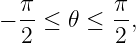
 The common principal branch is
2 Visual reference
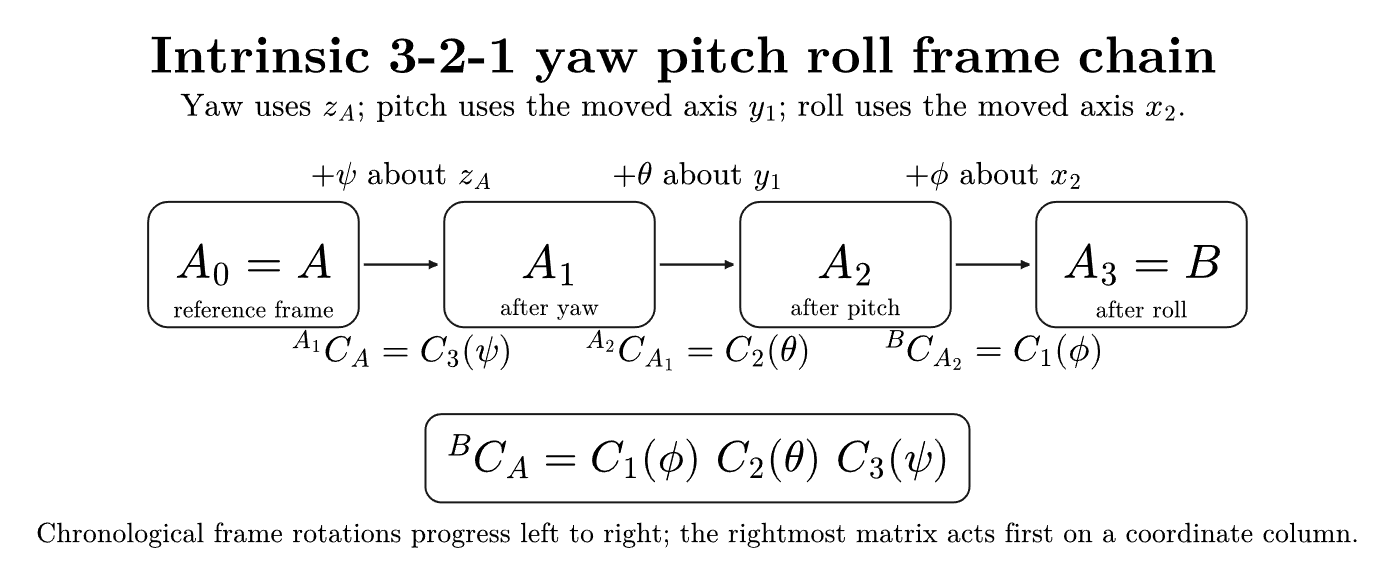
Figure. Intrinsic 3-2-1 frame chain: yaw about zA, pitch about y1, and roll about x2.
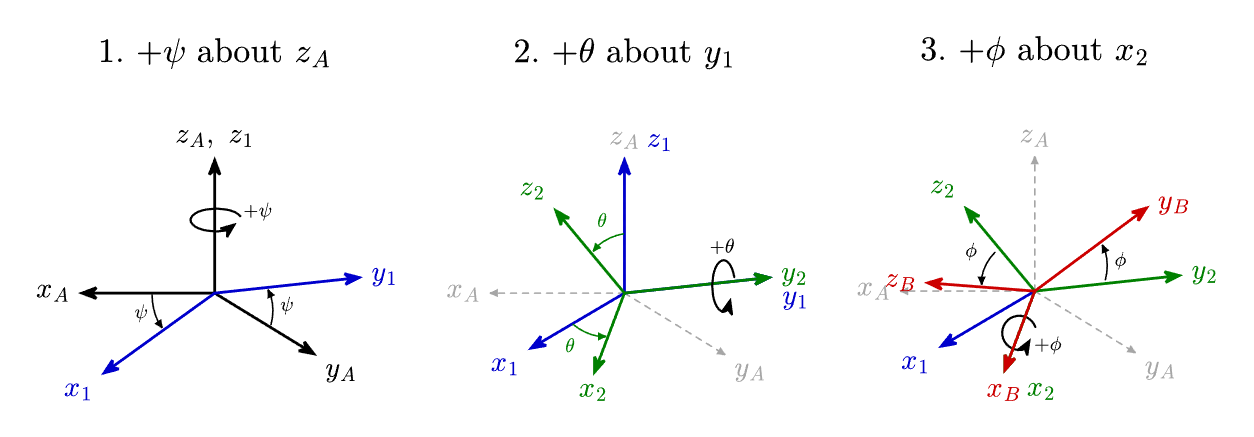
Figure. Positive yaw, pitch, and roll directions for the conventional Forward-Right-Down body-axis interpretation.
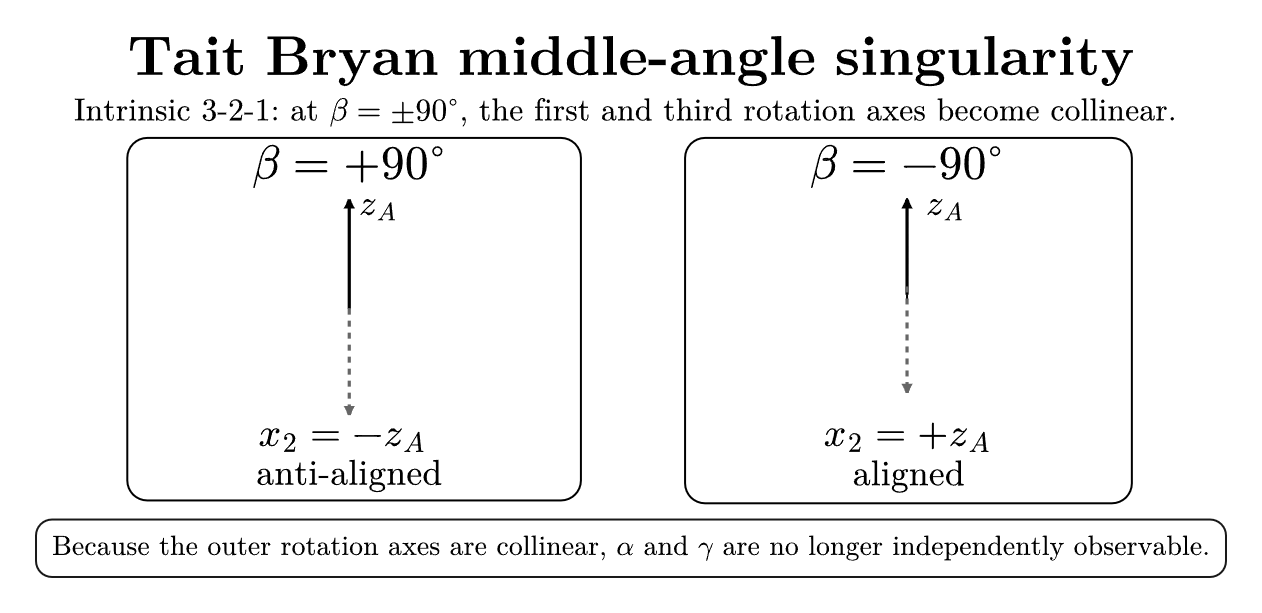
Figure. At 𝜃 = ±90∘, the first and third physical rotation axes become collinear.
3 Exercises
4 Solutions
Solution 1: map direction and chronological orderThe equation
 means that the physical vector is unchanged while its coordinates are re-expressed from frame A into frame B. The chronological intrinsic rotations are
Thus the first axis belongs to the initial frame, while the second and third axes belong to successive intermediate frames.
Solution 2: intermediate-frame constructionLet
 The three passive frame maps are
and
Matching adjacent frame labels gives
Solution 3: aerospace positive-angle interpretationFor Forward-Right-Down axes:
These are physical frame rotations following the right hand rule.
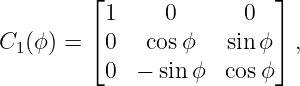
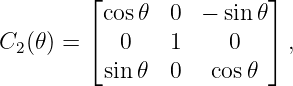
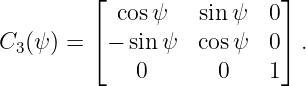
Solution 4: elementary passive matrices and single-axis checksThe passive elementary matrices are
and
Therefore
and
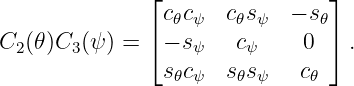
Solution 5: derive the full passive 3-2-1 DCMUse
 with analogous notation for 𝜃 and ψ. First,
Premultiplication by C1(ϕ) gives
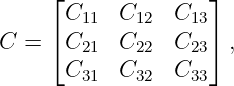
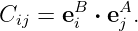
Solution 6: interpret rows and columnsFor
 its entries satisfy
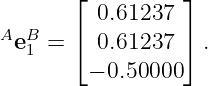
Thus row i is the body basis vector eiB expressed in frame A, and column j is the reference basis vector ejA expressed in frame B. The first row is the body forward axis expressed in the reference frame:
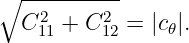
Solution 7: recover yaw and pitch from the forward axisThe horizontal components are equal and positive, so
The Down component gives
 hence
Roll cannot be determined from the forward axis alone because the final roll is about that same forward axis and therefore does not change its direction.
Solution 8: principal rangesA common principal branch is
and
Because 𝜃 lies between minus and plus ninety degrees,
Solution 9: inverse DCM extractionAway from the singularity,
and
The two-argument arctangent is required to preserve the correct quadrant.
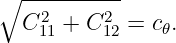
Solution 10: alternative pitch extractionFrom the first row of the DCM,
 Therefore
On the principal branch, c𝜃 ≥ 0, so
Since
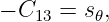 the atan2 expression uses (sin 𝜃, cos 𝜃) and returns the same principal pitch.
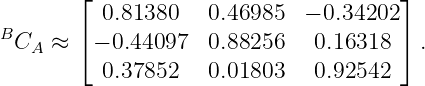
Solution 11: numerical DCMFor

Solution 12: numerical round trip and DCM checksThe extraction equations give

 and
 Thus
A valid DCM must satisfy
and
The reverse map is
Solution 13: locate and interpret the singularityThe singularity condition is
so
At 𝜃 = +90∘, the third rotation axis x 2 is anti-aligned with the first rotation axis zA:
At 𝜃 = −90∘, they are aligned:
The physical orientation remains valid; only the Euler coordinate chart loses local uniqueness.
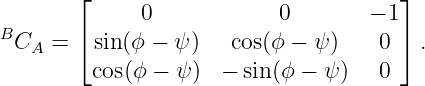
Solution 14: exact coupling at positive ninety degreesSetting
 in the full DCM gives
Only
appears. Therefore yaw and roll cannot be recovered independently.
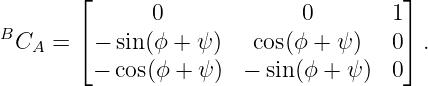
Solution 15: exact coupling at negative ninety degreesAt

Only
is observable.
Solution 16: a singular-case software conventionAt positive ninety degrees,
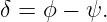 For the original angles,
If software imposes
 then it must satisfy
 Therefore it should return
This new pair represents the same singular orientation because the observable combination remains ϕ − ψ = −30∘.
Solution 17: equivalent extrinsic descriptionReverse the axis order and angle association:
Both descriptions produce the same final orientation and the same passive DCM.
Solution 18: active versus passiveThe corresponding active rotation matrix is
Thus an active-vector reference can legitimately display the transpose of the PhysicsLibrary passive coordinate map. Apparent sign or factor-order conflicts should be investigated at the transformation-semantics level before being called errors.
Solution 19: passive quaternion compositionFor a positive passive frame rotation,
 Therefore
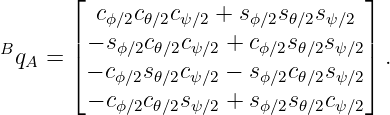
Define
 with analogous notation for 𝜃 and ψ. Using Hamilton multiplication and scalar-first storage,
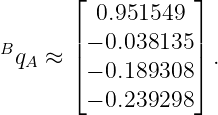
Solution 20: numerical quaternion consistencyFor
 the passive quaternion is approximately
It should have unit norm to numerical precision and satisfy
This is one of the strongest convention checks available because it compares two independent attitude representations.
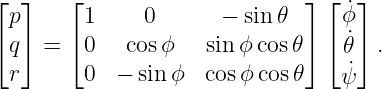
Solution 21: Euler rates to body angular velocityFor intrinsic 3-2-1,
At ϕ = 10∘, 𝜃 = 20∘, and the stated Euler rates,
and
Thus (p,q,r) are not simply (ϕ,𝜃,ψ).
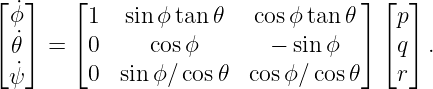
Solution 22: body angular velocity to Euler ratesAway from the singularity,
Substitution gives approximately
The inverse contains tan 𝜃 and 1∕ cos 𝜃. It therefore becomes singular when
This is the same geometric singularity found in the Euler coordinate chart.
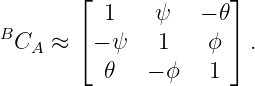
Solution 23: small-angle approximationFor small angles,
 Keeping only first-order terms gives
Define
 Then
This local relationship does not make finite yaw pitch roll triples ordinary vectors.
Solution 24: exact relative attitude versus Euler subtractionThe naive coordinate difference is
Let
 The exact passive relative map from frame B1 coordinates to frame B2 coordinates is
For the stated attitudes,
Extracting intrinsic 3-2-1 principal angles gives approximately
This differs from (5∘, 3∘, 3∘) because Euler coordinates are nonlinear sequence-dependent coordinates. Exact finite relative attitude must be formed by attitude composition rather than coordinate subtraction.
Solution 25: convention and implementation auditBefore copying a yaw pitch roll formula, determine at least:
A robust implementation should also verify zero-angle and single-axis cases, orthogonality, determinant +1, transpose reversal, DCM-to-Euler round trips, quaternion agreement, and expected behavior near the pitch singularity.
5 Compact reviewThe passive intrinsic 3-2-1 map is
Away from singularity,
and
The singularity is
with outer-angle coupling
and
The passive quaternion is
Body angular velocity and Euler coordinate rates are related by a state-dependent matrix and are not generally equal component by component.
6 Sources and exercise provenanceThe exercises and worked solutions in this companion are newly written for PhysicsLibrary to reinforce the convention and derivations developed in Euler angles: 3-2-1 yaw pitch roll.
References
[1] D. M. Henderson, Euler Angles, Quaternions, and Transformation Matrices: Working Relationships, JSC-12960, NASA Johnson Space Center, 1977. NASA Technical Reports Server [2] Federal Aviation Administration, Pilot’s Handbook of Aeronautical Knowledge, FAA-H-8083-25C, 2023. FAA Pilot’s Handbook of Aeronautical Knowledge [3] J. Diebel, “Representing Attitude: Euler Angles, Unit Quaternions, and Rotation Vectors,” Stanford University, 2006. Online PDF [4] SciPy Developers, “Rotation.from_euler,” SciPy documentation. SciPy Euler rotation documentation
LicenseUnless otherwise noted, this PhysicsLibrary entry is intended for release under the Creative Commons Attribution ShareAlike 4.0 International license. "example of Euler angles: 3-2-1 yaw pitch roll" is owned by bloftin.
This object's parent. Cross-references: norm, unit, operation, relative attitude, quaternion product, composition, observable, determinant, formulas, vector, matrices, relation, angular velocity, representation, quaternion, direction cosine matrix, Euler Angles This is version 1 of example of Euler angles: 3-2-1 yaw pitch roll, born on 2026-08-30. Object id is 1132, canonical name is ExampleOfEulerAngles321YawPitchRoll. Accessed 306 times total. Classification:
|
|
|
|
Pending Errata and AddendaNone.
|
DiscussionNo messages.
|
Interact |
![[parent]](https://images.physicslibrary.org/images/uparrow.png)






























![A B [ ]
e1 = c𝜃cψ c𝜃sψ − s𝜃 .](https://images.physicslibrary.org/cache/objects/1132/make4ht/ExampleOfEulerAngles321YawPitchRoll42x.png)





























![B
CA ≈ I − [𝜖×].](https://images.physicslibrary.org/cache/objects/1132/make4ht/ExampleOfEulerAngles321YawPitchRoll100x.png)











