![[parent]](https://images.physicslibrary.org/images/uparrow.png) example of Euler angles: 3-1-3 proper Euler sequence example of Euler angles: 3-1-3 proper Euler sequence
(Example)
Euler Angles: 3-1-3 Proper Euler Sequence Examples, Exercises, and Solutions
This entry is the self study companion to Euler Angles: 3-1-3 proper Euler sequence.
The problems develop intrinsic 3-1-3 proper Euler angles from their moving-axis geometry through
the passive direction cosine matrix, inverse extraction, singularity structure, quaternion
representation, angular velocity relation, classical precession-nutation-spin language, and numerical
implementation.
All exercises are stated first. Complete worked solutions follow afterward.
1 Convention summary
PhysicsLibrary uses the passive coordinate map
For intrinsic 3-1-3,
and therefore
A common principal branch is
The coordinate singularities occur at
2 Visual reference
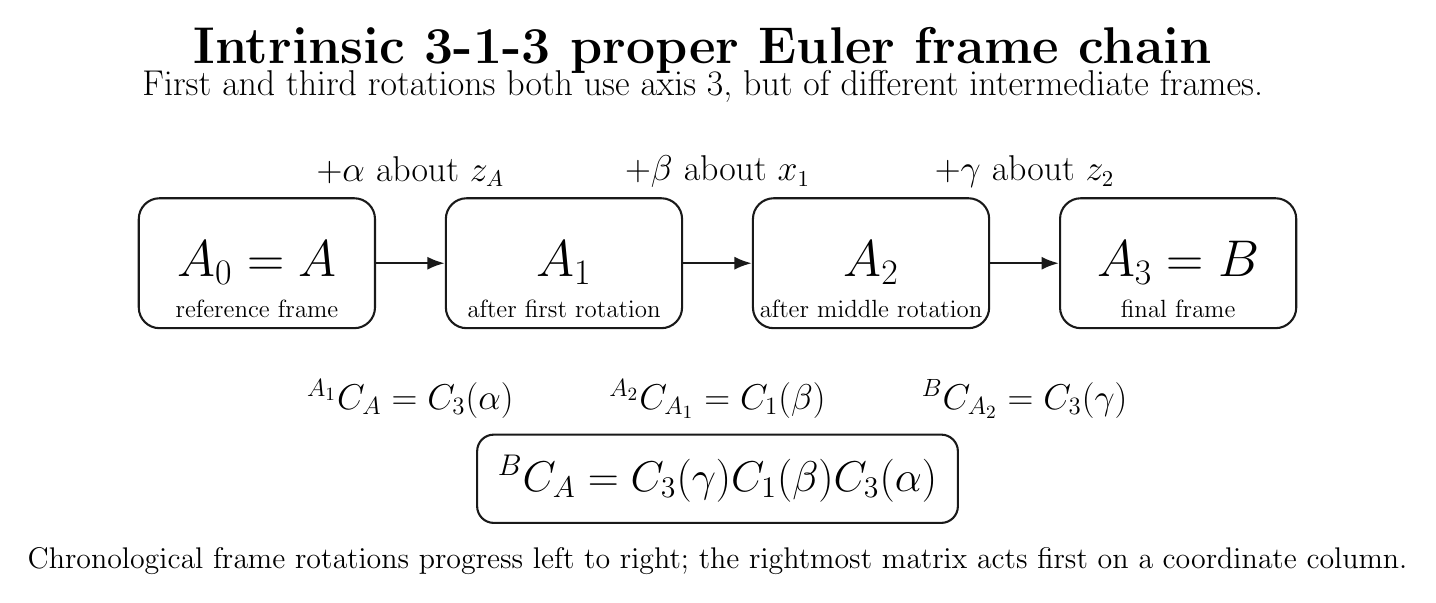
Figure. Intrinsic 3-1-3 frame chain: first rotate about zA, then about the moved axis x1,
then about the moved axis z2.
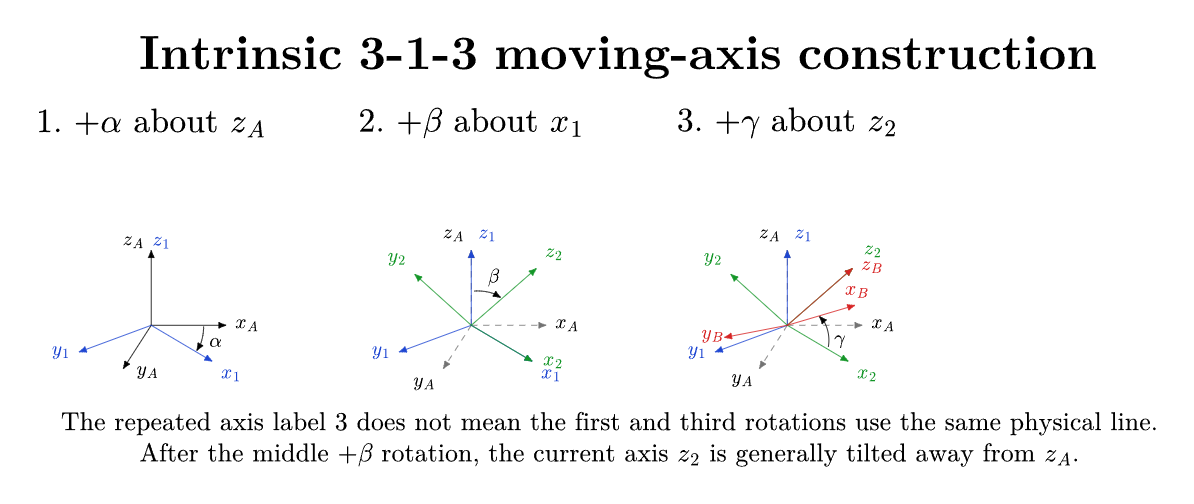
Figure. Moving-axis interpretation. Although the first and third axis labels are both 3, the
third rotation is generally about z2, not the original zA line.
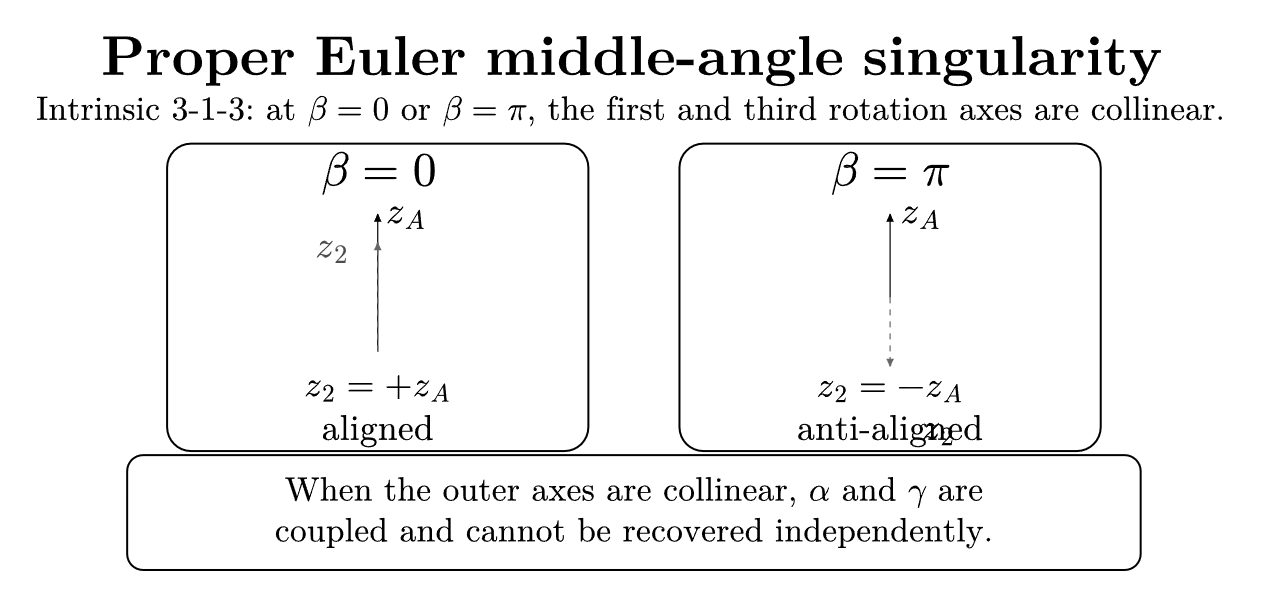
Figure. At β = 0 the first and third rotation axes are aligned; at β = π they are
anti-aligned.
3 Exercises
- Map direction and chronological order.
State the meaning of
Then state the chronological intrinsic 3-1-3 frame rotations associated with (α,β,γ).
- Intermediate-frame construction.
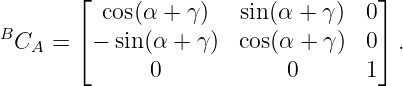
Introduce A0,A1,A2,A3 for intrinsic 3-1-3. Write the three frame-labeled passive
coordinate maps and show how their frame labels compose to give BC
A.
- Repeated axis label versus repeated physical axis.
Explain why the first and third rotations both carry the digit 3 but are generally not
rotations about the same physical line. Under what conditions do their physical axes
become collinear?
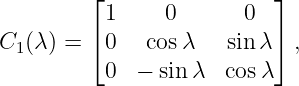
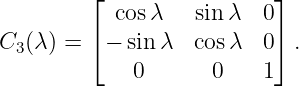
- Elementary passive matrices.
Write C1(λ) and C3(λ) in the PhysicsLibrary passive convention. Then write the three
factors used in the 3-1-3 product.
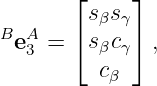
- Derive the full passive 3-1-3 DCM.
Starting from
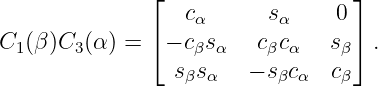
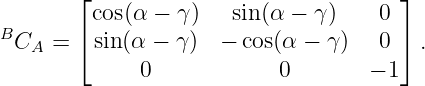
multiply the matrices and obtain all nine elements of BC
A.
- Single-angle reductions.
Show that the complete DCM reduces to C3(α), C1(β), and C3(γ) when the other two
angles vanish in each case.
- Rows, columns, and the middle angle.
For C = BC
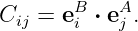
A, state the geometric meaning of Cij, of row i, and of column j. Use the
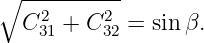
3-1-3 matrix to show that
What geometric angle does β measure?
- The line of nodes.
Show that the middle rotation leaves x1 unchanged, so that
Explain why this axis is naturally interpreted as the line of nodes between the planes
perpendicular to zA and z2.
- Principal ranges.
State a common principal branch for α,β,γ. What sign property of sin β follows on
this branch, and why is it useful in inverse extraction?
- Inverse DCM extraction.
For a nonsingular passive DCM
derive principal-branch formulas for α, β, and γ using atan2 and arccos.
- Numerically robust middle-angle extraction.
Starting from the DCM elements, show that
Use this fact to derive an atan2 formula for β that uses both sine-like and cosine-like
information.
- Numerical DCM round trip.
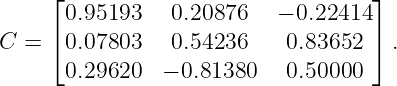
Consider
Assuming the principal branch, recover (α,β,γ).
- Locate the singularities.
Show from the inverse extraction formulas that intrinsic 3-1-3 becomes singular when
sin β = 0. Identify the singular values on the principal branch and explain the geometry
of the outer rotation axes at each one.
- Exact coupling at β = 0.
Set β = 0 in the matrix product. Show that the orientation depends only on
Explain why α and γ cannot then be recovered independently.
- Exact coupling at β = π.
Set β = π in the full 3-1-3 matrix and show that the orientation depends only on
Contrast this result with the β = 0 case.
- A singular-case software policy.
Suppose a software implementation detects | sin β| below a selected threshold and
chooses γ = 0 at singularity. Derive formulas for the reported α at β = 0 and at β = π
in terms of C11 and C12.
- Alternate Euler branch.
Away from singularity, verify that
represents the same orientation, up to wrapping the outer angles by integer multiples
of 2π. Why does imposing 0 ≤ β ≤ π help select a principal representative?
- Intrinsic-extrinsic reverse-order equivalence.
Write the extrinsic sequence equivalent to intrinsic 3-1-3 with chronological angles
(α,β,γ). Explain why the digit string still reads 3-1-3 even though the chronology
reverses.
- Active versus passive matrices.
If Cpassive is the PhysicsLibrary passive 3-1-3 matrix, state the active matrix for the
same geometric orientation relationship. Explain why confusing the two produces a
transpose or sign error.
- Passive quaternion equivalent.
Using
form the Hamilton product for intrinsic 3-1-3 and reduce it to a scalar-first quaternion
in terms of the sum and difference of the outer angles.
- Quaternion view of the singularities.
Evaluate the passive quaternion from the previous exercise at β = 0 and at β = π.
Show directly that only α + γ survives at the first singularity and only α − γ survives
at the second.
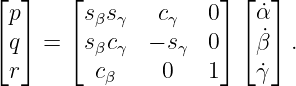
- Angular velocity from Euler rates.
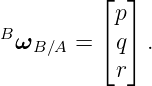
Let
Resolve the three instantaneous rotation axes in frame B and derive the matrix that
maps (α,β,γ) to (p,q,r).
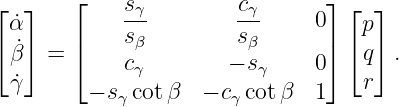
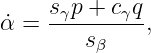
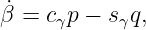
- Euler rates from body angular velocity.
Invert the rate matrix away from singularity. Derive formulas for α, β, and γ in terms
of p,q,r,β,γ. What is the determinant of the forward rate matrix?
- Numerical rate example and classical interpretation.
At
suppose
Compute (α,β,γ). Then state the common Classical Mechanics names often associated
with the first, middle, and third 3-1-3 angles.
- relative attitude and implementation audit.
Two frames B1 and B2 are each represented by 3-1-3 Euler triples relative to the same
reference frame A. Explain why componentwise subtraction of the two triples is not,
in general, the relative attitude. Write the correct DCM expression for B2C
B1.
Finally, list at least five convention or numerical checks that should be applied to a
3-1-3 implementation.
4 Solutions
- Map direction and chronological order.
The equation
means that the same physical vector is being re-expressed from coordinates in frame A to
coordinates in frame B. The vector itself is not physically rotated by this coordinate
map.
For intrinsic 3-1-3, the chronological frame rotations are
then
then
Positive frame rotation follows the right hand rule.
- Intermediate-frame construction.
Let
The three passive coordinate maps are
and
Matching adjacent frame labels gives
Therefore
The chronological rotations occur from left to right through the frames, but the rightmost
matrix acts first on a coordinate column.
- Repeated axis label versus repeated physical axis.
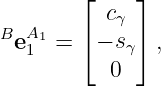
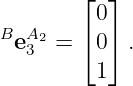
The first axis-3 rotation is about zA. Since that rotation does not change its own
axis,
The middle rotation is about x1. A nonzero rotation about x1 changes the directions of y1
and z1, producing a new z2. The third rotation is therefore about z2, not generally about
zA.
The two axis-3 directions become collinear when
or
They are aligned at β = 0 and anti-aligned at β = π.
- Elementary passive matrices.
The required elementary passive matrices are
and
Thus the 3-1-3 factors are
with the final product ordered as
- Derive the full passive 3-1-3 DCM.
Write
with analogous definitions for β and γ.
First,
Premultiplication by C3(γ) gives
- Single-angle reductions.
If β = γ = 0, then
If α = γ = 0, then
If α = β = 0, then
These checks verify both sign convention and multiplication order.
- Rows, columns, and the middle angle.
For orthonormal frames,
Thus row i is the ith basis vector of B expressed in A, while column j is the jth basis vector
of A expressed in B.
From the full matrix,
Therefore
Hence β is the angle between the initial and final axis-3 directions, often interpreted as a
nutation or tilt angle.
- The line of nodes.
The middle transformation is a rotation about x1. Any rotation leaves its own rotation axis
unchanged, so
This axis lies in the plane perpendicular to zA after the first rotation and is also the axis
about which zA is tilted into z2. It therefore forms the common line of intersection of the two
planes perpendicular to zA and z2, which motivates the classical name line of
nodes.
- Principal ranges.
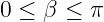
A common principal branch is
On this branch,
That sign information allows the positive square root of sin 2β to be used in the robust atan2
extraction of the middle angle.
- Inverse DCM extraction.
From
the principal middle angle is
Away from singularity,
so
Likewise,
so
These formulas require sin β≠0.
- Numerically robust middle-angle extraction.
From the third row,
Hence
On the principal branch sin β ≥ 0, so
Therefore
This uses both the sine-like and cosine-like information for the middle angle.
- Numerical DCM round trip.
First,
Next,
Finally,
Thus
This reproduces the principal triple used to construct the matrix.
- Locate the singularities.
The outer-angle extraction formulas divide the orientation information by the common factor
sin β. Therefore the chart is singular when
On 0 ≤ β ≤ π, this occurs at
At β = 0, z2 is aligned with zA. At β = π, z2 is anti-aligned with zA. In either case the first
and third physical rotation axes are collinear, so the two outer Euler coordinates lose
independent observability.
- Exact coupling at β = 0.
Setting β = 0 gives
Rotations about the same axis add:
Therefore
Only
is observable. Infinitely many pairs (α,γ) with the same sum describe the same
orientation.
- Exact coupling at β = π.
Substituting β = π into the full matrix gives
Only
is observable.
Thus the β = 0 singularity preserves the sum of the outer angles, while the β = π singularity
preserves their difference.
- A singular-case software policy.
At β = 0,
Define
If the chosen policy sets γ = 0, report
At β = π,
Define
With the same γ = 0 policy, report
The exact policy is conventional; consistency is the essential requirement.
- Alternate Euler branch.
The nonprincipal transformation
produces the same orientation away from singularity. This follows because changing the sign
of the middle rotation while shifting each outer rotation by π compensates for the reversed
orientation of the intermediate axes.
Since Euler coordinates are not unique globally, restricting
selects one standard branch for the middle angle, while the outer angles are wrapped into
their chosen 2π intervals.
- Intrinsic-extrinsic reverse-order equivalence.
Intrinsic 3-1-3 with chronological angles
is equivalent to extrinsic 3-1-3 with chronological angles
Symbolically,
Because the axis sequence 3-1-3 is palindromic, reversing the digit order leaves the visible
digit string unchanged. The angle association and chronology still reverse.
- Active versus passive matrices.
For the same orientation relationship,
The transpose arises because the passive matrix changes coordinates between
frames, whereas the active matrix rotates the physical vector in a fixed coordinate
frame.
Using an active formula where a passive map is required typically produces a transpose,
reversed product order, or angle-sign error.
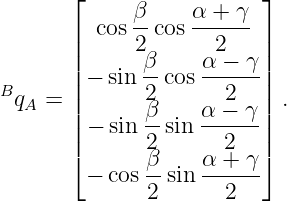
- Passive quaternion equivalent.
For a positive passive frame rotation,
The intrinsic 3-1-3 product is
Using Hamilton multiplication with scalar-first storage,
The DCM and quaternion represent the same passive map:
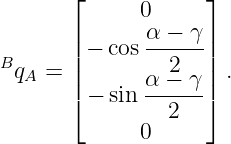
- Quaternion view of the singularities.
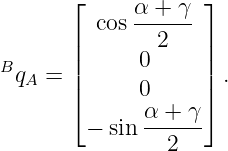
At β = 0,
Hence
Only α + γ appears.
At β = π,
Thus
Only α − γ appears. The quaternion itself remains nonsingular; the loss is in the Euler
coordinate chart.
- Angular velocity from Euler rates.
The physical angular velocity is the sum of the three instantaneous frame rotations:
Expressed in frame B,
and
Therefore
- Euler rates from body angular velocity.
Away from sin β = 0, inversion gives
Equivalently,
and
The determinant of the forward rate matrix is
Thus the rate mapping becomes singular at exactly the same configurations as the Euler
coordinate extraction.
- Numerical rate example and classical interpretation.
For
we have approximately
Using the inverse-rate formulas,
Next,
Finally,
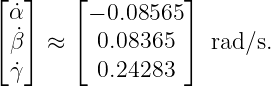
Thus
In common classical rigid-body language, α is often called precession, β nutation, and γ
spin. The names are application dependent; the frame-axis definitions remain
primary.
- Relative attitude and implementation audit.
Euler angles are ordered coordinates on the rotation group, not ordinary Cartesian vector
components. Therefore subtracting two Euler triples does not, in general, produce the
relative orientation.
If
and
describe the two frames relative to the same reference frame, then the passive relative map
from B1 coordinates to B2 coordinates is
If a 3-1-3 triple is desired for this relative attitude, extract it from this relative DCM using
the same branch and singularity policy.
Useful implementation checks include:
- verify the passive map direction Bv = BC
A Av;
- verify the product order C3(γ)C1(β)C3(α);
- check all three single-angle reductions;
- check CCT = I and det C = 1;
- verify DCM to Euler to DCM round trips away from singularity;
- explicitly test β = 0 and β = π;
- use atan2 for the outer angles;
- define and test a singular-case branch policy;
- verify the passive quaternion against the DCM;
- distinguish active and passive matrices by transpose;
- test the Euler-rate matrix determinant − sin β;
- avoid componentwise Euler-angle subtraction for finite relative attitudes.
5 Further study
The parent entry Euler angles: 3-1-3 proper Euler sequence develops the same formulas as a
continuous derivation. The broader articles Proper Euler angles, Euler sequence composition and
the twelve standard sequences, and Euler-angle singularities and gimbal lock place 3-1-3 within the
full family of Euler coordinate charts.
The 3-1-3 sequence is especially important in classical mechanics because it makes the geometry of
precession, nutation, and spin explicit. For numerical attitude propagation near either singular
endpoint, a nonsingular representation such as a quaternion or direction cosine matrix is generally
preferable as the propagated state.
6 References and further reading
References
[1] D. M. Henderson, Euler Angles, Quaternions, and Transformation Matrices: Working
Relationships, JSC-12960, NASA Johnson Space Center, 1977. NASA Technical Reports
Server
[2] J. K. Moore, Learn Multibody Dynamics, chapters “Orientation of Reference Frames”
and “Angular Kinematics,” 2026 edition. Licensed CC BY 4.0. Learn Multibody
Dynamics
[3] J. Diebel, “Representing Attitude: Euler Angles, Unit Quaternions, and Rotation
Vectors,” Stanford University, 2006. Online PDF
License
Unless otherwise noted, this PhysicsLibrary entry is intended for release under the Creative
Commons Attribution ShareAlike 4.0 International license.
"example of Euler angles: 3-1-3 proper Euler sequence" is owned by bloftin.(view preamble)
| Keywords: |
Euler angles, 3-1-3 sequence, proper Euler angles, intrinsic rotation, passive transformation, direction cosine matrix, precession, nutation, spin, singularity, quaternion, Euler rates, exercises, worked solutions |
This object's parent.
Cross-references: composition, spin, observable, square, vector, relative attitude, Classical Mechanics, determinant, detects, matrix product, formulas, matrices, relation, angular velocity, representation, quaternion, direction cosine matrix, Euler Angles
This is version 1 of example of Euler angles: 3-1-3 proper Euler sequence, born on 2026-08-30.
Object id is 1135, canonical name is ExampleOfEulerAngles313ProperEulerSequence.
Accessed 227 times total.
Classification:
|




















































































![˙γ = 0.20 − cot(60∘)[(− 0.258819 )(0.10 ) + (0.965926)(− 0.05)] ≈ 0.24283 rad ∕s.](https://images.physicslibrary.org/cache/objects/1135/make4ht/ExampleOfEulerAngles313ProperEulerSequence104x.png)