Example 5.4: Calculating the Power of a Star
While energy flux tells us how much power a star emits per square meter, we would often like to
know how much total power is emitted by the star. We can determine that by multiplying the
energy flux by the number of square meters on the surface of the star. Stars are mostly spherical,
so we can use the formula 4πR2 for the surface area, where R is the radius of the star. The
total power emitted by the star (which we call the star’s “absolute luminosity”) can
be found by multiplying the formula for energy flux and the formula for the surface
area:
Two stars have the same size and are the same distance from us. Star A has a surface temperature
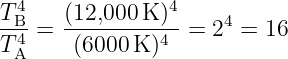
of 6000 K, and star B has a surface temperature twice as high, 12,000 K. How much more luminous
is star B compared to star A?
Solution
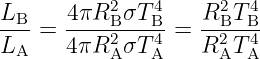
Take the ratio of the luminosity of Star A to Star B:
Because the two stars are the same size, RA = RB, leaving
Check Your Learning
Two stars with identical diameters are the same distance away. One has a temperature of 8700 K
and the other has a temperature of 2900 K. Which is brighter? How much brighter is
it?
Answer:
The 8700 K star has triple the temperature, so it is 34 = 81 times brighter.
Bibliography
This example is a derivative work of the Creative Commons source in [1].
[1] Andrew Fraknoi, David Morrison, and Sidney Wolff, “Example 5.4: Calculating the Power of a
Star,” in “5.2 The Electromagnetic Spectrum,” Astronomy 2e. Houston, Texas: OpenStax, 2022.
Licensed CC BY 4.0 in the original 2022 release (https://creativecommons.org/licenses/by/4.0/).
Changes: converted to LaTeX and separated from its parent section as a standalone PhysicsLibrary
example. Access for free at https://openstax.org/books/astronomy-2e/pages/1-introduction. Section
source: https://openstax.org/books/astronomy-2e/pages/5-2-the-electromagnetic-spectrum.

![[parent]](https://images.physicslibrary.org/images/uparrow.png)