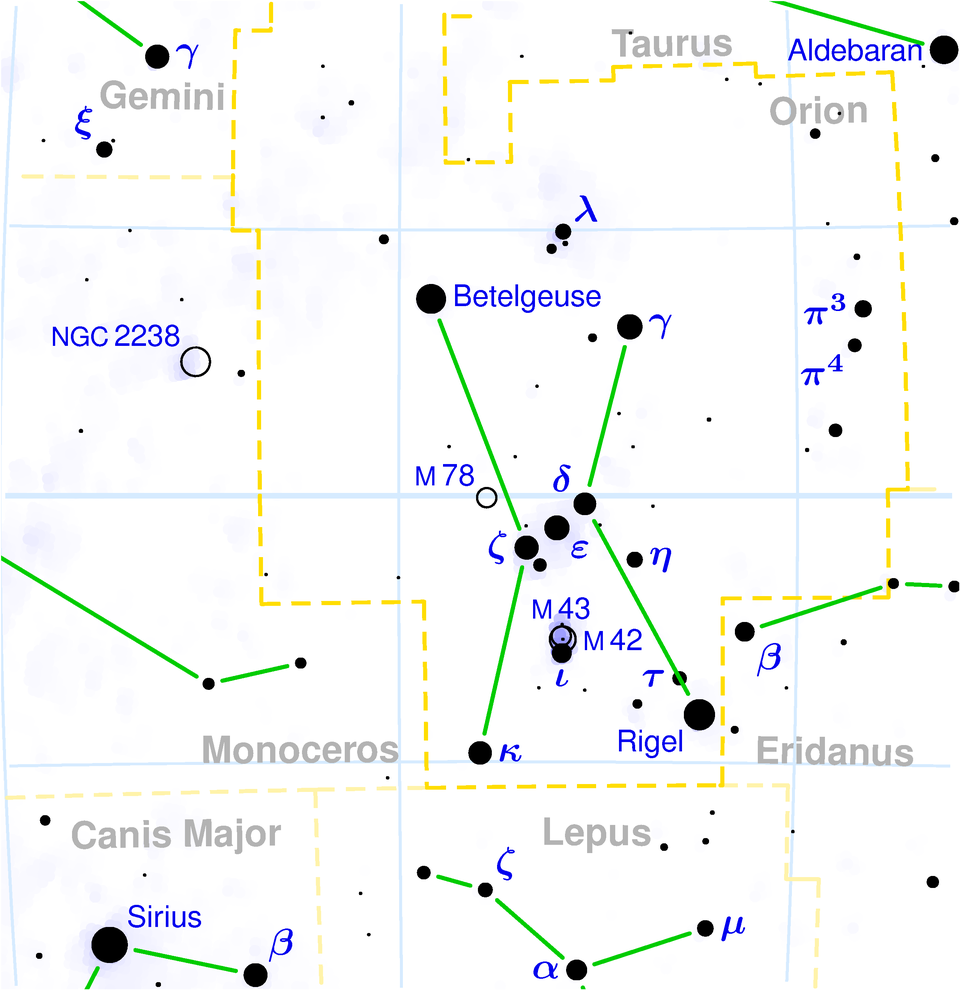
A Bayer designation is a stellar designation in which a specific star is identified by a Greek or
Latin letter followed by the genitive form of its parent Constellation’s Latin name. The original
list of Bayer designations contained 1564 stars. The brighter stars were assigned their
first systematic names by the German astronomer Johann Bayer in 1603, in his star
atlas Uranometria. Bayer catalogued only a few stars too far south to be seen from
Germany, but later astronomers (including Nicolas-Louis de Lacaille and Benjamin
Apthorp Gould) supplemented Bayer’s catalog with entries for southern constellations.
2 Scheme
Bayer assigned a lowercase Greek letter (alpha (α), beta (β), gamma (γ), etc.) or a Latin letter (A,
b, c, etc.) to each star he catalogued, combined with the Latin name of the star’s parent
constellation in genitive (possessive) form. The constellation name is frequently abbreviated to a
standard three-letter form.[1][a] For example, Aldebaran in the constellation Taurus (the Bull) is
designated α Tauri (abbreviated α Tau, pronounced Alpha Tauri), which means “Alpha of the
Bull”.[b][2]
Bayer used Greek letters for the brighter stars, but the Greek alphabet has only twenty-four
letters, while a single constellation may contain fifty or more stars visible to the naked eye. When
the Greek letters ran out, Bayer continued with Latin letters: uppercase A, followed by lowercase b
through z (omitting j and v, but o was included), for a total of another 24 letters.[3]
Bayer did not label “permanent” stars with uppercase letters (except for A, which he used instead
of a to avoid confusion with α). However, a number of stars in southern constellations have
uppercase letter designations, like B Centauri and G Scorpii. These letters were assigned by
later astronomers, notably Lacaille in his Coelum Australe Stelliferum and Gould in his
Uranometria Argentina. Lacaille followed Bayer’s use of Greek letters, but this was
insufficient for many constellations. He used first the lowercase letters, starting with a, and if
needed the uppercase letters, starting with A, thus deviating somewhat from Bayer’s
practice. Lacaille used the Latin alphabet three times over in the large constellation
Argo Navis, once for each of the three areas that are now the constellations of Carina,
Puppis and Vela. That was still insufficient for the number of stars, so he also used
uppercase Latin letters such as N Velorum and Q Puppis. Lacaille assigned uppercase letters
between R and Z in several constellations, but these have either been dropped to allow the
assignment of those letters to variable stars or have actually turned out to be variable.[4]
3 Order by magnitude class
In most constellations, Bayer assigned Greek and Latin letters to stars within a constellation in
rough order of apparent brightness, from brightest to dimmest. The order is not necessarily a
precise labeling from brightest to dimmest: in Bayer’s day stellar brightness could not be measured
precisely. Instead, stars were traditionally assigned to one of six magnitude classes (the brightest
to first magnitude, the dimmest to sixth), and Bayer typically ordered stars within a
constellation by class: all the first-magnitude stars (in some order), followed by all the
second-magnitude stars, and so on. Within each magnitude class, Bayer made no attempt
to arrange stars by relative brightness.[5] As a result, the brightest star in each class
did not always get listed first in Bayer’s order and the brightest star overall did not
necessarily get the designation “Alpha”. A good example is the constellation Gemini,
where Pollux is Beta Geminorum and the slightly dimmer Castor is Alpha Geminorum.
In addition, Bayer did not always follow the magnitude class rule; he sometimes assigned letters to
stars according to their location within a constellation, or the order of their rising, or
to historical or mythological details. Occasionally the order looks quite arbitrary.[3]
Of the 88 modern constellations, there are at least 30 in which Alpha is not the brightest star,
and four of those lack a star labeled “Alpha” altogether. The constellations with no
Alpha-designated star include Vela and Puppis, both formerly part of Argo Navis, whose
Greek-letter stars were split among three constellations. Canopus, the former α Argus,
is now α Carinae in the modern constellation Carina. Norma’s Alpha and Beta were
reassigned to Scorpius and re-designated N and H Scorpii respectively, leaving Norma
with no Alpha. Francis Baily died before designating an Alpha in Leo Minor, so it also
has no Alpha. (The star 46 Leonis Minoris would have been the obvious candidate.)
4 Orion as an example
In Orion, Bayer first designated Betelgeuse and Rigel, the two 1st-magnitude stars (those of
magnitude 1.5 or less), as Alpha and Beta from north to south, with Betelgeuse (the shoulder)
coming ahead of Rigel (the foot), even though the latter is usually the brighter. (Betelgeuse is a
variable star and can at its maximum occasionally outshine Rigel.)[6] Bayer then repeated the
procedure for the stars of the 2nd magnitude, labeling them from gamma through zeta in
“top-down” (north-to-south) order. Letters as far as Latin p were used for stars of the sixth
magnitude.
Although Bayer did not use uppercase Latin letters (except A) for “fixed stars”, he did use them to
label other items shown on his charts, such as neighboring constellations, “temporary stars”,
miscellaneous astronomical objects, or reference lines like the Tropic of Cancer.[7] In Cygnus, for
example, Bayer’s fixed stars run through g, and on this chart Bayer employs H through P as
miscellaneous labels, mostly for neighboring constellations. Bayer did not intend such labels as
catalog designations, but some have survived to refer to astronomical objects: P Cygni for example
is still used as a designation for Nova Cyg 1600. Tycho’s Star (SN 1572), another “temporary
star”, appears as B Cassiopeiae. In charts for constellations that did not exhaust the
Greek letters, Bayer sometimes used the leftover Greek letters for miscellaneous labels as
well.[7]
6 notes
[a] See the article 88 modern constellations (add article) for a list of the genitive forms and the
constellations’ standard abbreviations.
[b] The letters of the Greek alphabet were used in antiquity as numerals, however in a different
way.
References
This article is a derivative work of the creative commons share alike with attribution in
[8]. [1] Rabinowitz, Harold; Vogel, Suzanne (12 June 2009). The Manual of Scientific Style:
A Guide for Authors, Editors, and Researchers. Elsevier. pp. 363ff. [2] Bayer, Johann (1987). Uranometria. Archival Facsimiles. [3] Ridpath, Ian (1989). Bayer’s Uranometria and Bayer letters’. Star Tales. Lutterworth
Press. [4] Coelum australe stelliferum. H.L. Guerin and L.F. Delatour. 1763. [5] Swerdlow, N. M. (August 1986). “A Star Catalogue Used by Johannes Bayer”. Journal
for the History of Astronomy. 17 (50): 189-197. pg. 192. [6] Patrick Moore (1996). Brilliant
Stars. Cassell. [7] Wagman, Morton (2003). Lost Stars. McDonald and Woodward. [8]
Wikipedia contributors, “Bayer designation,” Wikipedia, The Free Encyclopedia.
This is version 18 of Bayer designation, born on 2025-04-15, modified 2026-08-16.
Object id is 1000, canonical name is BayerDesignation.
Accessed 4308 times total.